More Rush
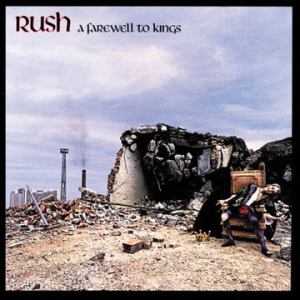
- This outstanding pressing boasts solid Double Plus (A++) sound or close to it on both sides
- We guarantee there is dramatically more richness, fullness and presence on this copy than anything else around, and that’s especially true for whatever godawful Heavy Vinyl pressing is currently being foisted on an unsuspecting record buying public
- 4 stars: “On 1977’s A Farewell to Kings it quickly becomes apparent that Rush had improved their songwriting and strengthened their focus and musical approach… [it] successfully built on the promise of their breakthrough 2112, and helped broaden Rush’s audience on both sides of the Atlantic Ocean.”
This vintage Mercury pressing has the kind of Tubey Magical Midrange that modern records can barely BEGIN to reproduce. Folks, that sound is gone and it sure isn’t showing signs of coming back. If you love hearing INTO a recording, actually being able to “see” the performers, and feeling as if you are sitting in the studio with the band, this is the record for you. It’s what vintage all analog recordings are known for — this sound.
If you exclusively play modern repressings of vintage recordings, I can say without fear of contradiction that you have never heard this kind of sound on vinyl. Old records have it — not often, and certainly not always — but maybe one out of a hundred new records do, and those are some pretty long odds.
What the Best Sides of A Farewell to Kings Have to Offer Is Not Hard to Hear
- The biggest, most immediate staging in the largest acoustic space
- The most Tubey Magic, without which you have almost nothing. CDs give you clean and clear. Only the best vintage vinyl pressings offer the kind of Tubey Magic that was on the tapes in 1977
- Tight, note-like, rich, full-bodied bass, with the correct amount of weight down low
- Natural tonality in the midrange — with all the instruments having the correct timbre
- Transparency and resolution, critical to hearing into the three-dimensional studio space
No doubt there’s more but we hope that should do for now. Playing the record is the only way to hear all of the qualities we discuss above, and playing the best pressings against a pile of other copies under rigorously controlled conditions is the only way to find a pressing that sounds as good as this one does.
What We’re Listening For on A Farewell to Kings
- Energy for starters. What could be more important than the life of the music?
- Then: presence and immediacy. The vocals aren’t “back there” somewhere, lost in the mix. They’re front and center where any recording engineer worth his salt would put them.
- The Big Sound comes next — wall to wall, lots of depth, huge space, three-dimensionality, all that sort of thing.
- Then transient information — fast, clear, sharp attacks, not the smear and thickness so common to these LPs.
- Tight punchy bass — which ties in with good transient information, also the issue of frequency extension further down.
- Next: transparency — the quality that allows you to hear deep into the soundfield, showing you the space and air around all the instruments.
- Extend the top and bottom and voila, you have The Real Thing — an honest to goodness Hot Stamper.
TRACK LISTING
Side One
A Farewell To Kings
Xanadu
Side Two
Closer To The Heart
Cinderella Man
Madrigal
Cygnus X-1
AMG 4 Star Review
On 1977’s A Farewell to Kings it quickly becomes apparent that Rush had improved their songwriting and strengthened their focus and musical approach. Synthesizers also mark their first prominent appearance on a Rush album, a direction the band would continue to pursue on future releases. With the popular hit single “Closer to the Heart,” the trio showed that they could compose concise and traditionally structured songs, while the 11-minute “Xanadu” remains an outstanding accomplishment all these years later (superb musicianship merged with vivid lyrics help create one of Rush’s best all-time tracks).
The album-opening title track begins with a tasty classical guitar/synth passage, before erupting into a powerful rocker. The underrated “Madrigal” proves to be a delicately beautiful composition, while “Cinderella Man” is one of Rush’s few songs to include lyrics penned entirely by Geddy Lee. The ten-minute tale of a dangerous black hole, “Cygnus X-1,” closes the album on an unpredictable note, slightly comparable to the two extended songs on 1975’s Caress of Steel. A Farewell to Kings successfully built on the promise of their breakthrough 2112, and helped broaden Rush’s audience on both sides of the Atlantic Ocean.