More of the Music of Jacques Offenbach
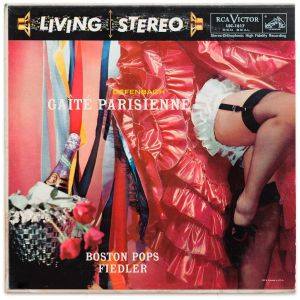
- Stunning sound on both sides of this Shaded Dog pressing of LSC-1817 from 1954 (!) with each earning Shootout Winning Triple Plus (A+++) grades – exceptionally quiet vinyl too
- This is a true Demo Disc quality recording – both sides are big, full-bodied, clean and clear, with huge amounts of energy and tons of space around all of the players
- This 2-track recording is RCA’s first stereo recording of the work, made all the way back in 1954 – can you believe it?
- Two mics and two channels and it blows away most of the classical recordings that followed it
- Some old record collectors (like me) say classical recording quality ain’t what it used to be – this record proves it
- In the 90s I was regularly selling this title for $1000+ and people were happy to pay it! They were getting their money’s worth
In a listing from a while back we wrote:
I love Fiedler’s performance and the 1954 two track RCA Living Stereo sound but finding an original Shaded Dog pressing in clean condition under $500 with the right stampers (something above 10 as I recall) is all but impossible nowadays. If you want to go that way more power to you.
Well we found one! With the right stampers! There are other good stampers for this album, but none that sounded as good as these in the shootout. And the vinyl is exceptionally quiet for a pressing from circa 1958 (the first year that stereo pressings were available; before that you had to buy the music on reel to reel to hear it in stereo).
This vintage Shaded Dog Living Stereo pressing has the kind of Tubey Magical Midrange that modern records can barely BEGIN to reproduce. Folks, that sound is gone and it sure isn’t showing signs of coming back. If you love hearing INTO a recording, actually being able to “see” the performers, and feeling as if you are sitting in the studio with the band, this is the record for you. It’s what vintage all analog recordings are known for — this sound.
If you exclusively play modern repressings of vintage recordings, I can say without fear of contradiction that you have never heard this kind of sound on vinyl. Old records have it — not often, and certainly not always — but maybe one out of a hundred new records do, and those are some pretty long odds.
What amazing sides such as these have to offer is not hard to hear:
- The biggest, most immediate staging in the largest acoustic space
- The most Tubey Magic, without which you have almost nothing. CDs give you clean and clear. Only the best vintage vinyl pressings offer the kind of Tubey Magic that was on the tapes in 1954
- Tight, note-like, rich, full-bodied bass, with the correct amount of weight down low
- Natural tonality in the midrange — with all the instruments having the correct timbre
- Transparency and resolution, critical to hearing into the three-dimensional studio space
No doubt there’s more but we hope that should do for now. Playing the record is the only way to hear all of the qualities we discuss above, and playing the best pressings against a pile of other copies under rigorously controlled conditions is the only way to find a pressing that sounds as good as this one does.
Everything has to be tuned up and on the money before we can even hope to get the record sounding right. Careful VTA adjustment could not be more critical in this respect.
This is an excellent record to test with. As you no doubt know, there is a lot of “action” in this piece of music. To get the strings and the brass to sound lively yet natural is a bit of a trick. When I first played this record years ago I was none too happy about the string tone. After making a few tweaky adjustments, the strings became much clearer and more textured. The overall presentation still sounded rich but was now more natural and above all correct.
What We’re Listening For on Gaite Parisienne
- Energy for starters. What could be more important than the life of the music?
- The Big Sound comes next — wall to wall, lots of depth, huge space, three-dimensionality, all that sort of thing.
- Then transient information — fast, clear, sharp attacks, not the smear and thickness so common to these LPs.
- Tight punchy bass — which ties in with good transient information, also the issue of frequency extension further down.
- Next: transparency — the quality that allows you to hear deep into the soundfield, showing you the space and air around all the instruments.
- Extend the top and bottom and voila, you have The Real Thing — an honest to goodness Hot Stamper.
Golden Age Living Stereo
What do we love about LIVING STEREO pressings? The timbre of every instrument is Hi-Fi in the best sense of the word. The instruments on this vintage recording are reproduced with remarkable fidelity.
Now that’s what we at Better Records mean by “Hi-Fi,” not the kind of Audiophile Phony BS Sound that passes for Hi-Fidelity these days. There’s no boosted top, there’s no bloated bottom, there’s no sucked-out midrange. There’s no added digital reverb (Patricia Barber, Diana Krall, et al.). The microphones are not fifty feet away from the musicians (Water Lily) nor are they inches away (Three Blind Mice).
This is Hi-Fidelity for those who recognize The Real Thing when they hear it. I’m pretty sure our customers do, and whoever picks this one up is guaranteed to get a real kick out of it.
Gaite Parisienne
Jacques Offenbach died in 1880, yet it is his name that is attached to this ballet that first appeared in 1938. While the tunes in Gaîté Parisienne are his, much of the orchestration, as well as the arrangement of the numbers, was done by Manuel Rosenthal.
The story concerns the seedy patrons of a Paris bistro called Tortoni’s Restaurant, an actual business establishment. There are many amorous adventures in the ballet, with the story centering on two men: a baron who chases after a young woman selling gloves, and a Peruvian who pursues a relationship with a flower girl. It is all quite mischievous fun, colorfully packaged and brilliantly suited by the Offenbach/Rosenthal score. The premiere on April 5, 1938, at the Théâtre de Monte Carlo, was a great success and the music has been in the standard repertory ever since, often presented in “pops” concerts.
Much of the music in Gaîté Parisienne, of course, was already familiar when it was first presented, which may have aided its success. The popular “Can-Can,” for example, is taken from Offenbach’s operetta, Orpheus in the Underworld (1858; rev. 1874). The familiar Barcarolle, which closes the ballet, comes from the Tales of Hoffman (1881), his last operetta.
There is much other attractive music in Gaîté Parisienne, all of it in a light vein. There are two colorful polkas, five waltzes, a Ländler, and many other dances, most frothy and joyous, all quite tuneful and direct. In sum, this is unpretentious, well-crafted music, and while it will not appeal to those exclusively interested in serious listening, it is undeniably masterful within its genre.
Description by Robert Cummings
Other Pressings
The original Mercury release of this record (SR 90016) is a shrill piece of trash, as is the Mercury Wing pressing. So many of the early Mercurys were poorly mastered it seems.
Of course what you really need is the right copy to know ultimately how good the recording can be, and to find it you might have to clean and play ten LPs, or more. That’s where we come in.
Heavy Vinyl
The last time I played the Classic of LSC 1817 I thought it was a smeary mess, as awful as their awful Scheherazade (both shamefully on the TAS List as I recall). If I were to play it today I’m guessing it would end up as yet another Classic entry in our hall of shame.