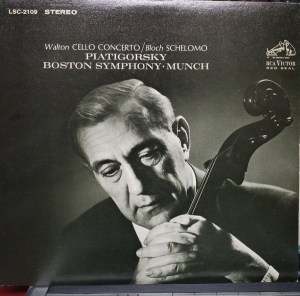
This Super Hot Stamper RCA original White Dog pressing has a SUPERB side two. Piatigorsky’s cello sounds rich and resonant with virtually no trace of smear. All the subtleties of the bowing can be clearly heard, just as they would be in concert (assuming you sprang for the good seats). The recording venue is spacious and open. Above all the sound is relaxed and NATURAL.
If only side one sounded this good…
Side One
Yes, side one is a drag. To parody Harry Pearson: No Hot Stamper, this.
It has a nice extended top but the whole frequency balance is shifted up, making it thin and pinching the upper mids. Solid A sound at most.
Side Two
Super Hot Stamper A++ sound, just lovely! It could even be better than that, but without more copies to audition we prefer to be conservative in our grading. It’s AT LEAST A++.
This is an Older Classical/Orchestral Review
Most of the older reviews you see are for records that did not go through the shootout process, the revolutionary approach to finding better sounding pressings we started developing in the early 2000s and have since turned into a veritable science.
We found the records you see in these older listings by cleaning and playing a pressing or two of the album, which we then described and priced based on how good the sound and surfaces were. (For out Hot Stamper listings, the Sonic Grades and Vinyl Playgrades are listed separately.)
We were often wrong back in those days, something we have no reason to hide. Audio equipment and record cleaning technologies have come a long way since those darker days, a subject we discuss here.
Currently, 99% (or more!) of the records we sell are cleaned, then auditioned under rigorously controlled conditions, up against a number of other pressings. We award them sonic grades, and then condition check them for surface noise.
As you may imagine, this approach requires a great deal of time, effort and skill, which is why we currently have a highly trained staff of about ten. No individual or business without the aid of such a committed group could possibly dig as deep into the sound of records as we have, and it is unlikely that anyone besides us could ever come along to do the kind of work we do.
The term “Hot Stampers” gets thrown around a lot these days, but to us it means only one thing: a record that has been through the shootout process and found to be of exceptionally high quality.
The result of our labor is the hundreds of titles seen here, every one of which is unique and guaranteed to be the best sounding copy of the album you have ever heard or you get your money back.
Wikipedia’s Entry
The Italian critic Guido Gatti wrote of Schelomo, “The violoncello, with its ample breadth of phrasing, now melodic and with moments of superb lyricism, now declamatory and with robustly dramatic lights and shades, lends itself to a reincarnation of Solomon in all his glory. The violoncello part is of so remarkably convincing and emotional power that it may be set down as a veritable masterpiece; not one passage, not a single beat, is inexpressive; the entire discourse of the soloist, vocal rather than instrumental, seems like musical expression intimately conjoined with the Talmudic prose.”
The first section of Schelomo opens with a rhapsodic lament in the solo cello leading into a cadenza in the low range of the instrument. The first section is thickly orchestrated and utilizes many extravagant tonal colors and effects including unresolved dissonances, exotic chord progressions, col legno in the strings, and bold brass statements. The first section ends with a powerful orchestral climax leading into the central section of the work.
The second theme is a rhythmic figure stated first by the bassoon and soon after by the oboe. The cello repeats the cadenza of the first theme while the second theme continues as a counter melody in the woodwinds and brass. The solo cello continues to reiterate the first theme but is overwhelmed by the swelling and increasingly frenzied orchestra.
The third section begins with material first presented in the first and second sections. A forceful orchestral climax gives way to a hushed, tense mood where the cello makes its final statement, ending on a resigned low D.
Side One (Walton)
Cello Concerto
Side Two (Bloch)
Schelomo