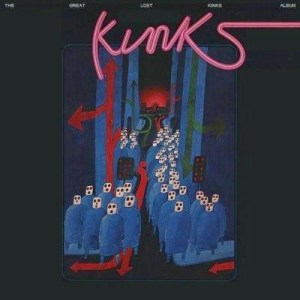
- An outstanding copy of the band’s 1973 release with solid Double Plus (A++) sound on both sides
- This one knocks it out of the park – it’s lively and rich, with plenty of deep punchy bass, a nicely extended top and a huge three-dimensional soundfield
- If you enjoy the classic late ’60s Kinks albums such as Village Green, Arthur, and Lola, you are going to love this album
- 4 1/2 stars: “An aptly titled collection; out of print for many years, there are even some Kinks cultists who have never been able to hear this ragtag but worthy collection of late-’60s and early-’70s outtakes and rarities… Kinks fans will find it quite worthwhile, and should be on the lookout for it…”
This vintage Reprise pressing has the kind of Tubey Magical Midrange that modern records can barely BEGIN to reproduce. Folks, that sound is gone and it sure isn’t showing signs of coming back. If you love hearing INTO a recording, actually being able to “see” the performers, and feeling as if you are sitting in the studio with the band, this is the record for you. It’s what vintage all analog recordings are known for — this sound.
If you exclusively play modern repressings of vintage recordings, I can say without fear of contradiction that you have never heard this kind of sound on vinyl. Old records have it — not often, and certainly not always — but maybe one out of a hundred new records do, and those are some pretty long odds.
What the best sides of The Great Lost Kinks Album have to offer is not hard to hear:
- The biggest, most immediate staging in the largest acoustic space
- The most Tubey Magic, without which you have almost nothing. CDs give you clean and clear. Only the best vintage vinyl pressings offer the kind of Tubey Magic that was on the tapes in 1973
- Tight, note-like, rich, full-bodied bass, with the correct amount of weight down low
- Natural tonality in the midrange — with all the instruments having the correct timbre
- Transparency and resolution, critical to hearing into the three-dimensional studio space
No doubt there’s more but we hope that should do for now. Playing the record is the only way to hear all of the qualities we discuss above, and playing the best pressings against a pile of other copies under rigorously controlled conditions is the only way to find a pressing that sounds as good as this one does.
Size
One of the qualities that we don’t talk about on the site nearly enough is the SIZE of the record’s presentation. Some copies of the album just sound small — they don’t extend all the way to the outside edges of the speakers, and they don’t seem to take up all the space from the floor to the ceiling. In addition, the sound can often be recessed, with a lack of presence and immediacy in the center.
Other copies — my notes for these copies often read “BIG and BOLD” — create a huge soundfield, with the music positively jumping out of the speakers. They’re not brighter, they’re not more aggressive, they’re not hyped-up in any way, they’re just bigger and clearer.
And most of the time those very special pressings just plain rock harder. When you hear a copy that does all that, it’s an entirely different listening experience.
What We Listen For on The Great Lost Kinks Album
- Energy for starters. What could be more important than the life of the music?
- Then: presence and immediacy. The vocals aren’t “back there” somewhere, lost in the mix. They’re front and center where any recording engineer worth his salt would put them.
- The Big Sound comes next — wall to wall, lots of depth, huge space, three-dimensionality, all that sort of thing.
- Then transient information — fast, clear, sharp attacks, not the smear and thickness so common to these LPs.
- Tight punchy bass — which ties in with good transient information, also the issue of frequency extension further down.
- Next: transparency — the quality that allows you to hear deep into the soundfield, showing you the space and air around all the instruments.
- Extend the top and bottom and voila, you have The Real Thing — an honest to goodness Hot Stamper.
TRACK LISTING
Side One
Til Death Do Us Part
There Is No Life Without Love
Lavender Hill
Groovy Movies
Rosemary Rose
Misty Water
Mr. Songbird
Side Two
When I Turn Off The Living Room Light
The Way Love Used To Be
I’m Not Like Everybody Else
Plastic Man
This Man He Weeps Tonight
Pictures In The Sand
Where Did The Spring Go
AMG 4 1/2 Star Review
An aptly titled collection; out of print for many years, there are even some Kinks cultists who have never been able to hear this ragtag but worthy collection of late-’60s and early-’70s outtakes and rarities.
Most of these were recorded around the same time as the 1968 LP Village Green Preservation Society; these low-key, wry, bouncy tunes would have fit in well with that record. Lyrically, they’re on the whole slighter than much of their late-’60s work, perhaps accounting for why the group did not deign to release them at the time.
Still, songs like “Rosemary Rose,” “Misty Water,” and “Mr. Songbird” would have hardly embarrassed the group, and rank as the highlights of this anthology. Besides 1969-era outtakes, it includes the single “Plastic Man,” a couple of okay, way-obscure B-sides featuring Dave Davies, and some songs penned for long-forgotten film and television productions.
It also has the dynamite 1966 B-side “I’m Not Like Everybody Else,” though that’s easily available on reissue these days. That’s not the case for most of the rest of this album; Kinks fans will find it quite worthwhile, and should be on the lookout for it in the used bins.