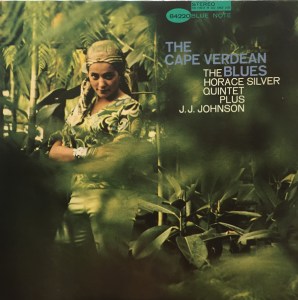
- The Cape Verdean Blues makes its Hot Stamper debut with outstanding Double Plus (A++) sound from first note to last – exceptionally quiet vinyl too
- This vintage stereo LP is well balanced, big and lively, with wonderful clarity in the mids and highs, and a spacious soundfield
- RVG in 1966 is hard to beat for you-are-there immediacy, and we guarantee this pressing delivers on that sound like no other copy you’ve ever heard, especially if all you’ve heard is the kind of vague, veiled, lifeless modern reissue that seems to be everywhere these days
- 4 stars: “… there’s a spirit of adventure that pervades the entire album, a sense of exploration that wouldn’t have been quite the same with Silver’s quintet of old…”
This vintage Blue Note pressing has the kind of Tubey Magical Midrange that modern records rarely even BEGIN to reproduce. Folks, that sound is gone and it sure isn’t showing signs of coming back. If you love hearing INTO a recording, actually being able to “see” the performers, and feeling as if you are sitting in the studio with the Horace Silver Quintet, this is the record for you. It’s what vintage all analog recordings are known for — this sound.
If you exclusively play modern repressings of vintage recordings, I can say without fear of contradiction that you have never heard this kind of sound on vinyl. Old records have it — not often, and certainly not always — but maybe one out of a hundred new records do, and those are some pretty long odds.
What the best sides of The Cape Verdean Blues have to offer is not hard to hear:
- The biggest, most immediate staging in the largest acoustic space
- The most Tubey Magic, without which you have almost nothing. CDs give you clean and clear. Only the best vintage vinyl pressings offer the kind of Tubey Magic that was on the tapes in 1966
- Tight, note-like, rich, full-bodied bass, with the correct amount of weight down low
- Natural tonality in the midrange — with all the instruments having the correct timbre
- Transparency and resolution, critical to hearing into the three-dimensional space of the studio
No doubt there’s more but we hope that should do for now. Playing the record is the only way to hear all of the qualities we discuss above, and playing the best pressings against a pile of other copies under rigorously controlled conditions is the only way to find a pressing that sounds as good as this one does.
Copies with rich lower mids and nice extension up top did the best in our shootout, assuming they weren’t veiled or smeary of course. So many things can go wrong on a record! We know, we’ve heard them all.
Top end extension is critical to the sound of the best copies. Lots of old records (and new ones) have no real top end; consequently, the studio or stage will be missing much of its natural air and space, and instruments will lack their full complement of harmonic information.
Tube smear is common to most vintage pressings and this is no exception. The copies that tend to do the best in a shootout will have the least (or none), yet are full-bodied, tubey and rich.
What We’re Listening For on The Cape Verdean Blues
- Energy for starters. What could be more important than the life of the music?
- The Big Sound comes next — wall to wall, lots of depth, huge space, three-dimensionality, all that sort of thing.
- Then transient information — fast, clear, sharp attacks, not the smear and thickness common to most LPs.
- Tight, note-like bass with clear fingering — which ties in with good transient information, as well as the issue of frequency extension further down.
- Next: transparency — the quality that allows you to hear deep into the soundfield, showing you the space and air around all the players.
- Then: presence and immediacy. The musicians aren’t “back there” somewhere, lost in the mix. They’re front and center where any recording engineer worth his salt — Rudy Van Gelder in this case — would put them.
- Extend the top and bottom and voila, you have The Real Thing — an honest to goodness Hot Stamper.
The Players
Horace Silver – piano
Woody Shaw – trumpet
Joe Henderson – tenor sax
J.J. Johnson – trombone
Bob Cranshaw – bass
Roger Humphries – drums
TRACK LISTING
Side One
The Cape Verdean Blues
The African Queen
Pretty Eyes
Side Two
Nutville
Bonita
Mo’ Joe
AMG 4 Star Review
After the success of Song for My Father and its hit title cut, Horace Silver was moved to pay further tribute to his dad, not to mention connect with some of his roots. Silver’s father was born in the island nation of Cape Verde (near West Africa) before emigrating to the United States, and that’s the inspiration behind The Cape Verdean Blues. Not all of the tracks are directly influenced by the music of Cape Verde (though some do incorporate Silver’s taste for light exoticism); however, there’s a spirit of adventure that pervades the entire album, a sense of exploration that wouldn’t have been quite the same with Silver’s quintet of old.
On average, the tracks are longer than usual, and the lineup — featuring tenor saxophonist Joe Henderson (a holdover from the Song for My Father sessions) and trumpeter Woody Shaw — is one of the most modernist-leaning Silver ever recorded with. They push Silver into more advanced territory than he was normally accustomed to working, with mild dissonances and (especially in Henderson’s case) a rawer edge to the playing.
What’s more, bop trombone legend J.J. Johnson appears on half of the six tracks, and Silver sounds excited to finally work with a collaborator he’d been pursuing for some time. Johnson ably handles some of the album’s most challenging material, like the moody, swelling “Bonita” and the complex, up-tempo rhythms of “Nutville.” Most interesting, though, is the lilting title track, which conjures the flavor of the islands with a blend of Latin-tinged rhythms and calypso melodies that nonetheless don’t sound quite Caribbean in origin. Also noteworthy are “The African Queen,” with its blend of emotional power and drifting hints of freedom, and “Pretty Eyes,” Silver’s first original waltz. Yet another worthwhile Silver album.