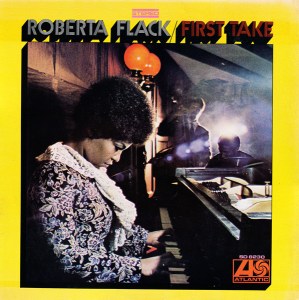
- Roberta Flack’s stunning debut album finally arrives on the site with outstanding Double Plus (A++) sound from start to finish
- The sound here is richer, fuller, more musical and more natural – Flack’s breathy voice is reproduced with a solidity and immediacy that’s not easy to find on vinyl
- 5 stars: “Roberta Flack’s debut album, titled First Take in true underachiever fashion, introduced a singer who’d assimilated the powerful interpretive talents of Nina Simone and Sarah Vaughan, the earthy power of Aretha Franklin, and the crystal purity and emotional resonance of folksingers like Judy Collins… one of the most fascinating soul debuts of the era.”
*NOTE: A mark makes 4 light to moderately loud pops about one-third inch into track 2, The First Time Ever I Saw Your Face.
This ’60s Atlantic LP has the kind of Tubey Magical Midrange that modern pressings cannot BEGIN to reproduce. Folks, that sound is gone and it sure isn’t showing any sign of coming back.
Having done this for so long, we understand and appreciate that rich, full, solid, Tubey Magical sound is key to the presentation of this primarily vocal music. We rate these qualities higher than others we might be listening for (e.g., bass definition, soundstage, depth, etc.). The music is not so much about the details in the recording, but rather in trying to recreate a solid, palpable, real ROBERTA FLACK singing live in your listening room. The best copies have an uncanny way of doing just that.
If you exclusively play modern repressings of older recordings (this one is now 50 years old), I can say without fear of contradiction that you have never heard this kind of sound on vinyl. Old records have it — not often, and certainly not always — but less than one out of 100 new records do, if our experience with the hundreds we’ve played can serve as a guide.
What the best sides of First Take have to offer is not hard to hear:
- The biggest, most immediate staging in the largest acoustic space
- The most Tubey Magic, without which you have almost nothing. CDs give you clean and clear. Only the best vintage vinyl pressings offer the kind of Tubey Magic that was on the tapes in 1969
- Tight, note-like, rich, full-bodied bass, with the correct amount of weight down low
- Natural tonality in the midrange — with all the instruments having the correct timbre
- Transparency and resolution, critical to hearing into the three-dimensional space of the studio
No doubt there’s more but we hope that should do for now. Playing the record is the only way to hear all of the qualities we discuss above, and playing the best pressings against a pile of other copies under rigorously controlled conditions is the only way to find a pressing that sounds as good as this one does.
Copies with rich lower mids and nice extension up top did the best in our shootout, assuming they weren’t veiled or smeary of course. So many things can go wrong on a record! We know, we’ve heard them all.
Top end extension is critical to the sound of the best copies. Lots of old records (and new ones) have no real top end; consequently, the studio or stage will be missing much of its natural air and space, and instruments will lack their full complement of harmonic information.
Tube smear is common to most vintage pressings and this is no exception. The copies that tend to do the best in a shootout will have the least (or none), yet are full-bodied, tubey and rich.
What We’re Listening For on First Take
- Energy for starters. What could be more important than the life of the music?
- The Big Sound comes next — wall to wall, lots of depth, huge space, three-dimensionality, all that sort of thing.
- Then transient information — fast, clear, sharp attacks for the guitars, horns and drums, not the smear and thickness common to most LPs.
- Tight, note-like bass with clear fingering — which ties in with good transient information, as well as the issue of frequency extension further down.
- Next: transparency — the quality that allows you to hear deep into the soundfield, showing you the space and air around all the players.
- Then: presence and immediacy. The vocals aren’t “back there” somewhere, way behind the speakers. They’re front and center where any recording engineer worth his salt would have put them.
- Extend the top and bottom and voila, you have The Real Thing — an honest to goodness Hot Stamper.
TRACK LISTING
Side One
Compared To What
Angelitos Negros
Our Ages Or Our Hearts
I Told Jesus
Side Two
Hey, That’s No Way To Say Goodbye
The First Time Ever I Saw Your Face
Tryin’ Times
Ballad Of The Sad Young Men
AMG 5 Star Rave Review
Roberta Flack’s debut album, titled First Take in true underachiever fashion, introduced a singer who’d assimilated the powerful interpretive talents of Nina Simone and Sarah Vaughan, the earthy power of Aretha Franklin, and the crystal purity and emotional resonance of folksingers like Judy Collins.
Indeed, the album often sounded more like vocal jazz or folk than soul, beginning with the credits: a core quartet of Flack on piano, John Pizzarelli on guitar, Ron Carter on bass, and Ray Lucas on drums, as fine a lineup as any pop singer could hope to recruit. With only one exception — the bluesy, grooving opener “Compared to What,” during which Flack proves her chops as a soul belter — she concentrates on readings of soft, meditative material.
A pair of folk covers, “The First Time Ever I Saw Your Face” and “Hey, That’s No Way to Say Goodbye,” are heart-wrenching standouts; the first even became a surprise hit two years later, when its appearance in the Clint Eastwood film Play Misty for Me pushed it to the top of the pop charts and earned Flack her first Grammy award for Record of the Year. Her arrangement of the traditional “I Told Jesus” has a simmering power, while “Ballad of the Sad Young Men” summons a stately sense of melancholy.
Flack also included two songs from her college friend and future duet partner, Donny Hathaway, including a tender examination of the classic May-December romance titled “Our Ages or Our Hearts.” The string arrangements of William Fischer wisely keep to the background, lending an added emotional weight to all of Flack’s pronouncements.
No soul artist had ever recorded an album like this, making First Take one of the most fascinating soul debuts of the era.