More Mel Torme
Mel Torme Albums We’ve Reviewed
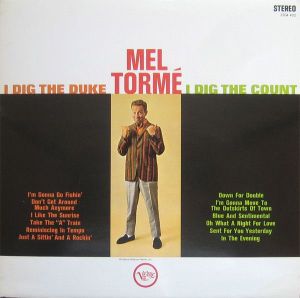
- Torme’s 1962 release makes its Hot Stamper debut here with STUNNING Shootout Winning Triple Plus (A+++) sound from start to finish
- This is not one of Mel’s better known albums, but we found it to be prime Velvet Fog, right up there with the best of his work auditioned to date – if you haven’t heard the man in his prime, this would be a great place to start
- Val Valentin did the engineering – as he often did over the course of his long and storied career, he knocked this one out of the park
- 4 1/2 stars: “Recorded with the Johnny Mandel Orchestra at sessions in Los Angeles, it includes one half Duke Ellington and one half Count Basie… With all these things going for it, how can Tormé do wrong?”
Sometimes the copy with the best sound is not the copy with the quietest vinyl. The best sounding copy is always going to win the shootout, the condition of its vinyl not withstanding. If you can tolerate the problems on this pressing you are in for some killer Mel Torme music with exceptional sound. If for any reason you are not happy with the sound or condition of the album we are of course happy to take it back for a full refund, including the domestic return postage.
The sound of this superb jazzy ensemble fronted by one of the most effortlessly skilled vocalists of his generation is big, lively, open and clear, with Tubey Magical richness you will not find anywhere but on these early Verve stereo LPs.
Why is that? Well, for starters, this vintage pressing has the kind of Tubey Magical Midrange that modern records rarely begin to reproduce. Folks, that sound is gone and it sure isn’t showing any sign of coming back.
Having done this for so long, we understand and appreciate that rich, full, solid, Tubey Magical sound is key to the presentation of this primarily vocal music. We rate these qualities higher than others we might be listening for (e.g., bass definition, soundstage, depth, etc.).
Hot Stamper sound is rarely about the details of a given recording. In the case of this album, more than anything else a Hot Stamper must succeed at recreating a solid, palpable, real Mel Torme singing live in your listening room. The better copies have an uncanny way of doing just that.
If you exclusively play modern repressings of vintage recordings, I can say without fear of contradiction that you have never heard this kind of sound on vinyl. Old records have it — not often, and certainly not always — but less than one out of 100 new records do, if our experience with the hundreds we’ve played over the years can serve as a guide.
What the Best Sides of I Dig the Duke – I Dig the Count Have to Offer Is Not Hard to Hear
- The biggest, most immediate staging in the largest acoustic space
- The most Tubey Magic, without which you have almost nothing. CDs give you clean and clear. Only the best vintage vinyl pressings offer the kind of Tubey Magic that was on the tapes in 1962
- Tight, note-like, rich, full-bodied bass, with the correct amount of weight down low
- Natural tonality in the midrange — with all the instruments having the correct timbre
- Transparency and resolution, critical to hearing into the three-dimensional studio space
No doubt there’s more but we hope that should do for now. Playing the record is the only way to hear all of the qualities we discuss above, and playing the best pressings against a pile of other copies under rigorously controlled conditions is the only way to find a pressing that sounds as good as this one does.
Richness Is Key
Copies with rich lower mids did the best in our shootout, assuming they weren’t veiled or smeary of course. So many things can go wrong on a record! We know, we’ve heard them all.
Top end extension is critical to the sound of the best copies. Lots of old records (and new ones) have no real top end; consequently the studio or stage will be missing much of its natural ambience and space, and instruments will lack their full complement of harmonic information.
Tube smear is common to pressings from every era and this is no exception. The copies that tend to do the best in a shootout will have the least (or none), yet are full-bodied, tubey and rich.
What We’re Listening For on I Dig the Duke – I Dig the Count
- Energy for starters. What could be more important than the life of the music?
- The Big Sound comes next — wall to wall, lots of depth, huge space, three-dimensionality, all that sort of thing.
- Then transient information — fast, clear, sharp attacks, not the smear and thickness common to most LPs.
- Tight, note-like bass with clear fingering — which ties in with good transient information, as well as the issue of frequency extension further down.
- Next: transparency — the quality that allows you to hear deep into the soundfield, showing you the space and air around all the players.
- Then: presence and immediacy. The vocals aren’t “back there” somewhere, lost in the mix. They’re front and center where any recording engineer worth his salt — Val Valentin in this case — would put them.
- Extend the top and bottom and voila, you have The Real Thing — an honest to goodness Hot Stamper.
Engineering Excellence
Val Valentin’s list of credits runs for days. Some high points are of course Ella and Louis and Getz/Gilberto, two records that belong in any audiophile collection worthy of the name.
Recently we played a copy of We Get Requests by the Oscar Peterson Trio that blew our minds. And we have been big fans of Mel Tormé Swings Shubert Alley for more than a decade (but only on the reissue, not the original. Go figure).
Pull up his credits on Allmusic. No one I am familiar with other than Rudy Van Gelder recorded more great music, and in our opinion Valentin’s recordings are quite a bit more natural sounding than Rudy’s, especially with regard to the piano.
Vinyl Condition
Mint Minus Minus is about as quiet as any vintage pressing will play, and since only the right vintage pressings have any hope of sounding good on this album, that will most often be the playing condition of the copies we sell. (The copies that are even a bit noisier get listed on the site are seriously reduced prices or traded back in to the local record stores we shop at.)
Those of you looking for quiet vinyl will have to settle for the sound of later pressings and Heavy Vinyl reissues, purchased elsewhere of course as we have no interest in selling records that don’t have the vintage analog magic that is a key part of the appeal of these wonderful recordings.
If you want to make the trade-off between bad sound and quiet surfaces with whatever Heavy Vinyl pressing might be available, well, that’s certainly your prerogative, but we can’t imagine losing what’s good about this music — the size, the energy, the presence, the clarity, the weight — just to hear it with less background noise.
Skip the Mono
This album is far more common in mono, but we found the sound of the mono pressings we played seriously wanting. The mono is smaller, more recessed and more lifeless than even the worst of the stereo pressings we auditioned.
If you’re a vintage record collector of course you want the mono. If you’re an audiophile who likes vintage vocal albums, you will want the stereo. And if you are a very serious audiophile who has a great deal of time and money tied up in his equipment and room, someone whose motto might best be summed up as “nothing but the best,” then you need a killer Hot Stamper pressing like this one.
TRACK LISTING
Side One
I’m Gonna Go Fishin’
Don’t Get Around Much Anymore
I Like The Sunshine
Take The ‘A’ Train
Reminiscing In Tempo
Just A Sittin’ And A Rockin’
Side Two
Down For Double
I’m Gonna Move To The Outskirts Of Town
Blue And Sentimental
Oh What A Night For Love
Sent For You Yesterday (And Here You Come Today)
In The Evening (When The Sun Goes Down)