art-over

Artist overview.

Elvis Costello – An Overview

xxx

Hot Stamper Pressings of Elvis’s Albums Available Now

Note that the bulk of this commentary was written many years ago. I still feel the same way about Elvis’s albums and play them regularly to this day.


Trust is one of my three favorite Elvis Costello albums, along with his first and third, My Aim Is True and Armed Forces.

All three are Must Owns in my book.

I remember loving the sound of my old Brit copy from twenty years back [now 30], even to the point of agreeing with Michael Fremer when he put it on his top 40 rock album list. Now I know better: that most of them leave something to be desired, especially in the lower frequencies.

Did I have good one? Did he? Who can say? Everything is different, and revisiting old sonic favorites can sometimes be a bit of a shock.

Elvis: Still The King

By the way, we played a domestic copy of this album, just for fun you might say, and sure enough it was a real mess.

Boosted highs (Columbia had a habit of doing that for records mastered from dub tapes), poor bass definition and copious amounts of grit and grain — 70s Columbia at their best. What else is new?

The first album and Spike (far from the best but tolerable) are the only Elvis records I know of that work on domestic vinyl. Forget the rest.

If you love Elvis Costello as much as we do around here, we suggest you do yourself a favor and trash your domestic LPs — you need a British copy to even get in the ballpark on most of his albums, and even that’s far from a guarantee of good sound. Elvis is “Still the King,” but you will never know it without the right pressing.

Trust, along with Armed Forces, is one of the records that helped me make real progress in audio.

(more…)

Ranking The First Seven Albums by The Eagles

More of the Music of The Eagles

Without question the first Eagles album is still their best sounding release.

Hotel California is a classic, no argument there, but even the best sounding copies are a little “modern” for our tastes. I prefer both the music and the sound of On The Border to Hotel CA, but that should clearly be seen as a minority opinion. De gustibus and all that.

Let’s call them their second and third best, we’ll leave the order to you.

The third tier would have One of These Nights, followed by Desperado, The Long Run and Eagles Live.

The less said about any of their albums after 1980 the better.

You know the first album. You know Hotel California. The best Eagles album you don’t know is On The Border.

We’ve recently compiled a list of records we think every audiophile should get to know better, along the lines of “the 1001 records you need to hear before you die,” but with less accent on morbidity and more on the joy these amazing audiophile-quality recordings can bring to your life. On the Border is a good example of a record most audiophiles don’t know well but would most likely benefit from getting to know it better.


(more…)

Listening in Depth to Loggins & Messina’s Classic Yacht Rockers

Hot Stamper Pressings of the Music of Loggins and Messina Available Now

The elements that make up a good sounding Loggins and Messina album can be found, in varying degrees, on all the Hot Stamper pressings we offer. Permit us to break them down for you. (We’ve borrowed heavily from ourselves here so if this material looks familiar don’t be surprised, we’ve used it before.)

Top End Extension

Absolutely critical to this record. Most copies of this album have no extreme highs, which causes the percussion and guitar harmonics to be blunted and dull. Without extreme highs the percussion can’t extend up and away from the other elements in the mix. Consequently these elements end up fighting for space in the midrange and getting lost in the dense mixes that Jim Messina favors (and we audiophiles love).

Clarity and Presence

Equally critical. So many copies are veiled in the midrange, partly because they may have shortcomings up top, but also because they suffer from blurry, smeary mids and upper mids. With so many stringed instruments; horns and woodwinds (oboe, saxes, flute, recorder); as well as plenty of percussion elements in the mix for practically every song, dull, dead sounding L & M pressings can’t begin to communicate the musical values in their superb recordings. Boredom will set in before long.

With a real Hot Stamper the sound is TOTALLY INVOLVING, and so is the music! You hear the breath in the voices, the pick on the strings of the guitars and mandolins — these are the things that allow us to suspend our disbelief, to forget it’s a recording we’re listening to and not living, breathing musicians.

Transparency

Although this quality is related to the above two, it’s not as important overall as the one below, but it sure is nice to have. When you can really “see” into the mix, it’s much easier to pick out each and every brass and wind instrument, and hear all the effects on the guitars, in order to gain more insight into the arrangement and the recording of the material.

Seeing into the mix is a way of seeing into the mind of the artist. To hear the hottest copies was to appreciate even more the talents of all the musicians and producers involved, not to mention the recording engineers.

Bass

No rock or pop record without good bass can qualify as a top quality Hot Stamper. How could it? It’s the rhythmic foundation of the music, and who wants a pop record that lacks rhythm? L&M are famous for putting plenty of bass on their records; this album is no exception. Bass is a big part of their sound. The best copies have prodigious amounts of deep, note-like, well-controlled bass. If you have a high-fidelity full-range system, this is some serious Demo Disc Quality Pop Sound.

(more…)

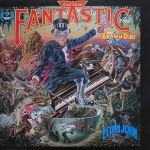
Captain Fantastic… – Number Six of Seven Consecutive Chart Topping Albums

More Reviews and Commentaries for the Music of Elton John

The Classic Elton John According to Wikipedia

Besides being the most commercially successful period, 1970–1976 is also held in the most regard critically. Within only a three-year span, between 1972 and 1975 John saw seven consecutive albums reach number one in the US, which had not been accomplished before. Of the six Elton John albums to make Rolling Stone’s list of “The 500 Greatest Albums of All Time” in 2003, all are from this period, with Goodbye Yellow Brick Road ranked highest at number 91; similarly, the three Elton John albums given five stars by Allmusic (Tumbleweed Connection, Honky Château, and Captain Fantastic) are all from this period. 

After 1975, good Elton John music is hard to come by. A few songs scattered among a few albums — pretty slim pickins. But the four or five albums he made in the early ’70s are nothing less than AMAZING (and amazing sounding, when you get the right pressings of course).

The albums that went to Number One are listed below in bold.

Three of his best, including his absolute best album, Tumbleweed, did not go to Number One, although they did make the top ten.

1969 Empty Sky 
1970 Elton John 
1971 Tumbleweed Connection
1971 11-17-70 [live] 
1971 Madman Across the Water 
1972 Honky Chateau 
1973 Don’t Shoot Me I’m Only the Piano Player
1973 Goodbye Yellow Brick Road 
1974 Caribou 
1975 Captain Fantastic and the Brown Dirt Cowboy
1975 Rock of the Westies 

Elton John Shootouts

Elton John is one of the handful of artists to produce an immensely enjoyable and meaningful body of work throughout the ’70s, music that holds up to this day. The music on his albums, so multi-faceted and multi-layered, will endlessly reward the listener who makes the effort and takes the time to dive deep into the sound of his classic releases.

Repeated plays are the order of the day. The more critically you listen, the more you are sure to discover within the exceedingly dense mixes favored by Elton and his bandmates. And the better your stereo gets the more you can appreciate the care and effort that went into the production of the recordings.

Elton John albums always make for tough shootouts. His producers’ (Gus Dudgeon being the best of them) and engineers’ (Ken Scott and Robin Geoffrey Cable, likewise the best) approach to recording — everything-but-the-kitchen-sink as a rule — make it difficult to translate their complex sounds to disc, vinyl or otherwise.

Everything has to be tuned up and on the money before we can even hope to get the record sounding right. Careful VTA adjustment could not be more critical in this respect.

If we’re not hearing the sound we want, we keep messing with the adjustments until we do. There is no getting around sweating the details when sitting down to test a complex recording such as this. If you can’t stand the tweaking tedium, get out of the kitchen (or listening room as the case may be). Obsessing over every aspect of record reproduction is what we do for a living. Pink Floyd’s recordings require us to be at the top of our game, both in terms of reproducing their albums as well as evaluating the merits of individual pressings.

When you love it, it’s not work, it’s fun. Tedious, occasionally exasperating fun, but still fun nonetheless.

Obsessed? You Better Believe It

Many of the Elton John albums you see listed above are records we admit to being obsessed with.

Currently we have identified about 150 that fit that description, so if you have some spare time, check out what we have to say about them.

Music Does the Driving

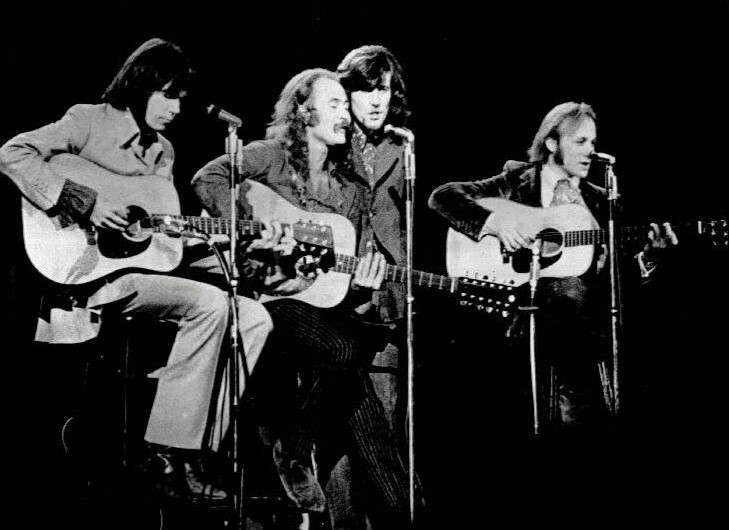
More CrosbyMore Stills / More Nash / More Young

As a budding audiophile I went out of my way to acquire any piece of equipment that could make these records from the ’70s (the decade of my formative music-buying years) sound better than the gear I was using. It’s the challenging recordings by Crosby, Stills, Nash and Young, as well as scores of other pop and rock artists from the era, that drove my pursuit of higher quality audio, starting all the way back in high school.

And here I am — here we are — still at it, forty years later, because the music still sounds fresh and original, and the pressings that we find get better and better with each passing year.

That kind of progress is proof that we’re doing it right. It’s a good test for any audiophile. If you are actively and seriously pursuing this hobby, perhaps as many as nine out of ten non-audiophile pressings in your collection should sound better with each passing year.

As your stereo improves, not to mention your critical listening skills, the shortcomings of some of them will no doubt become more apparent. For the most part, however, with continual refinements and improvements to your system and room, as well as cleaning techniques, vintage pressings will continue to sound better the longer you stay active in the hobby.

That’s what makes it fun to play old records: They just keep getting better!

(more…)

Sergio Mendes’ Discography – Courtesy of brasil66.com

More of the Music of Sergio Mendes and Brasil ’66
Discography by brasil66.com

1966 Sergio Mendes & Brasil ’66

The Brasil ’66 debut album on A&M opens with a bang–“Mas Que Nada” was, and still is, one of Mendes’ finest recordings. Using a sparse combination of female vocalists, drums, piano, bass and percussion, this album was Brasil ’66 at its leanest. “One Note Samba/Spanish Flea” cleverly combines two popular songs, one of Bossa Nova fame, the other straight out of the Tijuana Brass catalog. Henry Mancini’s “Lujon” (from the excellent Mr. Lucky Goes Latin album) is given vocals and retitled “Slow Hot Wind”. “O Pato” and “Agua De Beber” cover a couple more tracks from the popular Brazilian repertoire, and the American popular scene is represented by “Going Out Of My Head” and “Day Tripper”. One of the more interesting tunes here is “Berimbau”, based on a Brazilian chant. (Interesting tidbit: “Mas Que Nada” has been misspelled, in perpetuity, as “Mais Que Nada” on Brasil 66 albums!)

1967 Equinox

This sophomore effort of Brasil ’66 covers a lot of the same ground as the first album. Most notable is the addition of guitarist John Pisano, from the Tijuana Brass. There are more excellent arrangements; the standouts are “Triste”, “Chove Chuva” and “Night and Day.”

1967 Look Around

Comprised of the same musicians as the first two Brasil ’66 album, there are a few new twists. The most prominent are the two Lani Hall showcases, “Like A Lover” and “So Many Stars”, both lightly sprinkled with strings. Other favorites include “Roda”, “Batucada”, the title track and the distinctly Mendes arrangement of “With A Little Help From My Friends”.

1968 Fool on the Hill

This album presents a second version of Brasil ’66, including the excellent Brazilian musicians Rubens Bassini, Sebastiao Neto and Dom Um Romao. The string arrangements were written by Dave Grusin. What’s different is the direction in which the music on this album took. Turning from pop music influences, these songs reflect more of the Brazilian heritage of the musicians, and are more adventurous as a result. The most-recognized arrangements from this album would be the two cover versions: “Fool On The Hill” and “Scarborough Fair”. In case you’re wondering what kind of “hill” the “fools” on the cover are sitting on, on the original LP gatefold jacket, take a closer look!

(more…)

Squeeze – A Great Band that Deserves More Respect from Audiophiles

More Hot Stamper Pressings We Only Offer on Import Vinyl Available Now

If you’re a fan of Elvis Costello, Graham Parker, Nick Lowe, Joe Jackson and even quite a few other lesser-knowns from this era, Squeeze is the band for you. I put them right up there with Elvis Costello and Peter Gabriel in the pantheon of Best British Pop Music of All Time.

If you think you might enjoy the mashup of Pub Rock and New Wave that this group unleashed on the pop music scene of the ’70s and ’80s I could not recommend any album of theirs more highly than Argybargy. It’s a MASTERPIECE.

Squeeze’s prime period with Jools Holland on keyboards encompasses four albums, any of which is worth owning. The band really gets going with their second album, Cool for Cats (1979), then pulls it all together and takes it to another level for their breakthrough third, Argybargy (1980).

The band then produces two more of high quality, East Side Story (1981, produced mostly by Elvis Costello) and the darker but equally brilliant Sweets from a Stranger (1982).

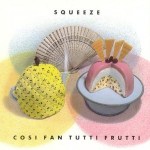
I’m a huge fan of all four, as well as two from their later days, the amazing-to-this-day Cosi Fan Tutti Frutti (1985) and the weaker but still enjoyable Babylon and On (1987).

I play all of them on a regular basis and enjoy the hell out of them whenever I do.

Squeeze Background

Squeeze are a British band that came to prominence in the United Kingdom during the new wave period of the late 1970s, and continued recording successfully in the 1980s and 1990s.

They are known in the UK for their hit songs “Cool for Cats”, “Up the Junction”, “Tempted”, “Labelled with Love”, “Black Coffee in Bed”, “Another Nail in My Heart”, “Pulling Mussels (from the Shell)” and “Hourglass”. Though not as commercially successful in the United States, Squeeze had American chart hits with “Tempted”, “Hourglass” and “853-5937”, and they have a dedicated following there and continue to attract new fans.

All of Squeeze’s hits were written by band members Chris Difford and Glenn Tilbrook, with the former penning the lyrics and the latter handling the composition. The duo were hailed as “the heirs to Lennon and McCartney’s throne” during their peak of popularity in the early 1980s.

Wikipedia