Hot Stamper Pressings of the Music of Jackson Browne Available Now
During the recording of The Pretender, a newly invented piece of electronics was used called the Aphex Aural Exciter. It harmonically “richened” the sound in interesting and, most would say, pleasing ways.
It was designed to have a euphonic effect, and it succeeded in that aim, beguiling its listeners for a while, especially those at the lo- and mid-fi level, the obvious if unspoken target market these days (although the thought of admitting such a thing would surely cause the sky to fall) for the Heavy Vinyl reissue.
The Aphex was clearly creating distortions, but they were the kinds of distortions that many folks of the audiophile persuasion seemed to like. Which is the very definition of euphonic colorations.
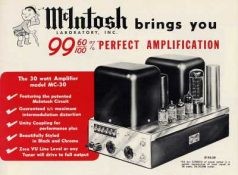
The poster boy for euphonic colorations is our friend here, the famous Mac 30, an amp that came on the market in 1954 and one that still has adherents to this day, some of them quite famous. I had a pair and learned some lessons — as I did with every piece of equipment I owned — in the time I spent listening to them.
If you like old school tubey colorations, the kind we’ve found to be antithetical to the proper reproduction of music in the home, this is the amp for you.
How Much Is Too Much of a Good Thing?
When you play the MoFi pressing of The Pretender, it just seems to have more of that Aphex Aural Excitement.
Here’s the $64,000 question: is MoFi’s supposedly superior mastering technology revealing more of the “aphexy” sound already present on the tapes, or is it adding its own distortions that mimic the Aphex distortions?
It seems to me that in the case of The Pretender it’s clearly the latter.
Deja Vu on MoFi has that same too rich, too smooth sound. Where on earth did that extra richness and smoothness come from? No vintage pressings we have ever played has ever had that sound.
Obviously MoFi preferred The Pretender to sound the way they preferred it to sound, or perhaps it’s more accurate to say that they wanted it to sound the way they thought their customers would prefer it to sound.
Or maybe they have no idea what they’re doing and never did. That strikes me as the most likely explanation for a label that should have gone out of business a long time ago.
Is it just EQ? I’m not expert enough to know, but I do know this: Hot Stamper pressings of The Pretender have much more transparency and clarity, while at the same time offering a good balance of of sweetness and smoothness, with less of that thick, blurry, overly-rich quality that you find on the MoFi pressings of the album.
More on the Aphex
Owen Penglis on the Happymag.tv site describes the Aphex Aural effect this way:
The Aural Exciter brought presence, intelligibility, ‘air’ without hiss, and renewed clarity through its arbitrary process of adding phase shift, harmonics, compression, and intermodular distortion.