Prog Rock – Reviews and Commentaries

Reverse Your Polarity, My Wayward Son

kansalefto

This is one of the pressings we’ve discovered with Reversed Polarity.

About eight years ago (time flies!) we discovered that the first track on side one is in the wrong polarity, or out of absolute phase, whichever terminology you prefer (we ourselves use both). The full story can be found below.

Here’s what we wrote:

But last night (07/13/06) we made an AMAZING discovery. I was listening to another Sterling original, and the slightly aggressive, hi-fi-ish quality of the opening vocals made me think that maybe I had been putting up with a problem that I should have investigated further. What really sold me on the idea was listening to the vocals and noticing that the ambience was “disconnected” from the voices. It’s hard to explain exactly what that sound is, but it’s almost as if the ambience is added in on top of the voice instead of surrounding and resulting from the voice. I suspected reversed absolute phase.
(more…)

Red – Reviewed in 2009

This is a Minty British Polydor red label import LP. These British imports are consistently superior to their domestic counterparts. We do not even bother to pick up domestic King Crimson albums anymore; the sub-generation tapes they are made from cause them to be smeary, veiled and compressed. If there are good ones out there we sure haven’t heard them.

As for this copy, both sides are tubey magical and sweet, again, qualities sorely lacking in domestic pressings. Both sides are however a bit recessed compared to the best we’ve played. Side two is especially dynamic though; the sound really jumps in places.

For those of you who like more adventurous prog rock, this might just be the ticket. 

(more…)

Pieces Of Eight – What to Listen For

More of the Music of Styx

More Records with Specific Advice on What to Listen For

Number one: Too many instruments and voices jammed into too little space in the upper midrange.

When the tonality is shifted-up, even slightly, or there is too much compression, there will be too many elements — voices, guitars, drums — vying for space in the upper part of the midrange, causing congestion and a loss of clarity. This is especially noticeable on songs with loud choruses.

With the more solid sounding copies, the lower mids are full and rich; above them, the next “level up” so to speak, there’s plenty of space in which to fit all the instruments and voices comfortably, not piling them one on top of another as is often the case. Consequently, the upper midrange area does not get overloaded and overwhelmed with musical information.

Number Two: edgy vocals, which is related to Number One above. Most copies have at least some edge to the vocals — the boys want to really belt it out in the choruses, and they do — but the best copies keep the edge under control, without sounding compressed, dark, dull or smeary.

The highest quality equipment, on the hottest Hot Stamper copies, will play the loudest and most difficult to reproduce passages with virtually no edge, grit or grain, even at very loud levels

Tracks two and three on side one were our favorite test tracks. Plat track three to hear how correct, smooth and sweet the midrange is.

(more…)

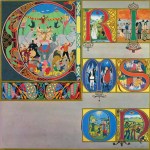
Lizard – Heavy on the Mellotron

More of the Music of King Crimson

More Hot Stamper Pressings of Prog Rock Albums

Every bit the sonic equal of the first album, if you love colorful Big Production Jazzy Prog Rock (with mellotron!) is your thing you can’t go wrong here

Standard Operating Procedures

What are the criteria by which a record like this should be judged? Pretty much the ones we discuss in most of our Hot Stamper listings: energy, vocal presence, frequency extension (on both ends), transparency, harmonic textures (freedom from smear is key), rhythmic drive, tonal correctness, fullness, richness, and so on down through the list.

When we can get all, or most all, of the qualities above to come together on any given side we provisionally award it a grade of “contender.” Once we’ve been through all our copies on one side we then play the best of the best against each other and arrive at a winner for that side. Repeat the process for the other side and the shootout is officially over. All that’s left is to see how the sides matched up.

It may not be rocket science, but it is a science of a kind, one with strict protocols that we’ve developed over the course of many years to insure that the results we arrive at are as accurate as we can make them. 

The result of all our work speaks for itself, on this very record in fact. We guarantee you have never heard this music sound better than it does on our Hot Stamper pressing — or your money back.

AMG 4 Star Review

Lizard is very consciously jazz-oriented — the influence of Miles Davis (particularly Sketches of Spain) being especially prominent — and very progressive, even compared with the two preceding albums. The pieces are longer and have extensive developmental sections, reminiscent of classical music, and the lyrics are more ornate, while the subject matter is more exotic and rarified — epic, Ragnarok-like battles between good and evil that run cyclically.

The doom-laden mood of the first two albums is just as strong, except that the music is prettier; the only thing missing is a sense of humor… At the time of its release, some critics praised Lizard for finally breaking with the formula and structure that shaped the two preceding albums, but overall it’s an acquired taste.