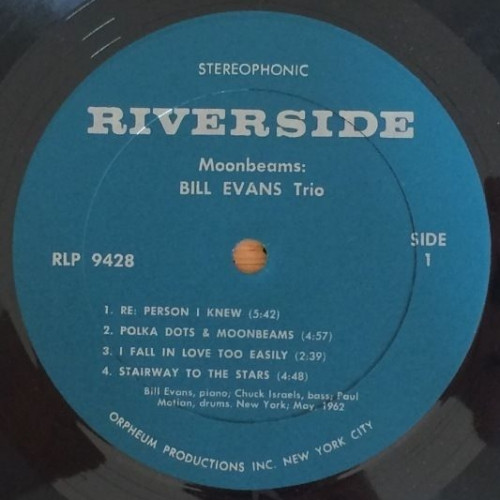
More of the Music of Bill Evans

- This Riverside reissue pressing of Evans’s 1962 classic boasts solid Double Plus (A++) sound from first note to last
- Full-bodied and warm, exactly the way vintage analog should sound, yet as clear and as open as any pressing you’ve heard (or your money back)
- The first album Evans recorded after Scott LaFaro’s death and it is a deeply immersive experience
- AllMusic raves it’s “…so well paced and sequenced the record feels like a dream … Moonbeams was a startling return to the recording sphere and a major advancement in his development as a leader.”
Moon Beams is one of the best sounding Bill Evans records we’ve ever played. Play “It Might As Well Be Spring” for the kind of sublime musical experience you only find on 20th century analog.
Both sides are Tubey Magical, rich, open, spacious and tonally correct. We’ve never heard the record sound better, and that’s coming from someone who’s been playing Bill Evans’s albums since the 80s when they were first reissued in their current form.
These guys are playing live in the studio and you can really feel their presence on every track — assuming you have a copy that sounds like this one.
This vintage Riverside pressing has the kind of Tubey Magical Midrange that modern records can barely BEGIN to reproduce. Folks, that sound is gone and it sure isn’t showing signs of coming back. If you love hearing INTO a recording, actually being able to “see” the performers, and feeling as if you are sitting in the studio with the band, this is the record for you. It’s what vintage all analog recordings are known for — this sound.
If you exclusively play modern repressings of vintage recordings, I can say without fear of contradiction that you have never heard this kind of sound on vinyl. Old records have it — not often, and certainly not always — but maybe one out of a hundred new records do, and those are some pretty long odds.
What The Best Sides Of Moon Beams Have To Offer Is Not Hard To Hear
- The biggest, most immediate staging in the largest acoustic space
- The most Tubey Magic, without which you have almost nothing. CDs give you clean and clear. Only the best vintage vinyl pressings offer the kind of Tubey Magic that was on the tapes in 1962
- Tight, note-like, rich, full-bodied bass, with the correct amount of weight down low
- Natural tonality in the midrange — with all the instruments having the correct timbre
- Transparency and resolution, critical to hearing into the three-dimensional studio space
No doubt there’s more but we hope that should do for now. Playing the record is the only way to hear all of the qualities we discuss above, and playing the best pressings against a pile of other copies under rigorously controlled conditions is the only way to find a pressing that sounds as good as this one does.
Copies with rich lower mids and nice extension up top did the best in our shootout, assuming they weren’t veiled or smeary of course. So many things can go wrong on a record. We know, we’ve heard them all.
Top end extension is critical to the sound of the best copies. Lots of old records (and new ones) have no real top end; consequently, the studio or stage will be missing much of its natural air and space, and instruments will lack their full complement of harmonic information.
Tube smear is common to most vintage pressings. The copies that tend to do the best in a shootout will have the least (or none), yet are full-bodied, tubey and rich.
What We’re Listening For On Moon Beams
- Energy for starters. What could be more important than the life of the music?
- The Big Sound comes next — wall to wall, lots of depth, huge space, three-dimensionality, all that sort of thing.
- Then transient information — fast, clear, sharp attacks, not the smear and thickness so common to these LPs.
- Tight, full-bodied bass — which ties in with good transient information, also the issue of frequency extension further down.
- Next: transparency — the quality that allows you to hear deep into the soundfield, showing you the space and air around all the instruments.
- Extend the top and bottom and voila, you have The Real Thing — an honest to goodness Hot Stamper.
Side One
Re: Person I Knew
Polka Dots And Moonbeams
I Fall In Love Too Easy
Stairway To The Stars
Side Two
If You Could See Me Now
It Might As Well Be Spring
In Love In Vain
Very Early
AMG Review
Moonbeams was the first recording Bill Evans made after the death of his musical right arm, bassist Scott LaFaro. Indeed, in LaFaro, Evans found a counterpart rather than a sideman, and the music they made together over four albums showed it. Bassist Chuck Israels from Cecil Taylor and Bud Powell’s bands took his place in the band with Evans and drummer Paul Motian and Evans recorded the only possible response to the loss of LaFaro — an album of ballads.
The irony on this recording is that, despite material that was so natural for Evans to play, particularly with his trademark impressionistic sound collage style, is that other than as a sideman almost ten years before, he has never been more assertive than on Moonbeams. It is as if, with the death of LaFaro, Evans’ safety net was gone and he had to lead the trio alone.
And he does first and foremost by abandoning the impressionism in favor of a more rhythmic and muscular approach to harmony. The set opens with an Evans original, “RE: Person I Knew,” a modal study that looks back to his days he spent with Miles Davis. There is perhaps the signature jazz rendition of “Stairway to the Stars,” with its loping yet halting melody line and solo that is heightened by Motian’s gorgeous brush accents in the bridge section.
Other selections are so well paced and sequenced the record feels like a dream, with the lovely stuttering arpeggios that fall in “If You Could See Me Now,” and the cascading interplay between Evan’s chords and Israel’s punctuation in “It Might As Well Be Spring,” a tune Evans played for the rest of his life. The set concludes with a waltz in “Very Early,” that is played at that proper tempo with great taste and delicate elegance throughout, there is no temptation by the rhythm section to charge it up or to elongate the harmonic architecture by means of juggling intervals.
Moonbeams was a startling return to the recording sphere and a major advancement in his development as a leader.