 Robert Brook runs a blog called The Broken Record, with a subtitle explaining that the aim of his blog is
A GUIDE FOR THE DEDICATED ANALOG AUDIOPHILE
We know of none better, outside of our own humble efforts to enlighten that portion of the audiophile community who love the sound of music reproduced with the highest fidelity and, more importantly, are serious enough to be willing to spend a great deal of their money and their time in order to make that happen.
If you aspire to great things in audio, Robert’s blog is for you, as is the one you are now on.
An excerpt:
[A] few months ago I came across an article on a Room Coupling Method for speaker placement. Encouraged by finding some common ground with author Richard Mak’s thinking, I started trying it out, and it has helped me make some meaningful progress.
One thing I particularly appreciated in Mak’s article was his assertion that “measurements” and “analysis” are not a substitute for “listening.”
“Charts, graphs, room nodes, reflection coefficients, or even a Ph.D. in room acoustics won’t get you there. Many who are armed with an arsenal of scientific knowledge do not even know how or what to listen for on a reference test track.”
To Mak’s point, as I attempted to apply his approach to my speaker and listening chair positions, I realized in the process that even though the placement of my speakers and listening chair have been suboptimal for some time, that time was far from wasted.
Because in that time I’ve done A LOT of listening, and that listening has led to a special kind of knowledge, which for a long time was without a clear application. Mak’s methodology has since given me an outlet for this knowledge, and all that listening is now paying off.
In his article, Mak walks us through a process that begins with how to determine the distance of the speakers from the back wall. From there he describes how to determine their width, then their toe-in angle, and finally how to dial in the position of the listening chair.
For those of you who would like to tune and tweak the location of their speakers, the article seems to have some good advice for doing that, with plenty of tests to challenge both your setup and your critical listening skills. (We have some great test records you might find useful as well. The more difficult ones to get to sound right can be found here.)
This subject is so complicated that to say much more might send me down a rabbit hole I’d have a hard time climbing out of, but here’s a thought or two.
I’ve had many different big speaker systems set up in a number of good-sized rooms over the years, starting in 1975. When I moved into the house I bought in Thousand Oaks in the early 2000s there was a “great room” with a piano on the far end (where the speakers are now) and a dining table at the opposite end. It measured 15×30 with about a nine foot ceiling.
I was hoping to use my Legacy Whisper speakers in this room so that I could audition records all day (my desk can be seen there on the right). I spent about two years trying to make the speakers sound good where you see them in the picture below.

Nothing I tried worked. The room was too narrow for such a big speaker, even one that is designed to be aimed at a 45 degree angle, so as to cross in front of the listener, unusual for a massive speaker but one that seemed to work experimentally for the Whisper.
There were too many windows — zero is the ideal number — and throwing blankets over them made the room insufferably dull.
But that was nothing compared to the biggest problem I faced — the lower octaves. With the speaker a few feet out from the back wall, the ideal listening position for the mids and highs was at about the 15 foot mark in the room, dead center.
The center of the room, midway between the walls and the floor/ceiling, is where there will always be the least amount of bass. The closer you get to any boundary, the more bass you will hear.
The lowest points in the corners in the room, where three boundaries meet — floor, side wall and back wall — will have the most bass, with the bass falling off the further away you move from that spot.
The place where the listener needed to sit in this room had practically no bass.
I artificially constructed a back wall to make a rear boundary at about twenty feet, which helped, but now I had a room that was 15×20, too small for such a large speaker. Eventually I gave up, bought a pair of Legacy Focuses (used for about $2500, the best $2500 I ever spent), moved them into my modified 18×20 living room and never looked back. I own that pair to this day.
And yes, the picture of the records all over the floor is pretty much the way I lived until I met my wife in 2012. I didn’t care about anything but music and sound back then and, for the most part, I still don’t.
The studio we built for the business in a Westlake industrial park meant we could finally have a real house to live in. To tell you the truth, I would have been perfectly happy either way.
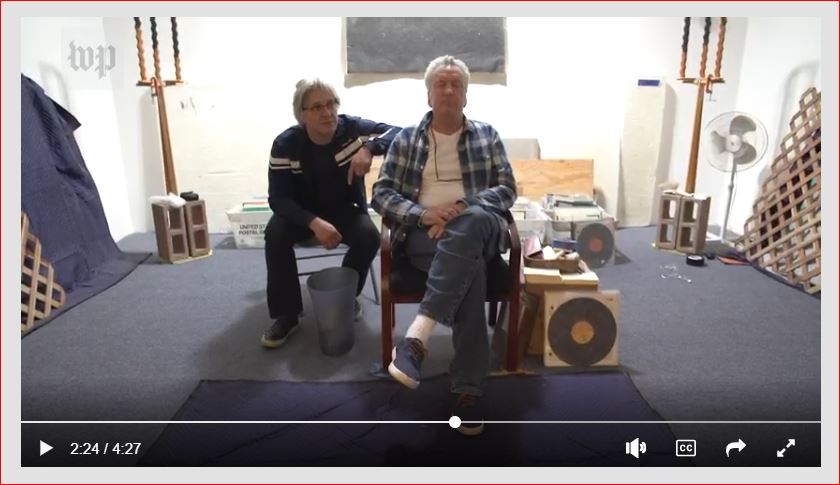
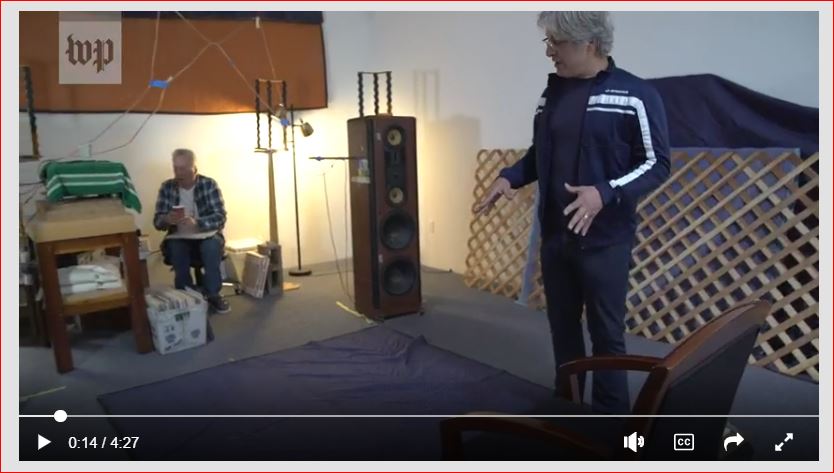
Our studio. The one in our house looked very much like the room you see in these pictures.
Not pretty, but it sure sounded good.