 Skeptical Thinking Is Critical to Achieving Better Sound
Let me be clear: conventional wisdom applied to collecting higher quality vintage vinyl pressings will be right more often than it is wrong. If it were the other way around, it would not be wisdom, it would be folly.
The person who applies the kind of advice you see described below will surely end up with a decent collection of records, records which will no doubt be better sounding than if he were buying records randomly.
As we said, conventional wisdom generally gets more records right than wrong. More right than wrong, yes, but plenty wrong just the same. That is the subject of this commentary.
Mr. edgewear does us a huge favor by laying out a great many of the most popular tenets of record collecting advice in the two posts below. (I probably found his post on the Steve Hoffman forum discussion of Hot Stampers. It goes on for days.)
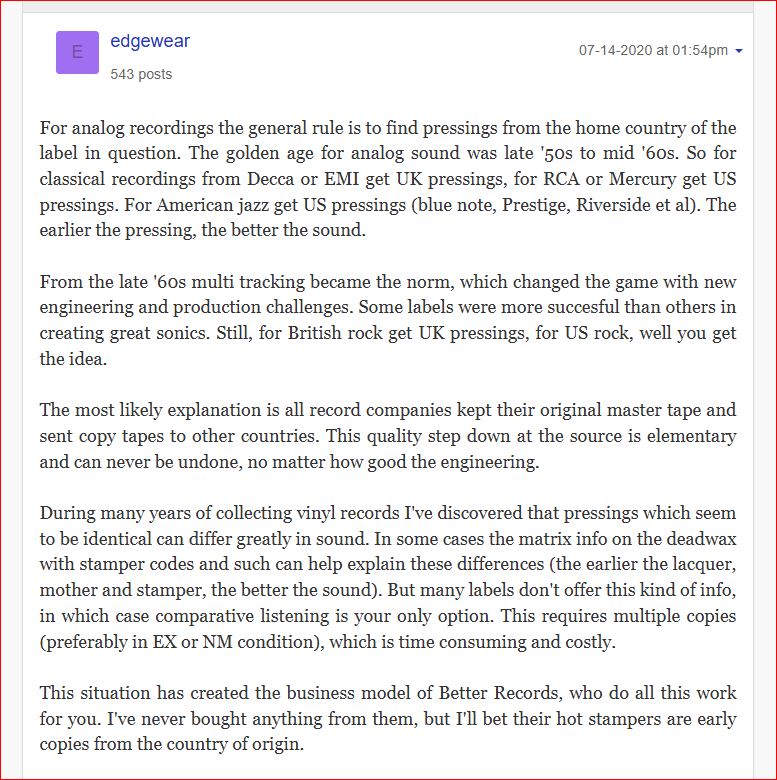
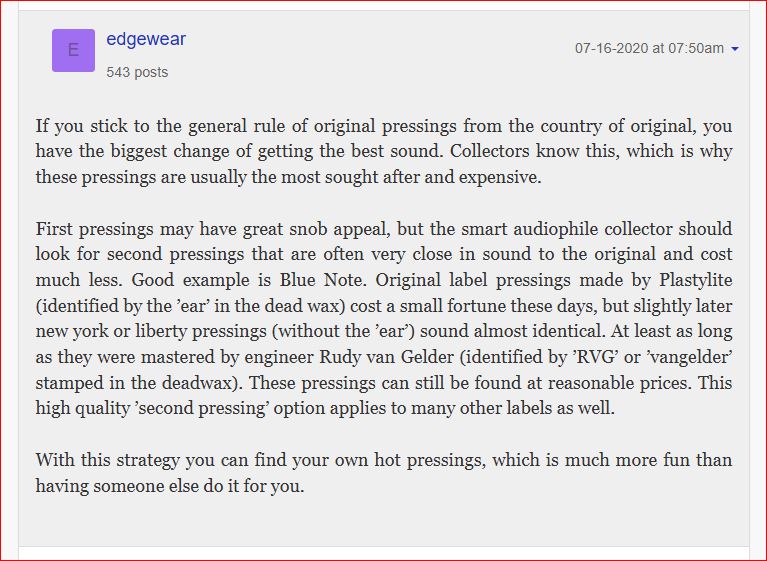
I plan to follow up on some of these assertions in greater detail. (Please note that “assertions” is the most accurate description of the information Mr. edgewear provides, as there is simply no effort made to provide evidence of any kind to back up his pronouncements, the standard operating procedure for the internet.)
Let’s look closer at some of the most likely results if someone were to follow the advice offered above.
The Inherent Problem
Conventional wisdom offers no method or approach for improving one’s chances of finding the best sounding pressing of any specific title.
We grant that it can certainly be of some general help.
However, for a great many titles it will be of no use at all.
It works in favor of some artists’ records and against those of others artists, and offers no way of knowing which artists fit into which of those two categories. For some artists the conventional wisdom is mostly true. For others it is as wrong as wrong can be.
For example, it advises those looking for top quality sound to buy original pressings of The Beatles records, even though few of them sound as good as the right* reissues. (More on that subject here.)
A better term for “few“ would be “practically none.“
We often talk about rules of thumb here on the blog, mostly to point out how much trouble they can cause when applied to areas in which they are too crude to be of service.
Yes, it’s true, the 1S shaded dog pressing will often be the best sounding, but not always.
Will the original Island Pink Label pressing be the best sounding? (That depends.)
Are the original Blue Notes the best sounding? (Maybe yes, maybe no.)
The exceptions to the rule quickly grow into mountains. If those mountains of misinformation actively mislead you in your search for the best pressings of your favorite albums, you should understand that by following this advice, you will never be able to hear many of those albums sound their best.
Nobody tells you that because so few appreciate the limitations of this approach. They may know of a handful of examples where the rules break down — discovered no doubt by accident — but that is hardly a reason to toss out the collective wisdom of millions of record collectors and audiophiles.
That way leads to discomfort, and obviously nobody wants that. Instead, audiophiles and record collectors, like people everywhere, want answers. And they want them so badly that they will accept them even if they are wrong.
If the approach Mr. edgewear offers can be mistaken, there needs to be a process for separating fact from fiction, even if it only works for one album at a time.
The process we have adopted and refined is called the record shootout. Done right, it is only way to answer questions about the sound quality of the pressings of any given album.
New Knowledge
It allows for the acquisition of new knowledge to overturn previous understanding.
Conventional wisdom does no such thing. It is stuck with the most simplest, most logical, most obvious understanding. And it will always be stuck, since it does not allow for outliers, unconventional thinking and unpredictable knowledge.
It traps the record collector into a system that is full of holes. If favorite albums of yours happen to be in those holes, you are plain out of luck.
This is something I would never accept.
If there is a better pressing of a favorite album of mine, I want to know what it is. For practically every album I’ve ever wanted to acquire, to find the best sounding pressing I had to ignore the wisdom of others and seek the truth for myself.
This is not an easy road. Consequently, few will take it. But those who do have the potential to achieve successes that are all but unimaginable to the Mr. edgewears of the world.
Success in the form of a collection comprising the best sounding pressings ever made, of the greatest recordings ever made, of the most wonderful music ever made.
Stay tuned for more to come on this subject. There is still a great deal left to learn from Mr. edgewear.
*A short note on the “right” Beatles reissues.
As you can imagine, depending on how you define the term, there are by definition a very limited number of UK originals. Conversely, there are a huge number of reissues, especially if you add in the pressings made outside the UK.
Finding the right reissues of The Beatles’ music has taken my staff and me a lifetime of work. Speaking only for myself, I can also say that for more than forty years it has been immensely rewarding every step of the way.
That guy you see pictured at the upper left of this post has spent much of the last forty years wandering around used record stores looking for better records (ahem).
Before that he wandered around stores selling new records because he didn’t know how good old used records could be.
Here are some of the things he’s learned since he started collecting at the age of ten more than sixty years ago.
(First purchase: She Loves You on 45. It’s still in my collection, although it got a crack in it a time long ago and is no longer playable.)