More Chet Baker
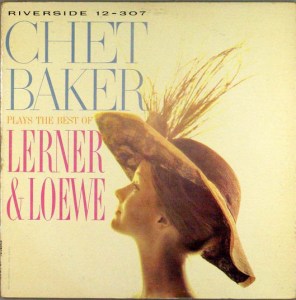
- This superb Riverside stereo recording boasts Double Plus (A++) sound or close to it from first note to last, pressed on exceptionally quiet OJC vinyl
- Big, rich, smooth, open, natural, with plenty of note-like bass (particularly on side one) – what’s not to like? This copy is doing just about everything right
- Some of the best jazz guys of the day back up Chet on this one: Zoot Sims, Pepper Adams, Bill Evans, Herbie Mann and more
- “…the timelessness of the melodies, coupled with the assembled backing aggregate, make Chet Baker Plays the Best of Lerner and Loewe (1959) a memorable concept album.”
This is a wonderful Chet Baker record that doesn’t seem to be getting the respect it deserves in the wider jazz world. You may just like it every bit as much as the Chet album, and that is one helluva record to compare any album to. In our estimation it’s about as good as it get.
Finding good Chet Baker records is like finding hen’s teeth these days. The albums he did for Pacific Jazz in the 50s can be wonderful but few have survived in audiophile playing condition. The Mariachi Brass albums are as awful as everyone says — we know, we’ve played them.
The Old Paradigm, Not Really a Paradigm At All
Both sides here are Tubey Magical, rich, open, spacious and tonally correct. We’ve never heard the record sound better than in our most recent shootout, and that’s coming from someone who’s been playing the album since it was first reissued in the 80s.
I used to sell these very records in the 90s — we retailed them for ten bucks back then — but we had no clue just how good they could be back in those days. We couldn’t clean them right, or even play them right, and it would never have occurred to us to listen to a big pile of them one after another in order to pick out the best sounding copies.
What The Best Sides Of …Plays the Best of Lerner and Loewe Have To Offer Is Not Hard To Hear
- The biggest, most immediate staging in the largest acoustic space
- The most Tubey Magic, without which you have almost nothing. CDs give you clean and clear. Only the best vintage vinyl pressings offer the kind of Tubey Magic that was on the tapes in 1959
- Tight, note-like, rich, full-bodied bass, with the correct amount of weight down low
- Natural tonality in the midrange — with all the instruments having the correct timbre
- Transparency and resolution, critical to hearing into the three-dimensional studio space
No doubt there’s more but we hope that should do for now. Playing the record is the only way to hear all of the qualities we discuss above, and playing the best pressings against a pile of other copies under rigorously controlled conditions is the only way to find a pressing that sounds as good as this one does.
Copies with rich lower mids and nice extension up top did the best in our shootout, assuming they weren’t veiled or smeary of course. So many things can go wrong on a record. We know, we’ve heard them all.
Top end extension is critical to the sound of the best copies. Lots of old records (and new ones) have no real top end; consequently, the studio or stage will be missing much of its natural air and space, and instruments will lack their full complement of harmonic information.
Tube smear is common to most vintage pressings. The copies that tend to do the best in a shootout will have the least (or none), yet are full-bodied, tubey and rich.
What We’re Listening For On …Plays the Best of Lerner and Loewe
- Energy for starters. What could be more important than the life of the music?
- The Big Sound comes next — wall to wall, lots of depth, huge space, three-dimensionality, all that sort of thing.
- Then transient information — fast, clear, sharp attacks, not the smear and thickness so common to these LPs.
- Tight, full-bodied bass — which ties in with good transient information, also the issue of frequency extension further down.
- Next: transparency — the quality that allows you to hear deep into the soundfield, showing you the space and air around all the instruments.
- Extend the top and bottom and voila, you have The Real Thing — an honest to goodness Hot Stamper.
The Players and Personnel
- Alto Saxophone, Tenor Saxophone – Zoot Sims
- Baritone Saxophone – Pepper Adams
- Bass – Earl May
- Drums – Clifford Jarvis
- Flute – Herbie Mann
- Piano – Bill Evans (tracks: A1, B2 to B4), Piano – Bob Corwin (tracks: A2 to A4, B1)
- Producer – Orrin Keepnews
- Engineer – Roy Friedman
Side One
I’ve Grown Accustomed To Your Face
I Could Have Danced All Night
The Heather On The Hill
On The Street Where You Live
Side Two
Almost Like Being In Love
Thank Heaven For Little Girls
I Talk To The Trees
Show Me
AMG Review
This is one of the last Chet Baker (trumpet) long players recorded in the States prior to the artist relocating to Europe in the early ’60s. Likewise, the eight-tune collection was the final effort issued during his brief association with the Riverside Records imprint.
The project was undoubtedly spurred on by the overwhelming success of the Shelly Manne-led combo that interpreted titles taken from the score to My Fair Lady (1956). In addition to becoming an instant classic, Manne’s LP was also among of the best-selling jazz platters of all time.
While Baker and crew may have gained their inspiration from Manne, these readings are comparatively understated. That said, the timelessness of the melodies, coupled with the assembled backing aggregate, make Chet Baker Plays the Best of Lerner and Loewe (1959) a memorable concept album.