More Joni Mitchell
Joni Mitchell – An Overview
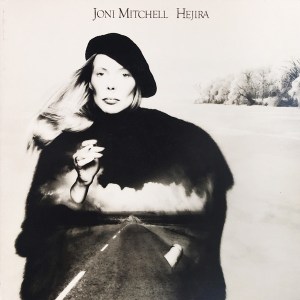
- Outstanding sound throughout this vintage Asylum label pressing, with both sides earning Double Plus (A++) grades
- Most copies we played were too compressed or veiled to involve you in the music, but this one has the big, rich, clear sound of analog at its best that Joni’s spacey “beatnik jazz” needs to work its magic
- “Joni Mitchell’s Hejira is the last in an astonishingly long run of top-notch studio albums dating back to her debut… Performances are excellent, with special kudos reserved for Jaco Pastorius’ melodic bass playing… This excellent album is a rewarding listen.”
We played a ton of copies and heard a lot to dislike. Many copies have a tendency to sound phony, a case of heavy-handed EQ in the mastering perhaps. When a copy sounds glossy, it loses its natural warmth and starts to sound like any old audiophile LP. We’re ideally looking for something akin to Blue here, and not the sound you find on Patricia Barber LPs. (Gratuitous maybe, but it feels like it’s been too long since we took a swipe at that junk. But I digress…)
Plenty of copies had natural sound but no real life or presence to speak of. It’s a sound you could live with until you heard a good one, but there’s no going back once you’ve heard what the album’s really capable of. A copy like this one gives you lots of richness and warmth without sacrificing the texture to the instruments or the breath to Joni’s voice. The percussion really comes through, the bass has more weight and the immediacy of the vocals put Joni front and center, just where she should be.
If you aren’t familiar with this album, it’s a few more steps down the path she started taking on Court and Spark. The musicians include Larry Carlton and Jaco Pastorius, so that should give you an idea about the jazz-fusion direction of the arrangements. It was a fun album to get to know and on a copy like this one, it really rewards multiple listens.
What The Best Sides Of Hejira Have To Offer Is Not Hard To Hear
- The biggest, most immediate staging in the largest acoustic space
- The most Tubey Magic, without which you have almost nothing. CDs give you clean and clear. Only the best vintage vinyl pressings offer the kind of Tubey Magic that was on the tapes in 1976
- Tight, note-like, rich, full-bodied bass, with the correct amount of weight down low
- Natural tonality in the midrange — with all the instruments having the correct timbre
- Transparency and resolution, critical to hearing into the three-dimensional studio space
No doubt there’s more but we hope that should do for now. Playing the record is the only way to hear all of the qualities we discuss above, and playing the best pressings against a pile of other copies under rigorously controlled conditions is the only way to find a pressing that sounds as good as this one does.
What We’re Listening For On Hejira
- Energy for starters. What could be more important than the life of the music?
- Then: presence and immediacy. The vocals aren’t “back there” somewhere, lost in the mix. They’re front and center where any recording engineer worth his salt would put them.
- The Big Sound comes next — wall to wall, lots of depth, huge space, three-dimensionality, all that sort of thing.
- Then transient information — fast, clear, sharp attacks, not the smear and thickness so common to these LPs.
- Tight punchy bass — which ties in with good transient information, also the issue of frequency extension further down.
- Next: transparency — the quality that allows you to hear deep into the soundfield, showing you the space and air around all the instruments.
- Extend the top and bottom and voila, you have The Real Thing — an honest to goodness Hot Stamper.
Side One
Coyote
Amelia
Furry Sings the Blues
A Strange Boy
Hejira
Side Two
Song for Sharon
Black Crow
Blue Motel Room
Refuge of the Roads
AMG Review
Joni Mitchell’s Hejira is the last in an astonishingly long run of top-notch studio albums dating back to her debut. Some vestiges of her old style remain here; “Song for Sharon” utilizes the static, pithy vocal harmonies from Ladies of the Canyon’s “Woodstock,” “Refuge of the Roads” features woodwind touches reminiscent of those in “Barangrill” from For the Roses, and “Coyote” is a fast guitar-strummed number that has precedents as far back as Clouds’ “Chelsea Morning.” But by and large, this release is the most overtly jazz-oriented of her career up to this point — hip and cool, but never smug or icy.
Arrangements are sparse, yet surprisingly varied, the most striking of which is the kaleidoscopically pointillistic one used on “Amelia.” Performances are excellent, with special kudos reserved for Jaco Pastorius’ melodic bass playing on “Refuge of the Roads” and the title cut. This excellent album is a rewarding listen.