More of the Music of Maurice Ravel
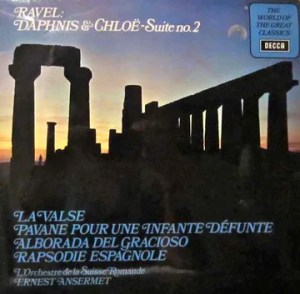
- An incredible Decca pressing of these amazing orchestral works with a Shootout Winning Triple Plus (A+++) side one mated to a superb Double Plus (A++) side two
- Both of these sides are clear, full-bodied and present, with plenty of space around the players, the unmistakable sonic hallmark of the properly mastered, properly pressed vintage analog LP
- The presentation of the Suisse Romande is wide, tall, spacious, rich and tubey, exactly the way we want to hear them
- When you hear how good this record sounds, you may have a hard time believing that it’s a budget reissue from the early-70s (1971 in this case), but that’s precisely what it is
- Here is a link to more records like this one containing some of our Favorite Performances with Top Quality Sound
This vintage Decca pressing has the kind of Tubey Magical Midrange that modern records can barely BEGIN to reproduce. Folks, that sound is gone and it sure isn’t showing signs of coming back. If you love hearing INTO a recording, actually being able to “see” the performers, and feeling as if you are sitting in the studio with the band, this is the record for you. It’s what vintage all analog recordings are known for — this sound.
If you exclusively play modern repressings of vintage recordings, I can say without fear of contradiction that you have never heard this kind of sound on vinyl. Old records have it — not often, and certainly not always — but maybe one out of a hundred new records do, and those are some pretty long odds.
What The Best Sides Of Daphnis & Chloe – Suite No. 2 Have To Offer Is Not Hard To Hear
- The biggest, most immediate staging in the largest acoustic space
- The most Tubey Magic, without which you have almost nothing. CDs give you clean and clear. Only the best vintage vinyl pressings offer the kind of Tubey Magic that was on the tapes beginning in 1957
- Tight, note-like, rich, full-bodied bass, with the correct amount of weight down low
- Natural tonality in the midrange — with all the instruments having the correct timbre
- Transparency and resolution, critical to hearing into the three-dimensional studio space
No doubt there’s more but we hope that should do for now. Playing the record is the only way to hear all of the qualities we discuss above, and playing the best pressings against a pile of other copies under rigorously controlled conditions is the only way to find a pressing that sounds as good as this one does.
Copies with rich lower mids and nice extension up top did the best in our shootout, assuming they weren’t veiled or smeary of course. So many things can go wrong on a record! We know, we’ve heard them all.
Top end extension is critical to the sound of the best copies. Lots of old records (and new ones) have no real top end; consequently, the studio or stage will be missing much of its natural air and space, and instruments will lack their full complement of harmonic information.
Tube smear is common to most vintage pressings. The copies that tend to do the best in a shootout will have the least (or none), yet are full-bodied, tubey and rich.
Size and Space
One of the qualities that we don’t talk about on the site nearly enough is the SIZE of the record’s presentation. Some copies of the album just sound small — they don’t extend all the way to the outside edges of the speakers, and they don’t seem to take up all the space from the floor to the ceiling. In addition, the sound can often be recessed, with a lack of presence and immediacy in the center.
Other copies — my notes for these copies often read “BIG and BOLD” — create a huge soundfield, with the music positively jumping out of the speakers. They’re not brighter, they’re not more aggressive, they’re not hyped-up in any way, they’re just bigger and clearer.
And most of the time those very special pressings are just plain more involving. When you hear a copy that does all that — a copy like this one — it’s an entirely different listening experience.
What We’re Listening For On Daphnis & Chloe – Suite No. 2
- Energy for starters. What could be more important than the life of the music?
- The Big Sound comes next — wall to wall, lots of depth, huge space, three-dimensionality, all that sort of thing.
- Then transient information — fast, clear, sharp attacks, not the smear and thickness so common to these LPs.
- Powerful bass — which ties in with good transient information, also the issue of frequency extension further down.
- Next: transparency — the quality that allows you to hear deep into the soundfield, showing you the space and air around all the instruments.
- Extend the top and bottom and voila, you have The Real Thing — an honest to goodness Hot Stamper.
Side One
Daphnis and Chloe – Suite No. 2
Lever Du Jour
Pantomime
Danse Generale
La Valse
Poème Choréographique
Side Two
Pavane Pour Une Infante Defunte
Miroirs
Alborada Del Gracioso
Rapsodie Espagnole
Prelude A La Nuit
Malaguena
Habanera
Feria
AllMusic on Daphnis & Chloe, Suite No. 2
Daphnis and Chloé was the largest work Ravel was ever to compose, occupying him from early 1909 until April 5, 1912. It is also widely regarded as his most impressive achievement, and among the greatest ballet scores of the twentieth century. The work calls for an enormous orchestra, with approximately fifteen distinct percussion instruments and a wordless chorus, heard both offstage and onstage. Given its sheer size, the ballet score is much better known by excerpts, and when heard in concert, is usually represented by one of two suites that Ravel extracted from it. The first suite, of 1911, draws material from the “Nocturne,” “Interlude” and “Danse guerriere,” while Ravel designated the final three numbers: “Lever du jour,” Pantomime,” and “Danse générale” as Suite No. 2, following the score’s completion in 1912.
Based on the pastoral drama by the Greek poet Longus, the ballet’s scenario was devised by Mikhail Fokine, a classically trained dancer and choreographer for Sergie Diaghilev’s Ballets Russes. In his autobiographical sketch, the composer described its conception: “In writing it I sought to compose a broad musical fresco, less concerned with archaic fidelity than with loyalty to the Greece of my dreams, which in many ways resembled that imagined and depicted by French artists at the latter part of the eighteenth century. The work is constructed symphonically on a very strict tonal plan, by means of a few themes, the development of which assures the work’s homogeneity.”
The first two scenes, which comprise Suite No. 1, portray the courtship of Daphnis and Chloé, and the latter’s abduction by, and miraculous escape from, a band of pirates. The third scene, comprising the three numbers of Suite No. 2, takes place in a grove sacred to the god Pan and begins with daybreak following the pirate’s night of terror.
Eventually the muted sounds of dawn give way to a stronger, more dynamic melodic thread in the strings, rising to an impassioned lyrical theme. Throughout this extended passage, Daphnis awakes, anxiously looks for Chloé, and sees her among a group of shepherdesses. The two lovers embrace as the melody reaches an impassioned climax.
In gratitude to Pan, whose intervention saved Chloé from the pirates, Daphnis and Chloé mime the adventures of the god and his beloved nymph, Syrinx, to a sultry flute accompaniment. Marked “expressive and supple,” the solo is actually shared by the four members of the flute section — piccolo, two flutes, and alto flute — but played as if written for a single instrument. Chloé dances to this flute music, which becomes increasingly energetic, and she in turn, more animated. The motion suddenly breaks at a woodwind descent, and with a last whirl, she falls languorously into the arms of Daphnis. In a brief but passionate epilogue, a group of young women enter, dressed as bacchantes and shaking tambourines, followed by a group of young men. Against a dizzying 5/4 meter, Ravel deploys the full resources of the orchestra to create an exhilarating Dionysian celebration of physical love.
– Brian Wise