More of the music of Rimsky-Korsakov (1844-1908)
Our Favorite Performance of Scheherazade – Ansermet with the Suisse Romande
This post was written in 2014 or so. It’s the story of the breakthrough pressing we discovered that year.
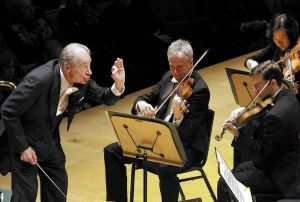
I attended the Dec. 2013 performance of the work at the Disney Hall. Pictured is Mr de Burgos conducting. It was a thrill like no other. (Well, maybe The Planets.)
“Guest conductor Rafael Frühbeck de Burgos’s attention to detail delivers the razzle dazzle and also discovers renewed radiance in ‘Scheherazade.'”
We did a monster shootout for this music in 2014, one we had been planning for more than two years. On hand were quite a few copies of the Reiner on RCA; the Ansermet on London (CS 6212, his second stereo recording, from 1961, not the earlier and noticeably poorer sounding recording from in 1959); the Ormandy on Columbia, and a few others we felt had shown potential.
The only recordings that held up all the way through — the fourth movement being THE Ball Breaker of all time, for both the engineers and musicians — were those by Reiner and Ansermet. This was disappointing considering how much time and money we spent finding, cleaning and playing those ten or so other pressings.
Here it is a year later and we’re capitalizing on what we learned from the first big go around, which is simply this: the Ansermet recording on Decca/London can not only hold its own with the Reiner on RCA, but beat it in virtually any area. The presentation and the sound itself are both more relaxed and natural, even when compared to the best RCA pressings.
The emotional content of the first three movements (all of side one) under Ansermet’s direction are clearly superior. The roller coaster excitement Reiner and the CSO bring to the fourth movement cannot be faulted, or equaled. In every other way Ansermet’s performance is the one for me.
Both Sides
Superb! Big brass, so full-bodied and dynamic, yet clear and not thick or overly tubey. Lots of space as is usually the case with Ansermet’s recordings from this era.
Both sides here are BIG, with the space and depth of the wonderful Victoria Hall that the L’Orchestre De La Suisse Romande perform in. As a rule, the classic ’50s and ’60s recordings of Ansermet and the Suisse Romande are as big and rich as any you’ve heard. On the finest pressings (known around these parts as Hot Stampers) they seem to be the ideal blend of clarity and richness, with depth and spaciousness that will put to shame 98% of the classical recordings ever made.
The solo violin is present and so real you will have a hard time believing it.
This copy is huge in every dimension, just as all the best ones always are, with maximum amounts of height, width, and depth. The transparency is also superb — you really hear into this one in the way that only the best Golden Age recordings allow.

 Most of what passed for good classical sound when I was coming up in audio — the DGs, EMIs, Sheffields and other audiophile pressings — are hard to take seriously when played on the modern high quality equipment of today.