*Cleaning Records

Record Cleaning Tips – Ultrasonic Cleaning

Our Step by Step Guide to Professional Record Cleaning

Year ago (2010?) we wrote:

We have not experimented with Ultrasonic cleaning, although we have heard good things about it from our audiophile friends and customers. It is simply not practical at this time to clean records the way we do — three steps of Walker fluids — and then add the additional steps required to bathe them in ultrasonic fluid and dry them. Our near-full-time record cleaning person can hardly keep up with the demands we make on her these days, what with shootouts going on five days a week. Making the cleaning process more time consuming is just not in the cards for the time being.


UPDATE 2016

We have now tried ultrasonic cleaning and are unable to see — read: hear — any benefit relative to the cleaning regimen that we have evolved over the last fifteen years of so.

Our take is simply this: No doubt it is better than nothing. It may be better than the VPI 16.5, or it might be better in conjunction with the 16.5. We leave it for others to determine how well any of these other approaches work.

We believe that the system we use does a dramatically better job than any other we have tested. It may not be cheap, but it really works, and it is worth every penny and every hour of what it costs in time and money.

(more…)

Advice on Cleaning Your Favorite Records

The Prelude Record Cleaning System Is Now Available

One of our customers wrote to us about cleaning his collection not long ago:

I plan to clean all 300-400 records I really care about. I mean they’ve never been cleaned.

Do you think that’s a waste in any way? I imagine any record will sound better throughly cleaned with the Prelude system. They have never been cleaned.

Maybe half these records were only pressed at one plant when they first came out, one run. They weren’t re-released until the world caught up 20 years later.

Andrew

Dear Andrew,

My general view is that it requires an enormous commitment to clean that many records.

Here is what I would consider a more realistic approach:

You have 300-400 records you want to clean. Every time you play one of these records, put it in an area on your record shelf that is strictly for records you have just played.

When you get to ten of those records, sit down and clean them. If you are using our approach, this will take between two and three hours.

For one reason or another, some of the records you own will simply never be played again. Unless they are going to get played, why clean them?

Clean the ones you know you will want to play because you’ve just played them!

If you have 1000 records, 900 or more are unlikely to get played in any given year. Maybe they won’t get played for another five years. As we said above. some may never get played again.

And yet you want to take the time to clean them now? Doing three an hour? How far to you think you will get with that project?

If you are like everyone I know who has talked about doing such a thing, you will not get far. It’s a lot of work.

Tastes change and evolve. That’s a good thing, not a bad one.

And when you find a new record you love after just having played it and can hardly wait to hear it again, make sure it gets put at the front of the queue to be cleaned. At some point you will have ten in the queue, and you can then set up a block of time to clean your ten great records.

Over the coming weeks you will look forward to playing them again, if for no other reason than to hear how much better they sound now.

(more…)

Professional Record Cleaning Using Two Machines, Powerful Enzymes and Plenty of Elbow Grease

Proper Record Cleaning Can Help You Find Your Own Hot Stamper Pressings

Many of our customers have asked us about our cleaning regimen.

Well, we’ve finally sat ourselves down and written out the bulk of it, with only one step not included for the simple reason that by itself it is responsible — to some degree, an improvement of roughly half a plus, sometimes more — for our Hot Stamper pressings sounding better than other copies even when those copies share the exact same stamper numbers.

Our approach has of course been refined many times over the last twenty-five years. At some point, we had to admit that nothing we could come up with to do differently made any difference to the sound quality of the records we had cleaned, so we stopped experimenting.

The instructions below detail the methods, fluids and hardware we have been using to clean the records that go in our shootouts for more than ten years.

You will need two machines, one for scrubbing and rinsing, using the various fluids we recommend, and another machine with a vacuum arm (threaded or unthreaded) to remove the fluids from the record.

As for the second vacuum machine, we have an Odyssey brand machine (no longer made), but Keith Monks was making a similar machine in the 70s — I know because in 1976 I paid to have my fifty favorite records cleaned on one. (Someday I will post a picture of the customer KMAL sleeve they put the cleaned record in, with a number of boxes, 25?, to be checked off each time the record was played, so that you would know when the record would need to be cleaned again.)

There are a number of Keith Monks machines made for the consumer market which we may have to buy one day when our current Odyssey gives up the ghost. (We have gone through two and have another one headed our way. It’s been money well spent; it would be hard to imagine the business running without these machines or others of the same design. The sound of every record cleaned on this kind of machine is improved, even when just cleaned with water!)

The Keith Monks style machines should work just as well as the Odyssey. Others with the thread design they pioneered will too.

  • Place the record on a VPI 16.5 machine or equivalent.

(The 16.5 is a workhorse and ideal for this aspect of cleaning. Note that if you need to clean lots of records, a fan placed under the machine to keep the vacuum from overheating is a must.)

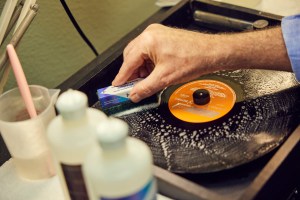
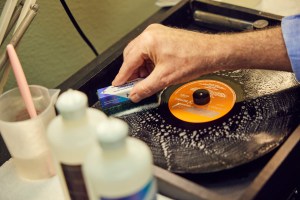
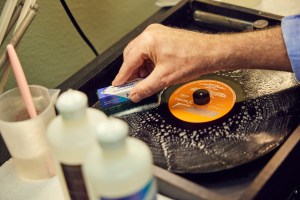
  • Apply premade step 1 enzyme solution and spread evenly across the  record with the step 1 brush, then scrub back and forth gently with the grooves for a couple of rotations.

Apply all solutions sparingly. Too much will foam over the edges of the record, and will require additional rinsing.

  • Vacuum the soap off with the 16.5 tube designated for soap.
  • Apply step 2 in the same fashion as step one.
  • Vacuum the soap off with the tube designated for soap.

Note that the soap is always vacuumed with one tube and the water with a different one. You will need two 16.5 suction tubes, one tube for water and one for soap.

Make sure to replace the fabric lips around the vacuum slot regularly as they wear out quickly with heavy use. I think we stopped trying to repair them and just buy new tubes, which is the more convenient option.

  • Switch to the vacuum tube designated for water, apply step 3 rinse water and vacuum.
  • Apply more step 3 rinse water.
  • Carefully place the record with water on it onto the vacuum machine (either the Odyssey or any other with a vacuum arm design) and run the vacuum across the record.
  • Use a microfiber cloth to wipe any droplets of liquid off the edge of the record after vacuuming is completed.
  • Place the now dry record on a basic turntable, set at 45 RPM, and drop the needed on the first track. This will “plow” out any softened material that may be left in the grooves.
  • Flip the record over and play the other side.

(more…)
The Prelude Cleaning System Is Now in Stock

Proper Record Cleaning Can Help You Find Your Own Hot Stamper Pressings

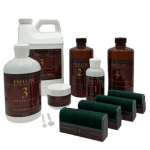
Better Records is now the exclusive distributor for The Prelude Record Cleaning System (formerly produced by Walker Audio).

Prelude is the only fluid we recommend for serious sound enhancement and cleaning of your LPs.

It is our strongly held belief that you have never really heard what’s in the grooves of your records until you’ve cleaned them using Prelude’s enzyme-based system. There is nothing in our experience that works as well.

The Prelude Record Cleaning System can be used with any vacuum record cleaning machine.

With Prelude, you will experience a cleaner, more transparent soundstage, with better harmonics and improved dynamics from top to bottom. You will hear things you’ve never heard, even on LPs you’ve listened to countless times before.

There are more nuances, more life, and more music in the recording than you know, and Prelude will reveal them to you while establishing a more natural space for the performers to exist within.

Cleaning records is a vital step in getting the best sound reproduction quality possible from a vinyl LP.

That is why we are pleased to offer Prelude to audiophiles who know and appreciate that analog is still the pinnacle of recorded playback and who want to maximize their listening experience.


Further Reading

(more…)

Letter of the Week – How Good Are Record Cleaning Services?

The Best Record Cleaning System on the Market Is Now Available

One of our customers thought he would try a record cleaning service to get some of his records cleaned. Here is what he found.

Hi Tom,

I got my first set of records back from the cleaning service. Very disappointing.

I’m being totally straight when I say you have set a new standard for what I expect a clean record to sound like. As soon as I heard the pressing of Sticky Fingers, and all subsequent records I bought from you, I realized it was possible to get old records really clean. Almost flawlessly clean like a CD I want to say. The sounds on the record are clearer but so are the littlest tiny pops in the groove. I don’t know what you call them to distinguish them from bigger pops, [we call them ticks] but you can hear them so clearly on quiet passages and between songs and really through the song except the loudest parts.

I know not all vinyl is dead quiet but there are few records from the 1980s I took very good care of and hadn’t played very much that they should have been able to get much much cleaner in my opinion. And the record’s surface is perfect to the eye, so I’m guessing it’s their cleaning methods. All the records have the same defect cleaning wise, except the brand new record I sent. That sounds better than it did and is crystal clear. Overall, no bueno.

Your records were way way better. I guess I’m going to have to get that particular solution system you recommended. Do I need that $4000 German machine to do it right after that? Or are there other ultrasonic cleaners worth investigating? I know some people make their own. Whatever you care to share as I don’t have $4000 dollars.

Andrew

Andrew,

Sorry to hear of this company’s failings. As you know, I am not the least bit surprised.

I don’t think anyone that offers such a service would know how to clean records properly. Real cleaning is much more difficult than any of these folks think it is. If they knew how hard it is, they would know how expensive the service would have to be and how unlikely it would be that anyone would want to pay such a price to have a record cleaned and its sound improved.

We don’t offer such a service partly because we know exactly how much work is involved.

(more…)

Give Your Cleaned Records 1 to 3 Plays Before Listening

Record Cleaning – An Overview

We have a series of turntables set up in the cleaning room that play through every record we’ve cleaned before it goes into the Hot Stamper shootout rotation.

We recommend that you play your records at least once and as many as three times through completely before listening to them, whether you are listening for pleasure or testing for sound quality.

Playing previously cleaned records plows loosened grunge out of the grooves and helps the cartridge “seat” itself in the dead center of the groove at the same time.

Two or three plays usually gets the job done, resulting in a clearly audible improvement of surfaces and sonics.

If you care to, you can clean them the way we do at 45 RPM in order to speed up the process.

For more record cleaning tips and tricks, click here.

To order The Prelude Record Cleaning System, exclusively available from Better Records and 100% guaranteed to be the best record cleaning fluid you have ever used or your money back, please click here.

Once you hear every record you have cleaned sounding better than it ever has, not to mention quieter, we think you will be more than glad you did.

(more…)

Record Cleaning Tips – Why Clean the Average Record?

Proper Record Cleaning Can Help You Find Your Own Hot Stamper Pressings

We gave the following advice to a customer who had just bought a record cleaning machine and was about to go on a tear cleaning his whole record collection — many of which were still sealed — to find the Hot Stampers lurking within.

We explained that this was not such a good idea. For one thing, you can’t find Hot Stampers without doing shootouts, and that means you need piles of the same title, which practically no one has.

You might find good sounding pressings among your old records, but even that will entail a great deal of work.

Since the average record sounds pretty average, and sealed records are unknowns in terms of pressing, mastering, etc., I would say it’s always a good idea to do a quick needle drop on a record before taking the time to clean it. The average record isn’t really worth cleaning, because it doesn’t really sound very good, so why waste the time?

Once you figure out what’s good and what’s not, you can start to target the better sounding records. This process typically takes about twenty years, but there’s no time like the present! If you want to skip all that time and effort, we are happy to get you the good stuff and save you from the bad. Such is the service we offer.

And one more thing: until you get your system cooking and really set up right, make a point not to buy any audiophile pressing of any kind. Once your stereo is working properly those pressings will more often than not show themselves to be lackluster if not downright awful. You won’t want to have too much time or money invested in that trash once you’ve learned just how bad it really is.

(more…)

Record Cleaning Tips – Reverse Osmosis Rinse Water

Record Cleaning – An Overview

We’ve had very good results with reverse osmosis water for rinsing.

It is audibly superior to everything else we’ve tried.

We’re not saying it’s the best rinse water on the planet; we’re simply saying it’s the best we’ve heard. For a couple hundred bucks, having a reverse osmosis water system installed in your house will turn out to be money well spent if you are cleaning a large collection.

Aquarium stores sell it by the gallon if you don’t plan on cleaning enough records to justify the expense of installing a unit.

(more…)

Record Cleaning Advice – Some Basics

The Prelude Record Cleaning System Is Now Available

Someone used to sit in an unheated, uncooled cottage all day, running the records through our proprietary multi-step cleaning process. (At the bottom of this listing you can see our old setup.)

There’s a very good reason why it was unheated and uncooled — not to save on electricity, but to allow the stereo to sound its best.

Now our record cleaning person has a nice big room adjoining our studio in an office complex to sit in.

Every Hot Stamper pressing has been vacuum cleaned on multiple machines using the Prelude Enzyme system.

Prelude is the only fluid we recommend for serious sound enhancement and cleaning of your LPs. You have never heard what’s really in the grooves of your records until you’ve cleaned them using The Prelude Record Cleaning System. There is nothing in our experience that works remotely as well.

We’ve also tried a number of “single step” record cleaning fluids and found that none were satisfactory. Disc Doctor is two steps, Prelude is three (or four depending on whether you choose to use their new final rinse. At this time we do not). If you can’t see yourself using a three step cleaning process — no matter how much better it makes your records sound — then stick with Disc Doctor. You are sacrificing a great deal of sound quality this way, but the choice is yours.

For cheap records alcohol and water are fine.

Cleaning Hot Stampers

We here at Better Records believe it’s virtually impossible to make meaningful comparisons among used or new (!) records that have not been properly cleaned. We have this fact thrown in our faces on a near daily basis, as so-so record after so-so record reveals layer upon layer of magic in its grooves after a good cleaning.

(more…)

Record Cleaning Tips – Prelude Step 2 Enzyme Cleaner

Proper Record Cleaning Is Key to Finding Your Own Hot Stamper Pressings

The Prelude Record Cleaning System is the only fluid we recommend for serious SOUND ENHANCEMENT and cleaning of your LPs. You have never heard what’s really in the grooves of your records until you’ve cleaned them using The Prelude Record Cleaning System. There is nothing in our experience that works as well.

We’ve also tried a number of “single step” record cleaning fluids and found that none were satisfactory. 

If you can’t see yourself using a three step cleaning process like The Prelude Record Cleaning System — no matter how much better it makes your records sound — then stick with Disc Doctor. For cheap records alcohol and water are fine.

Step Two

We think using the Step Two fluid in the final stage before rinsing has a clearly audible benefit regardless of how the record has been cleaned previously. No Hot Stamper record leaves here without having been cleaned with Step Two.

(more…)