More Miles Davis
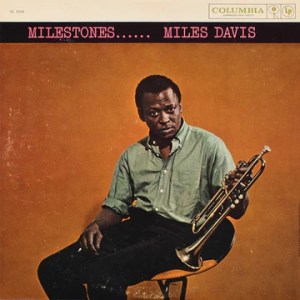
- Milestones appears on the site for only the second time ever, here with solid Double Plus (A++) sound or close to it throughout this vintage MONO 2-Eye pressing – exceptionally quiet vinyl too
- Huge amounts of three-dimensional space and ambience, along with boatloads of Tubey Magic (particularly on side two) – here’s a 30th Street recording from 1958 that demonstrates just how good Columbia’s engineers were back then
- Davis partners here with jazz greats, including John Coltrane, Cannonball Adderley and others
- Although the right 6-Eye mono originals will always win our shootouts, the 360 mono reissues still sound quite good to us, just not as good
- And don’t waste your money on most of the copies in clean enough condition to please an audiophile, meaning the reprocessed stereo pressings — they’re awful
- 5 stars: “What is immediately noticeable upon listening to Miles Davis’ classic first – and only – album with his original sextet is how deep the blues presence is on it. Though it’s true that the album’s title cut is rightfully credited with introducing modalism into jazz, and defining Davis’ music for years to come, it is the sole selection of its kind on the record. The rest is all blues in any flavor you wish you call your own.”
This vintage Columbia 2-Eye pressing has the kind of Tubey Magical Midrange that modern records can barely BEGIN to reproduce. Folks, that sound is gone and it sure isn’t showing signs of coming back. If you love hearing INTO a recording, actually being able to “see” the performers, and feeling as if you are sitting in the studio with the band, this is the record for you. It’s what vintage all analog recordings are known for — this sound.
If you exclusively play modern repressings of vintage recordings, I can say without fear of contradiction that you have never heard this kind of sound on vinyl. Old records have it — not often, and certainly not always — but maybe one out of a hundred new records do, and those are some pretty long odds.
What The Best Sides Of Milestones Have To Offer Is Not Hard To Hear
- The biggest, most immediate staging in the largest acoustic space
- The most Tubey Magic, without which you have almost nothing. CDs give you clean and clear. Only the best vintage vinyl pressings offer the kind of Tubey Magic that was on the tapes in 1958
- Tight, note-like, rich, full-bodied bass, with the correct amount of weight down low
- Natural tonality in the midrange — with all the instruments having the correct timbre
- Transparency and resolution, critical to hearing into the three-dimensional studio space
No doubt there’s more but we hope that should do for now. Playing the record is the only way to hear all of the qualities we discuss above, and playing the best pressings against a pile of other copies under rigorously controlled conditions is the only way to find a pressing that sounds as good as this one does.
Copies with rich lower mids and nice extension up top did the best in our shootout, assuming they weren’t veiled or smeary of course. So many things can go wrong on a record. We know, we’ve heard them all.
Top end extension is critical to the sound of the best copies. Lots of old records (and new ones) have no real top end; consequently, the studio or stage will be missing much of its natural air and space, and instruments will lack their full complement of harmonic information.
Tube smear is common to most vintage pressings. The copies that tend to do the best in a shootout will have the least (or none), yet are full-bodied, tubey and rich.
What We’re Listening For On Milestones
- Energy for starters. What could be more important than the life of the music?
- The Big Sound comes next — wall to wall, lots of depth, huge space, three-dimensionality, all that sort of thing.
- Then transient information — fast, clear, sharp attacks, not the smear and thickness so common to these LPs.
- Tight, full-bodied bass — which ties in with good transient information, also the issue of frequency extension further down.
- Next: transparency — the quality that allows you to hear deep into the soundfield, showing you the space and air around all the instruments.
- Extend the top and bottom and voila, you have The Real Thing — an honest to goodness Hot Stamper.
CBS 30th Street Studio
CBS 30th Street Studio, also known as Columbia 30th Street Studio, and nicknamed “The Church”, was an American recording studio operated by Columbia Records from 1949 to 1981 located at 207 East 30th Street, between Second and Third Avenues in Manhattan, New York City.
It was considered by some in the music industry to be the best sounding room in its time and others consider it to have been the greatest recording studio in history. A large number of recordings were made there in all genres, including Miles Davis’ Kind of Blue (1959), Leonard Bernstein’s West Side Story (Original Broadway Cast recording, 1957), Percy Faith’s Theme from A Summer Place (1960), and Pink Floyd’s The Wall (1979).
The Giants
- Bass – Paul Chambers
- Drums – Philly Joe Jones
- Piano – Red Garland
- Alto Saxophone – Cannonball Adderley
- Tenor Saxophone – John Coltrane
Side One
Dr. Jekyll
Sid’s Ahead
Two Bass Hit
Side Two
Milestones
Billy Boy
Straight, No Chaser
AMG 5 Star Rave Review
What is immediately noticeable upon listening to Miles Davis’ classic first — and only — album with his original sextet is how deep the blues presence is on it. Though it’s true that the album’s title cut is rightfully credited with introducing modalism into jazz, and defining Davis’ music for years to come, it is the sole selection of its kind on the record. The rest is all blues in any flavor you wish you call your own.
For starters, there’s the steaming bebop blues of “Dr. Jackle,” recorded in 1955 for a Prestige session with Jackie McLean. Davis is still in his role as a trumpet master, showing a muscularity of tone that reveals something more akin to Roy Eldridge or Louis Armstrong than Dizzy or Fats Navarro. The tempo is furious, as all the members of the sextet solo except for Jones. The saxophonists trade choruses and come off sounding like mirrored images of one another in the slower, post-bop blues that is “Sid’s Ahead,” which is followed by “Two Bass Hit,” written by Dizzy and John Lewis. It’s an off-kilter blues with a wide middle section, no doubt for Lewis’ piano to fill.
But then comes “Milestones” with its modal round and interval, where harmony is constructed from the center up. It is a memorable tune for not only its structure and how it would inform not only Davis’ own music, but jazz in general for the next seven years. The album’s closer is Monk’s “Straight, No Chaser,” which became a signature tune for the sextet even when Garland and Jones left to be replaced by Bill Evans and Jimmy Cobb, and later Evans by Wynton Kelly.