 Advice to Help You Make More Progress in Audio
Some audiophile reviewers opining at great length about the sound quality of various kinds of discs — both compact and vinyl — prefer to review only those that sound good to them and simply ignore the rest. (A small sample of the writings of one such reviewer can be found here on the blog, but there are doubtless others who follow the same approach.)
We think this does the audiophile community a disservice.
Needless to say, we see our role differently. Like Consumer Reports, we like to test things.
They test toasters, we test records. We put them through their paces and let the chips fall where they may.
They want to find out if the things they are testing offer the consumer good quality and value.
We want to find out if the records we are testing offer the audiophile good sound and music.
It takes a lot of people and a healthy budget to carry out large numbers of these kinds of tests.
No other record dealers, record reviewers or record collectors could possibly have auditioned more than a fraction of the records that we have. We’ve been looking for the best sounding pressings of records for a very long time, more than forty years.
Now, with a staff of ten or more, we can buy, clean and play records in numbers that are unimaginable for any single person to attempt.
That puts us in a unique position to help audiophiles looking for the highest quality pressings.
Yes, we have the resources, the staff and the budget. More importantly, we came up with a different approach.
We’ve learned through thousands and thousands of hours of experimentation that there is no reliable way to predict which pressings will have the best sound for any given album.
The impossibility of predicting the sound of records is one which we learned to accept as axiomatic. As a born skeptic, this was never difficult for me. Early on in my audio career, sometime in the ’80s, I realized it was self-evident.
The solution we put into practice given the nature of records comprises the four principles we adopted:
- We stopped pretending to know something that can’t be known.
- We stopped relying on theories proven to have very little if any predictive effect.
- We stopped relying on the experts and so-called authorities.
- We stopped assuming and speculating and, importantly, we stopped worrying about getting it wrong.
What remained was the simplest possible approach to the problem that would actually work. One that could be taught in a high school science class, if high school science classes were run by skeptical record collectors.
- Guess what pressings might be good for a given album.
- Buy some of those pressings.
- Clean them up, play them and see if your guess about the sound of the pressing turned out to be less true or more true.
- Repeat steps one through three with other pressings until you have found one that sounds markedly better than the others.
- Get hold of as many of those as you can, clean them up and play them against each other in a shootout.
- Continue to make other guesses and buy other pressings to play against the pressing you believe to be the best.
- Keep making improvements to your playback system and testing as many records as possible.
That’s it. Nothing to it. It all comes down to experimenting at scale.
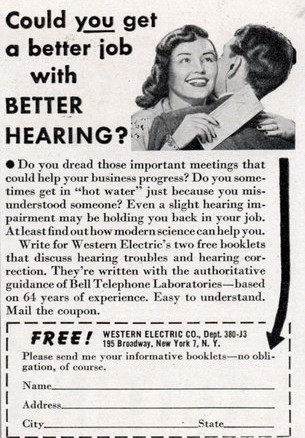 Edison is said to have failed 10,000 times before inventing a suitable filament for a light bulb that made it useful.
Most audiophiles do not have the time and money, not to say patience, needed to fail again and again this way and keep going. They tired of pushing one rock after another up the hill, and who can blame them? It’s tedious, hard work.
With our full-time staff of ten and a rather large record-buying budget, failures are common and nothing to be concerned about. They’re just part of the job.
Our successes pay for them, which is why our prices are as high as they are.
We don’t make a dime from writing about records that didn’t sound good to us. We review them on this blog as a service to the audiophile community.
We point out their shortcomings so that other audiophiles will know not to throw their money away on them the way we did.
Further Reading
- It ain’t easy being a one-man band
- How to go about collecting better sounding records
- These records helped us dramatically improve our playback
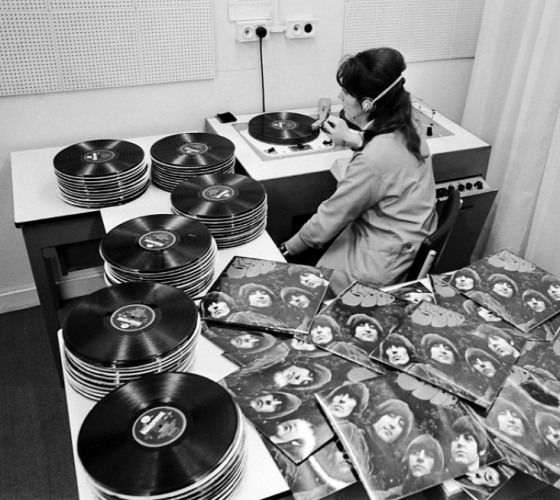
Which of these copies of Rubber Soul has the best sound I wonder?