
These Titles Are Good for Testing Presence in the Midrange
Many audiophile records suffer from a bad case of midrange suckout.
Vocals and other instruments seem to be so far back in the soundfield that they might as well be coming from another room.
Yet somehow there are still audiophiles who defend the records put out by the ridiculous label that single-handedly created and promoted that sound. What is wrong with these people?
(On a side note, yes, I was one of the audiophiles who fell for their phony EQ trickery in the 70s and 80s. In my defense, that was a long time ago.)
I Have a Theory
Actually, I have a good idea why so many so-called audiophile records have a sucked-out midrange.
A midrange suckout creates depth in a system that has difficulty reproducing it.
Imagine that instead of having your speakers pulled well out from the back wall the way you should, you instead have your speakers shoved flat up against that wall.
This arrangement has the effect of seriously limiting your speakers’ ability to reproduce the three-dimensional space of the recordings you play.
Kind of Blue on MoFi
I hinted back in 2022 I was going to discuss their pressing down the road, and like most things that I was supposed to write about down the road, we’re still waiting to see it.
The short version of that future commentary will note that the drums in the right channel of All Blues are about five feet further back in the soundfield than they are on our reference too-noisy-to-sell Six-Eye pressing, or any other pressing of the album we’ve played for that matter.
At the time I could not wrap my head around how Mobile Fidelity could have gotten hold of the multi-tracks in order to remix the album and place the drums further back in the mix.
My-fi Again?
I’m convinced now that it’s just an effect of their standard approach to mastering — sucking out the midrange — which they apparently find pleasing on speakers they have probably placed too close to the back wall.
If their speakers are not shoved up against a wall, perhaps they just like the sound of a lot less presence and a lot more depth in their recordings.
Whatever they’re doing, and however they’re doing it, the result is a sound they have created because they like it.
There is a well-know audiophile reviewer — a really well-known audiophile reviewer — who not only has his ginormous speakers placed too close to the back wall. He also has them shoved into the corners.
As you might have predicted, he has been overly fond of the records Mobile Fidelity has been putting out for years. For an especially embarrassing example, click here.
Until this very moment I have always been at a loss to understand why, but things are starting to make more sense to me now.

The front of the speakers, where the drivers that actually produce the soundwaves are located, are at least six feet from the back wall in our new studio.
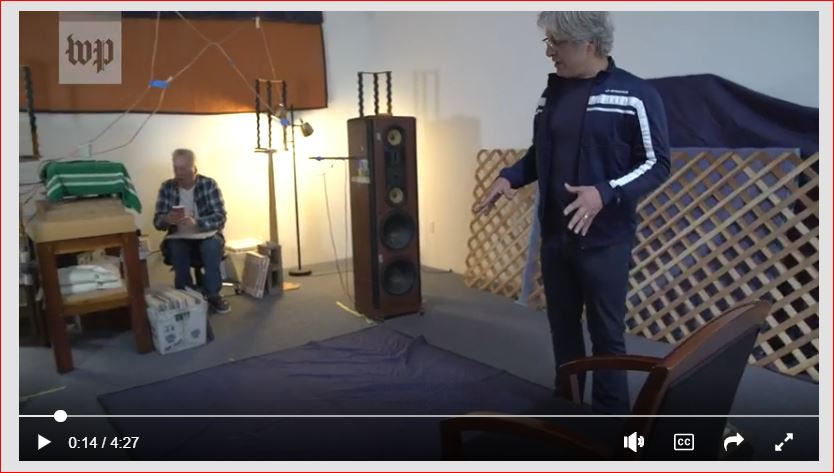
Plenty of space to walk around, as you can see. Nothing near the listening chair either, a big help.
Don’t you just love those 4×8 sheets of wooden lattice leaned up against the wall?
Wouldn’t you like to have some in your listening room?
Go for it. They’re cheap and they work like a charm. The sound-absorbent moving blankets behind them are key to dealing with reflections from the side walls, so be sure to experiment with those as well.
Further Reading
Tom, I used to cherish my MoFi records. They sounded astonishingly good on my former system (Clearaudio turntable, tube preamp, McIntosh amp, B&W speakers). The sound was full, and they always played well – somehow they are able to make them super-easy to track. It wasn’t until I bought my first record from you that I realized ordinary pressings can sound so much better. It did not take long for me to recognize that mofi (and other audiophile) pressings lack naturalness, and ultimately I find them less engaging. I hop up and do something else while the music’s still playing. I kept playing the mofis, though, since they made my system seem so good. What really made it possible for me to move on was learning that they are digitally sourced, and furthermore, how difficult it is to press records in any meaningful quantity anymore without using a digital step in the process. If it’s passed thorugh a digital bottleneck at some point, then why not just stream it, I figure.
Aaron,
The MoFi pressings made back when I was buying them had no digital in them, and for the most part they had the kind of sound you decry.
We like to put it this way: digital is not the problem. Digital is one problem among many, and the many problems these audiophile pressings have far outweigh the shortcomings a digital step would add.
We also like to say that “Good digital beats bad analog any day of the week.”
Best, TP