rimskscheh

What We Think We Know about Scheherazade

More of the music of Rimsky-Korsakov (1844-1908)

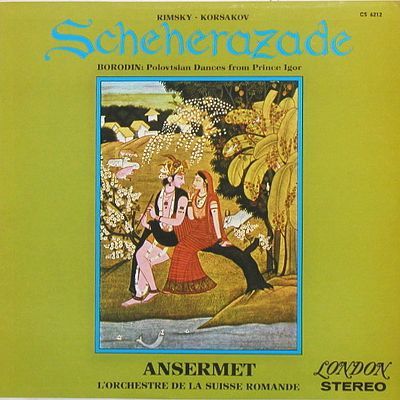
Our Favorite Performance of Scheherazade – Ansermet with the Suisse Romande

This post was written in 2014 or so. It’s the story of the breakthrough pressing we discovered that year.

I attended the Dec. 2013 performance of the work at the Disney Hall. Pictured is Mr de Burgos conducting. It was a thrill like no other. (Well, maybe The Planets.)

“Guest conductor Rafael Frühbeck de Burgos’s attention to detail delivers the razzle dazzle and also discovers renewed radiance in ‘Scheherazade.'”

We did a monster shootout for this music in 2014, one we had been planning for more than two years. On hand were quite a few copies of the Reiner on RCA; the Ansermet on London (CS 6212, his second stereo recording, from 1961, not the earlier and noticeably poorer sounding recording from in 1959); the Ormandy on Columbia, and a few others we felt had shown potential.

The only recordings that held up all the way through — the fourth movement being THE Ball Breaker of all time, for both the engineers and musicians — were those by Reiner and Ansermet. This was disappointing considering how much time and money we spent finding, cleaning and playing those ten or so other pressings.

Here it is a year later and we’re capitalizing on what we learned from the first big go around, which is simply this: the Ansermet recording on Decca/London can not only hold its own with the Reiner on RCA, but beat it in virtually any area. The presentation and the sound itself are both more relaxed and natural, even when compared to the best RCA pressings.

The emotional content of the first three movements (all of side one) under Ansermet’s direction are clearly superior. The roller coaster excitement Reiner and the CSO bring to the fourth movement cannot be faulted, or equaled. In every other way Ansermet’s performance is the one for me.

Both Sides

Superb! Big brass, so full-bodied and dynamic, yet clear and not thick or overly tubey. Lots of space as is usually the case with Ansermet’s recordings from this era.

Both sides here are BIG, with the space and depth of the wonderful Victoria Hall that the L’Orchestre De La Suisse Romande perform in. As a rule, the classic ’50s and ’60s recordings of Ansermet and the Suisse Romande are as big and rich as any you’ve heard. On the finest pressings (known around these parts as Hot Stampers) they seem to be the ideal blend of clarity and richness, with depth and spaciousness that will put to shame 98% of the classical recordings ever made.

The solo violin is present and so real you will have a hard time believing it.

This copy is huge in every dimension, just as all the best ones always are, with maximum amounts of height, width, and depth. The transparency is also superb — you really hear into this one in the way that only the best Golden Age recordings allow.

(more…)

A Simple Listening Test Makes It Easy to Judge Pressings of Scheherazade

Hot Stamper Orchestral Pressings Available Now

The Classic reissue of LSC 2446, as well as the Analogue Productions version from 2013 (the original 33 is the only one I have played, mastered by Ryan Smith at Sterling), are both disasters for many reasons, but they do have one specific failing that is easy to recognize.

Both pressings are worth further discussion and analysis because they provide an easy test that can show you how wrong they are.

When reading the commentary below, keep in mind that what is bad about the Classic Records reissue from 1995 is what is bad about the Analogue Productions remaster put out many years later.

As I noted for some of the Classic Heifetz titles a while back, for all I know the CDs for his Living Stereo recordings may have better sound. That’s probably the first place to go, considering Classic’s rather poor track record regarding the remastering of his music.

Case in point: The Living Stereo CDs I own (both the CD and the SACD) of Scheherazade are dramatically better than the awful Classic Records pressing of it.

Audiophiles who don’t notice what is wrong with the Classic pressing need to get hold of a nice RCA White Dog pressing to see just how poorly the Classic stacks up. (They could even find one that’s not so nice and listen through the surface noise. The difference would still be obvious.)


UPDATE 2025

It has been many years since a White Dog pressing won a shootout. In our last listing for a Hot Stamper White Dog pressing in 2024, we noted:

Now that we know which stampers have the potential to win our shootouts, the right Shaded Dog originals have lately been coming out on top, although the White Dog pressings can still sound quite good, just not as good.

No White Dog earned a higher grade than 2+, and none of the three WD pressings we had on hand earned 2+ on both sides.

Our notes for the various sides of the WD pressings read: “a bit brash, sometimes squawky, dry and bright,” and the like.

Those of you looking for the best sound should stick to the Shaded Dog label originals. They are rich and lush in a way that the WD reissues in our experience never are. I used to swear by the WD reissues, but I see now how wrong I was. My judgments were colored by a darker, less revealing stereo than the one we use now, and that makes all the difference in the world.


Back to LSC 2446

The solo violin in the left channel at the opening of the first movement should be all it takes to hear what is wrong with the modern remastered pressings.

Anyone has ever attended a classical music concert will have no trouble recognizing that the violin on any of the Heavy Vinyl pressings, including the Analogue Productions pressing, is completely wrong and sounds nothing like a violin in a concert hall would ever sound.

And I mean ever.

No matter where you might be sitting.

No matter how good or bad the hall’s acoustics.

The violin on these Heavy Vinyl pressings is dark, it’s veiled, and it’s overly rich, as well as lacking in overtones.

Solo violins in live performance never sound like that.

They are clear, clean and present. You have no trouble at all “seeing” them, no matter where you sit.

(more…)

Who Can’t Hear Differences in Sound from Side to Side on Most Records?

rimskscheh_2446Hot Stamper Pressings of the Music of Rimsky-Korsakov Available Now

Both the Chesky [1] and Classic reissue pressings of LSC 2446 are just plain terrible. Embarrassingly, the latter is found on the TAS List.

There is a newly [2013, time flies!] remastered 33 RPM pressing of the album garnering rave reviews in the audiophile press. We didn’t like it either. It fails the violin test that we wrote about here.

Please note that in many of the reviews for the new pressing, the original vinyl used for comparison is a Shaded Dog pressing. In our experience almost no Shaded Dog pressings are competitive with the later White Dog pressings, and many of them are just plain awful, as we have noted previously on the site.


UPDATE 2024: Now that we know which stampers have the potential to sound the best in our shootouts, the Shaded Dog originals have lately been winning top honors, although the White Dog pressings can still sound quite good, just not as good.


rimskscheh_chesky

The “original is better” premise of most reviewers renders the work they do practically worthless, at least to those of us who take the time to play a wide variety of pressings and judge them on the merits of their sound, not the color of their labels.

[A fairly embarrassing example of live and learn.]

Missing the Obvious

The RCA White Dog with the best side two in our shootout had a very unmusical side one. Since reviewers virtually never discuss the sonic differences between the two (or more) sides of the albums they audition, how critically can they be listening? Under the circumstances how can we take anything they have to say about the sound of the record seriously?

The sound is obviously different from side to side on most of the records we play, often dramatically so (as in the case of Scheherazade), yet audiophile reviewers practically never seem to notice these obvious, common, unmistakable differences in sound, the kind that we discuss in every listing on the site. If they can’t hear the clear differences in sound from side to side, doesn’t that call into question their abilities at the most basic level?

(more…)

We Heap Scorn Upon Chesky Records, With Good Reason

More of the music of Rimsky-Korsakov (1844-1908)

Sonic Grade: F

Chesky is one of the WORST AUDIOPHILE LABELS in the history of the world. Their recordings are so artificial and “wrong” that they defy understanding. That some audiophiles actually buy into this junk sound is equal parts astonishing and depressing.

Their own records are a joke, and their remasterings of the RCA Living Stereo catalog are an abomination.

The best RCA Living Stereo pressings are full of Tubey Magic. The Chesky pressings I have played have none.

What else would you need to know about their awful records than that?

If there is a more CLUELESS audiophile label on the planet, I don’t know what it could be, and I don’t want to find out. 

(Turns out there is someone producing the worst kind of remastered junk vinyl who may be even more clueless than Chesky, imagine that!)

Scheherazade Is a Classic Records Disaster

Hot Stamper Pressings of the Music of Rimsky-Korsakov Available Now

An audiophile record hall of shame pressing and a Heavy Vinyl disaster poorly mastered for the benefit of audiophiles looking for easy answers and quick fixes.

In 2009 or 2010, during our testing of the TT Weights turntable products, the record I played again and again — close to a hundred times over the course of two days — was a wonderful White Dog pressing of LSC 2446. The sound was glorious, some of the finest reproduction of a large orchestral work I have ever heard.  

(Late in life, Harry Pearson disgraced himself by putting this Classic Record on his TAS list of Super Discs.)

A week later I was still testing the system, and again using Scheherazade. A friend brought over his Classic pressing, probably the same one I would have sold him in the mid-90s. Now we could compare the two.

It was a massacre. The sound on the reissue is simply AWFUL.

There is no transient information anywhere on that Heavy Vinyl pressing whatsoever.

No instruments have any texture — not the strings, not the woodwinds, nothing.

There is no air going through the flutes.

There is no rosin on the bow of the solo violin.

The tympani are a blurry mess.

Triangle: okay.

Bass drum: okay.

Everything else: FAIL.

Not having played it in years, I could not believe how much worse the record sounded than I remember. The gulf between the real thing and the Classic wannabe was now so huge that the reissue was nothing less than positively UNPLEASANT to listen to.

Enjoyment? Out of the question.

TAS List? The original is, but the Classic is too. Now how messed up is that?

Disgraceful, that’s all I have to say about it.

If I were in charge of the TAS Super Disc list, obviously I would not have put this record on it.

Here are some others that we do not think qualify as Super Discs.

Here are some Hot Stamper pressings of TAS List titles that actually have audiophile sound quality, guaranteed.

And if for some reason you disagree with us about how good they sound, we will be happy to give you your money back.

Our favorite performance of Scheherazade is Ansermet’s with the Suisse Romande from 1961.

(more…)

Allow Us to Make the Case that Even CDs Have Better Sound than Classic’s Vinyl

brahmvioli_1903_debunk

Hot Stamper Classical and Orchestral Pressings Available Now

The Classic reissue of LSC 1903 is a disaster: shrill, smeary and profoundly unmusical.

In these four words we can describe the sound of the average Classic Records Living Stereo pressing.

The best Heifetz records on Classic were, if memory serves, LSC 2734 (Glazunov), LSC 2603 (Bruch) and LSC 2769 (Rozsa).

They aren’t nearly as offensive as the others, and one is actually quite good. If you can pick one up for ten or twenty bucks, you might get your money’s worth depending, I suppose, on how critically you listen to your classical records.

The CDs are better for all I know. That’s probably the first place to go, considering Classic’s generally poor track record.

(more…)

Neither the Sound Nor the Performance Here Make the Grade

Hot Stamper Pressings of the Music of Rimsky-Korsakov Available Now

In our experience this is not the recording of the work to buy, on either Decca or London. Of the two recordings by Ansermet, we much prefer the one made with the Suisse Romande in 1961 to that of the one he recorded with the Paris Conservatoire in 1954 (which was his second recording of the work with them).

We did a monster shootout for this music in 2014, one we had been planning for more than two years. On hand were quite a few copies of the Reiner on RCA; the Ansermet on London (CS 6212, his second stereo recording, from 1961, not the earlier and noticeably poorer sounding recording from in 1959); the Ormandy on Columbia, and a few others we felt had shown potential.

The only recordings that held up all the way through — the fourth movement being THE Ball Breaker of all time, for both the engineers and musicians — were those by Reiner and Ansermet.

This was disappointing considering how much time and money we spent finding, cleaning and playing those ten or so other pressings.

Here it is a year later and we’re capitalizing on what we learned from the first big go around, which is simply this: the Ansermet recording on Decca/London can not only hold its own with the Reiner on RCA, but beat it in virtually any area. The presentation and the sound itself are both more relaxed and natural, even when compared to the best RCA pressings.

The emotional content of the first three movements (all of side one) under Ansermet’s direction are clearly superior. The roller coaster excitement Reiner and the CSO bring to the fourth movement cannot be faulted, or equaled. In every other way Ansermet’s performance is the one for me.

There are other Deccas and Londons that we’ve cleaned and played recently that were disappointing, and they can be found here.

Our Pledge of Service to You, the Discriminating Audiophile 

(more…)

Our Scheherazade Shootout Winner from Long Ago

Hot Stamper Pressings of the Music of Rimsky-Korsakov Available Now

UPDATE 2024

Our favorite Scheherazade for about the last 10 years or so has been the one Ansermet conducted for Decca in 1961.

This review was written long before we discovered how good the Ansermet could be, when you find one with the right stampers. We started to get a clue in 2015. By 2019 we were sure of our findings.

In 2015 we still  had a lot to learn, even though we had been playing this wonderful piece of music on vintage vinyl since the early-90s. (I’m quoted about my preference for certain pressings of LSC 2446 in The RCA Bible, which was published in 1993. Don’t believe anything you read in it though, at least whatever is attributed to me. I was as lost as everybody else in audio back in those days.)

Clearly we needed to do more research and development,


Our Review from Then

White Hot on Side One! Big brass, so full-bodied and dynamic. The solo violin is present and so real you will not believe it. The highest resolution we have ever heard for this performance. Hard To Fault (HTF). 

This copy is huge in every dimension, just as all the best ones always are, with maximum amounts of height, width, and depth. The transparency is also superb — you really hear into this one in the way that only the best Living Stereos (and other golden age recordings) will allow. (more…)