bright-sound

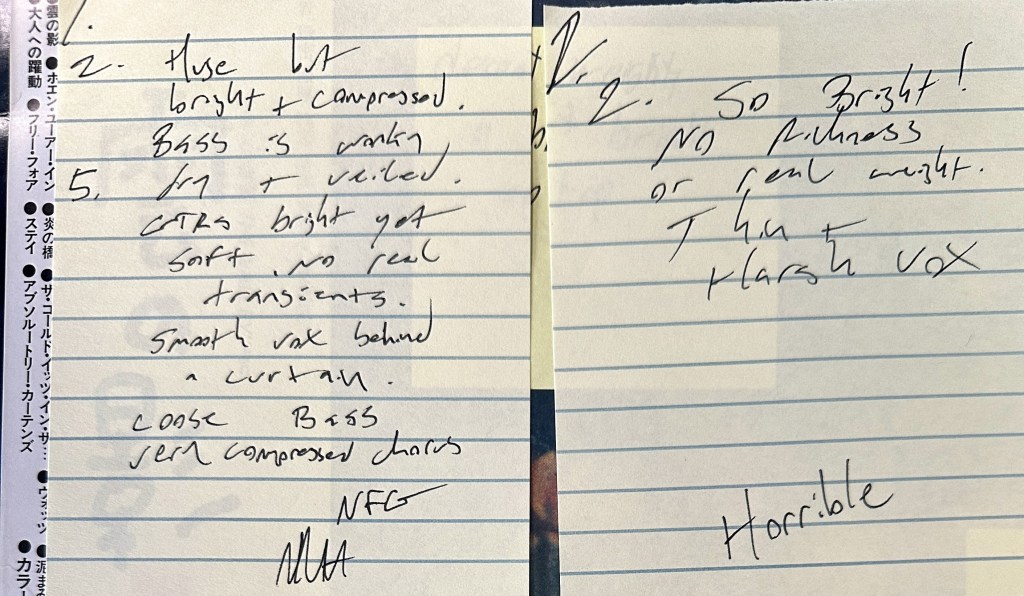
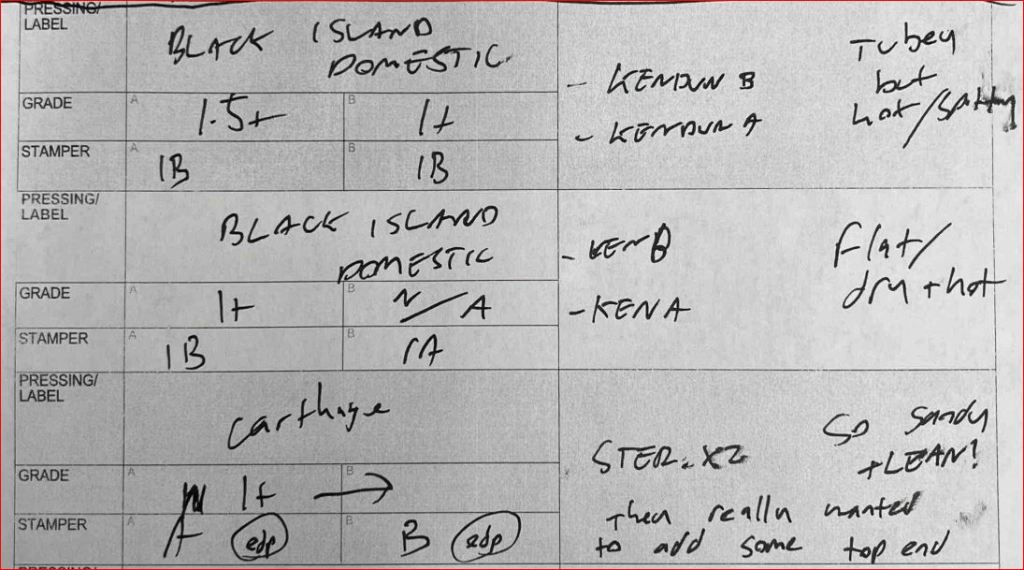
Below you will find a small sampling of records we played that we found to be too bright.

Keep in mind that the modern Heavy Vinyl reissue consistently has the opposite problem. They are almost always overly smooth and dull, displaying a frustrating and irritating lack of presence and clarity in the upper-midrange. The new Beatles remasters are the perfect example of just what a bad idea it was to boost the bass and cut the highs on their albums. They sound nothing like the ones we offer as Hot Stampers.

Our Hot Stamper Beatles pressings are as tonally correct as any that have ever been produced, yet they do not lack for clarity and presence in the least. Correct tonality is fundamental to the sound of our Hot Stamper LPs.

Porgy and Bess Gets the Speakers Corner Treatment, from Sterling No Less

Hot Stamper Pressings of Pop and Jazz Vocals Available Now

Here is how we described a recent Shootout Winning copy of Porgy and Bess.

Spacious, full-bodied and Tubey Magical, with Ella and Louis front and center, this is the sound you want to hear on their brilliant collaboration from 1958.

Two vocal giants came together to perform Gershwin’s timeless opera, revered by both music lovers and audiophiles to this day. If you’ve never heard exceptionally well recorded male and female vocals from the 50s, this is a great opportunity to have your mind blown.

Speakers Corner contracted Ryan Smith at Sterling to remaster their Heavy Vinyl pressing in 2013, which might sound like a wise move — Sterling has a good reputation around these parts, even if RKS does not — but the results were disastrous.

Or maybe it wasn’t such a good idea after all. Our notes tell the story of the sound, and it’s not pretty. Painful is actually the word that comes to mind.

Pity our poor listening panel that had to sit through a record that sounds as bad as this one does.

(This is a four sided set but we could not see the point in playing all of them when the first two sucked so badly.)

(Technically they don’t “have to” play these Heavy Vinyl pressings. We don’t force our talented staff to waste their time on modern records. They do it because they choose to, in order to have a better idea of what the competition is up to. Turns out the competition is up to no good.)

Our two sentence review should tell you everything you need to know. Let us hope it saves you from throwing your money away the way we did.

  • Loud, dry and pinched.
  • Hot vocals, no space, very sour and lacking bass.

When the voice is wrong, the sound is wrong. What more do you need to know?

And when the voice is wrong on a legendary recording such as this, you have a worthless piece of vinyl no matter how much you may have paid for it. (Current price on Discogs: about a hundred bucks.)

(more…)

Universal Japan and the Economics of Buying a Pig in a Poke

Skeptical Thinking Is Critical to Finding Better Records

One of my good customers sent me this email shortly after this series came out, circa 2000:

I noticed that Universal Japan has come out with several new titles, stuff I’m interested in, like Stevie Wonder / Innervisions… Stan Getz, James Brown… and many others — that are on acousticsounds.com.

Generally, for these somewhat expensive heavy vinyl releases (relative to used prices), I’m trying to stick with stuff where your site has favorable comments regarding the sound quality, but you don’t seem to carry these new items.

Do you think they are bad, or you just have not had a chance to check them out yet?”

I replied as follows:

We have a longstanding antipathy toward records pressed in Japan that were not recorded in Japan. (Here is one of the exceptions because the mastering was done by the real mastering engineer, using the real tape, here in America. There are also some excellent direct to disc albums that were recorded here in the states and subsequently pressed in Japan.)

Japanese pressings almost NEVER sound good to these ears. The only report I’ve heard concerned Aja, which was that it was awful, bright as bright can be.

A Japanese pressing that’s too bright? Shocking. Say it isn’t so.

We are going to be carrying almost no new releases of Heavy Vinyl pressings from now on.

They just don’t sound good to us and we don’t want to waste our time playing bad records when there are so many good ones sitting around that need a loving home.

If you pay $30 for Heavy Vinyl reissues and only one out of five sounds good — an optimistic estimate if you ask me — you’re really paying $150 for the one good one, right?

This makes no sense to me. And since the real odds are one out of ten, it’s really $300 for the good one.

(more…)

With The Beatles on Mobile Fidelity

Sonic Grade: C+

The MoFi pressing of With the Beatles has so many problems it would take an hour to describe them all. Suffice it to say, it’s thinner and brighter, with voices that are grittier and grainier. The overall effect is the sinking feeling that you are listening to a cheap reissue and not the real thing. Don’t the Beatles sound better than this? To be fair, some tracks are okay, others a disaster.

If you own the MoFi, play it. Listen to it carefully. Make notes of which songs sound better than others and why. That’s how we spend our days, evaluating the relative merits of various pressings, and it’s that and that alone that has given us the critical listening skills necessary to recognize and appreciate the differences among the records we play.

One of the biggest problems with the average Parlophone copy is just the reverse of the MOFI. They tend to have rolled off highs, which emphasizes the harshness in the upper midrange and causes a loss of transparency. (The best Hot Stamper copies are of course as smooth, sweet, and transparent as they come.) Even with those shortcomings though, I would still rather listen to a typical Parlophone pressing. I wouldn’t be frustrated by the sound of somebody fooling with the EQ and screwing it up.  (more…)

Could This Be More of the Sound Audiophiles Complain About with RVG’s Mastering?

Hot Stamper Pressings of the Music of John Coltrane Available Now

Some of the Rudy Van Gelder cuttings of this album were decent, but had you bought a copy with these stampers, you could be forgiven for using the man’s name in vain.

VAN GELDER in the dead wax is no guarantee of high quality sound, on any record. Records don’t work like that.

The 1+ grade found on side one of both discs means the sound for those two sides may be passable, but the NFG sound on side two of record one means you have at best only half an album with decent sound, and what good is that?

As you can see from our notes, the sound is way too hot and messy and thin.

Note that side two of the second record wasn’t played at all. Why waste more time on a record that clearly did not come off the press properly, whether from bad mastering or bad vinyl? Or bad something else, who can say?

We do not sell records with 1+ grades. You should have no trouble finding those on your own. The world is full of them.

Poor Rudy

Rudy Van Gelder comes in for a lot of criticism from the audiophile community, especially from audiophiles who tend to prefer the remastered Heavy Vinyl pressings made from his recordings.

Unsurprisingly, much of the criticism comes from some of the very same engineers responsible for the remastering those records.

Those who produce reissues of his recordings are notable critics as well.

(more…)

Soultrane Sucks on the Early OJC

Hot Stamper Pressings of the Music of John Coltrane Available Now

The early OJC reissues from 1982 of this title are awful.

And whatever Heavy Vinyl they’re churning out these days is probably every bit as bad, but — I’m guessing, never played one so don’t hold me to it — in the opposite way.

The OJC is thin and bright, and the modern reissue (I’m assuming, based on playing scores of them) is probably thick, veiled, overly smooth, lacking in space and boosted in the bass — because that’s the sound that audiophiles record buyers seem to like these days.

Without the excellent sounding 60s and 70s reissues that we are still able to find in audiophile playing condition, all that we would have available to buy for our shootouts would be the originals. 

At the big bucks those records go for nowadays, shootouts would be impossibly expensive.

So our thanks go to Rudy for doing a good job on these later pressings!


UPDATE 2025

We were surprised to find that the right stampers on the new OJC pressings can have very good sound. Click on the link below to that Soultrane has joined the group of good sounding modern OJC pressings.

(more…)

Led Zeppelin on Prestigious Japanese Limited Edition Vinyl

Hot Stamper Pressings of the Music of Led Zeppelin Available Now

A classic case of live and learn. In 2006 I finally woke up to how ridiculously bad these Japanese pressings I was selling back in the 90s actually were.

It’s what real progress in audio is all about, in this case about ten years’ worth. Those are ten years that really shook my world, and by 2007 we had discovered much better cleaning technologies and given up on Heavy Vinyl and audiophile bullshit pressings such as these, whew!

Our story from 2006:

I used to sell the German Import reissues of the Zep catalog in the 90s. At the time I thought they we’re pretty good, but then the Japanese AMJY Series came out and I thought they were clearly better.

I couldn’t have been more wrong. I now realize those Japanese pressings are bright as bright can be. Now, not-too-surprisingly, the German pressings sound more or less right (on some of their titles).

They tend to be tonally correct, which is more than you can say for most Zep pressings, especially some of the Classics [linked here], which have the same brightness issue (as well as many other problems).


UPDATE 2024

Only one of the German-pressed Zeppelin records is good enough to win shootouts, the only title of theirs on German vinyl that we buy these days. Of course we tried them all, at no small expense I might add, because there were a great many pressings cut by many different engineers over the course of decades that were pressed in Germany, and the only way we could judge them was to buy them and have them shipped over. In the end only one had the big, bold, dynamic sound we were after.

(more…)

“KEV” Didn’t Have a Clue How to Master Teaser and the Firecat

Hot Stamper Pressings of the Music of Cat Stevens Available Now

In 2025, in preparation for a new shootout, we ordered a copy of Teaser from overseas that supposedly had the right stampers — we know what they are and we are only interested in copies with the right ones — and were sent this “KEV” pressing by accident.

Accident is right — whoever KEV is, he sure has no business mastering records if the one we played is anything to go by.

Discogs has an entry for it, current price around $10. (Apparently the word got out about the sound of this miserable pressing.)

  • This release is the pink ring Island Label. No Sterling etchings. (KEV) in matrix.
  • Side 1 has 9514 hashed out and 9154 etched above
  • Matrix / Runout (A-side runout. etched): ILPS 9154A-1K 1 KEV B
  • Matrix / Runout (B-side runout. etched): ILPS 9154B-1K 1 KEV B

Our notes read:

  • Loud, congested and hot.
  • Big, wonky bass.
  • Opaque and so compressed that it pumps.

And the best line of all:

  • Not too different sounding from the 2021 remaster that’s on Spotify. (!)

I looked up that 2021 release, mastered at Abbey Road Studios, and it appears they remixed it for some reason, as those who work at Abbey Road are wont to do, the result of which seems to be one disaster after another.

(more…)

There’s a Very Good Chance We Were Wrong about Mulligan Meets Getz

More of the Music of Stan Getz /More of the Music of Gerry Mulligan

This is an album that we were probably wrong about in 2021 when the following Hot Stamper two-pak pressing went up for sale on the site. (The pressings we liked at the time are long gone by now.) Here is what we wrote back then:

Mulligan and Getz’s 1957 collaboration arrives on the site with this superb 2-pack offering Nearly Triple Plus (A++ to A+++) sound on both sides – just shy of our Shootout Winner

Full, rich, and spacious with tons of Tubey Magic and, better yet, not the least bit dry, hard or transistory

Practically impossible to find in stereo with audiophile playing surfaces – it took two different pressings to get two good sides, and they are very good indeed

The reissues we discovered in 2025 trounced the originals (in both stereo and mono) as well as the early reissues (on the Verve T Label) we played in our shootout, as you can see from the stamper sheet notes below:

Our mistaken judgment is simply the result of ignorance. In 2021 we simply had no idea just how good this recording could sound on vintage vinyl. We hadn’t done our homework properly, and because of that we came up with the wrong answer.

We only discovered the right pressings, with the right stampers, pressed in the right era, and mastered by the right guy, sometime in 2024 or so. We bought a bunch of those and in 2025 did the shootout with all kinds of copies, just to keep everybody honest.

That was the year much better sounding reissue copies that look like the one you see on the left came along. As we noted in the listing:

  • Leave it to Better Records to figure out a complicated title with a long history such as this one – originals, reissues, monos, stereos, we had to play them all to find a copy that sounds as good as this one does.
  • Full, rich, and spacious with an abundance of Tubey Magic and, better yet, not the least bit dry, hard or transistory.

Some quick notes:

Bowtie Label Stereo

  • Veiled and dry
  • Tons of reverb
  • 1.5+ at best (a good, not great Hot Stamper grade)

Our understanding is that Steve Hoffman chose to use the mono tapes as the source material for his DCC Gold CD because he felt there was too much reverb on the stereo tape. We heard too much reverb too.

What tapes our wonderful sounding reissues are made from we have no way of knowing. They do not suffer from too much reverb, that much we can tell you. The best pressings we offer sound great, and quite a bit better than any Gold CD will. However, if money is tight, the Gold CD is not a bad way to go for this music.

T Label Stereo

  • Dry, some squawk
  • 1+, what we would call passable sound

Mono Early Pressings

  • Rich but hot horns
  • 1.5+ at best

Lessons Learned

In this case, the conventional wisdom that the stereo originals would be the best sounding turned out to be incorrect.

Our lengthy commentary about conventional wisdom seeks to make the case that, although the most common record collecting approaches are more often right than wrong, there is simply no way to know what approach — original versus reissue, import versus domestic, mono versus stereo — will work the best for any given title.

(more…)

So You Actually Think an OJC Can Beat an Original Black Label Contemporary?

Hot Stamper Pressings of Contemporary Jazz Albums Available Now

Yes, we think that, because that’s what the evidence from our most recent shootout in 2025 showed us.

As you can see from the stamper sheet below, the A1/B2 stampers of our OJC, in a blinded test, came out on top.

Better mastering equipment? Better mastering skills? Better vinyl? Better pressing methods?

Who the hell knows?

Better yet, what audiophile or record collector with a lick of sense would even pretend to know?

Not us, that’s for sure. At this point we are very comfortable not having answers for the unanswerable questions we posed above.

But don’t rush off to buy the OJC of the Sonny Rollins record you see pictured. This commentary has nothing to do with that record. For now we’re keeping the title a mystery, consistent with the idea that we give out lots of the bad stampers on this blog, but rarely do we give out the good ones. (That said, here are some of the stampers that win shootouts, and we expect to be posting more soon, mostly for records we can no longer do shootouts for due to: 1.) a lack of interest, or 2.) unacceptably high costs for the best pressings, or 3.) or the fact that we are simply unable to find pressings that play quietly enough for audiophiles.)

So why is it that you can’t tell us the title of this record?

The cost of discovering the right stampers (aka R&D) is usually high, can sometimes take decades, and is fundamentally at the heart of how we make our money: by taking pressings we hope to be good, cleaning them up, playing them, and offering only those that actually do sound good, regardless of when they were made, who made them or why.

Once the shootout is done, the time for hoping and guessing is over. We have the evidence, and in our world that is the only thing that counts. That evidence may be provisional — we could prove ourselves wrong with the next shootout, and there have been times when that has happened — but for now this is the best information we have to work with.

Key Takeaways for this Mystery Record

  • We did not have enough copies with the right stampers to find a 3+ side two. (The other copies earned grades of no better than 2+/2+.)
  • Which simply means that if we’re not hearing faultless or nearly-faultless sound on one side or another, the sound is not White Hot and does not deserve a 3+ grade. Fair’s fair after all.
  • The original pressing you see with D2/D4 stampers had some of that “old record” sound we find on far too many vintage pressings.
  • True, it was very big and full, but lacked top end, causing, among other things, the horns to get hot and hard.
  • Who wants to listen to a Sonny Rollins famous classic jazz record with horns that don’t sound right?

(more…)

Does 1s Sound Great or Does It Sound Good (but Hot, Dry and Crude)?

Hot Stamper Pressings of Living Stereo Recordings Available Now

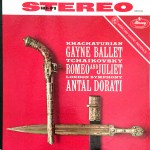
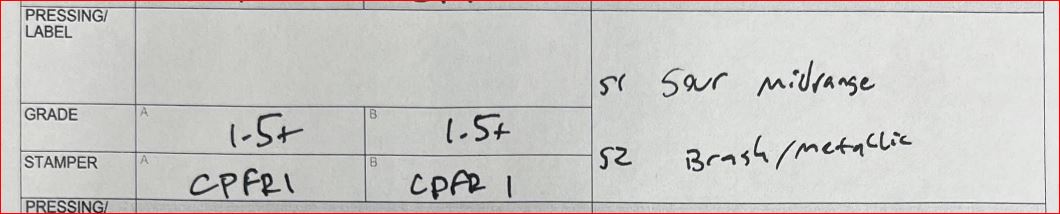
Below you will see the complete stamper sheet for a shootout we did recently.

Note that the album you see pictured is not the record we did the shootout for.

We are not revealing what record had these stampers and earned these grades for the simple reason that we rarely if ever give out the specific information that identifies the best sounding pressing of any album.

As I’m sure you can understand, we want you to buy the copy with the Hottest Stampers from us, not find one on your own! We’re happy to be moderately helpful, but naturally we find it necessary to draw the line somewhere, and giving out “the shootout winning stampers” is where we choose to draw it.

How Come?

Since, as we discovered recently, 1s wins, and handily, why would any 1s pressing sound as bad as the one at the bottom does?

(Which by the way is not actually bad — just far from the best.)

If the 1s wins the shootout as it did here, that means that the received knowledge about RCA Living Stereo pressings being better on the first pressing is correct.

But if you are the unlucky buyer of the 1s that did not do nearly as well, you might say to yourself “Hey, I thought the 1s pressing was supposed to be the hot ticket. Wha’ happen?” (Assuming you don’t conclude that the recording is at fault, which is what most audiophiles and record collectors would be likely to do. I did it and I bet you did too.)

We noted in a commentary from many years ago that the record collecting theories we see commonly promoted by those who consider themselves “in the know” seem to have a great deal of trouble accounting for these anomalies.

We had two copies of Court and Spark, each with one good side opposite a bad side on the same pressing. An excerpt:

(more…)