Jazz LPs to Improve Your Playback

Dexter Gordon Knocked Us Out Back in 2007

Hot Stamper Pressings of Blue Note Albums Available Now

UPDATE 2026

In 2007 we had a low opinion of both the Blue Note label and the work of Rudy Van Gelder, but that changed over the decades as we auditioned more and more of his amazing recordings, many of them reissues of one kind or another.

(Some text has been altered, mostly the overuse of capitalization.) Our latest review for One Flight Up can be found here.


Our 2007 Commentary

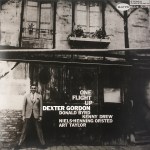
This Blue Note LP is without a doubt one of the best sounding jazz records we’ve ever heard. We were auditioning a bunch of jazz records today (4/25/07), and when the needle hit the grooves on this one we were absolutely blown away.

I can’t think of one jazz record we’ve ever played here at Better Records with this kind of whomp. Everything here is so rich and full — nothing like a typical Blue Note album.

(more…)

Listening in Depth to Heavy Weather

Hot Stamper Pressings of the Music of Weather Report Available Now

Heavy Weather has some of the biggest, boldest sound we’ve ever heard.

It’s clearly a big speaker Demo Disc. Play this one as loud as you can. The louder you play it, the better it will sound.

The commentary below contains track-by-track advice on what to listen for when auditioning the album.

Side One

Birdland

Not an easy track to get right; there’s so much upper midrange and high frequency information to deal with. If the synthesizers and horns are too much, the effect is exciting but won’t wear well. Too much 6k is the problem on most copies, along with not enough above 10. That is a deadly combination.

A Remark You Made

Such an original composition. This is the band at their unconventional, uncommercial best.

(more…)

Bashin’ Is a Good Test for Setup, Tweaks, Room Treatments, etc.

Hot Stamper Pressings of Large Group Jazz Recordings Available Now

On side one of Smith’s (and Oliver Nelson’s) Masterpiece, Bashin’, the bell tree in the right channel on track one is a great test for top end extension, resolution of harmonic complexity, overall clarity and freedom from smear.

Get all the top end you can from whatever turntable adjustment, tweak or room treatment you’re messing around with, then check to make sure that all the brass instruments still sound right. If they do, you are probably good to go.

Blary, smeary, leading-edge-challenged horns are the kiss of death on this album, as are grainy, gritty, transistory ones.

When the horns have clarity, correct tonality, plenty of space around them and a solid, full-bodied sound, probably every other instrument in the soundscape will too. Other records with brass instruments that are good for testing can be found here.

(more…)

Turned Up Good and Loud, Carnavalito Is Glorious

Records that Must Be Turned Up Good and Loud to Sound Their Best

UPDATE 2024

The commentary about Carnavalito you see below was written in 2016. With the 12 foot high ceiling in our new, bigger and quite a bit more spacious studio, I’ll bet this album sounds even more mind-blowing than it did back then.

Ken Perry mastered all the best early pressings — accept no substitutes.

Here in 2024 we’ve just done the shootout again, our first since 2016.

Sky Islands is not an easy record to find as it didn’t sell particularly well, but those of you who treasure the music of Weather Report or Return to Forever or The Mahavishnu Orchestra the way we do here at Better Record (or, to be clear, some of us do) will find much to like here.

Finding customers for music most audiophiles have never heard of, let alone heard, has always been the trick with well recorded, mostly unknown releases such as Sky Islands.

Which means that this is a woefully underrated album that should be more popular with audiophiles.

It’s also one of those difficult-to-reproduce records that I credit with helping me make real progress in audio (along with a great many others.).


Carnavalito is a track that really comes alive when you crank up the volume. I played it full blast on two different occasions for audiophile friends of mine just to show them what happens when a big speaker system meets a recording with absolutely amazing audiophile quality sound — big and bold, wall to wall and then some!

(more…)

Top End Extension Is Key to the Best Pressings of Fingers

airtofinge_

Hot Stamper Pressings of Jazz Fusion Albums Available Now

The best copies have the highs that are missing from so many of the CTI originals. When you play them against most copies, there is an extension to the top end that you won’t hear elsewhere. Since this album is heavy on percussion, that difference is critical.

The HARMONICS of the percussion are critically important to the music. When they go missing, it’s as if the music seems to slow down, a strange effect but a fairly common one with rhythmically dense arrangements such as these. Some of the energy of the music is lost. 

With an extended top end the sound is SWEET, not HARSH. Believe us when we tell you, the last thing you want is a harsh sounding pressing of a Rudy Van Gelder recording. (Not unless you have a dull, dull, deadly dull system. Those old school stereos are practically the only way one can tolerate some of his early recordings.)

With so many high frequency transients and such complex arrangements, this is a record that must be mastered (and pressed) with great skill or the result is going to be trouble. RVG, who both recorded and mastered the album, has a penchant for over-cutting records and being heavy handed when it comes to his favorite studio tricks, often to the detriment of instrumental fidelity. When his approach works, the resulting recordings are wonderful. When he gets too carried away with his “sound,” look out.

This is without a doubt the best album Airto ever made. On top of that, this copy really has the kind of sound we look for, with an open, fully extended top end that gives all the elements of this complex music room to breathe.

(more…)

These Records Helped Us Dramatically Improve Our Playback

Some of the Most Important Albums We Employed to Tune, Tweak and Improve Our Stereo, Room, Table Setup, Electrical Quality and More

The records on this list (limited to rock and pop for the most part but we’re working on adding in the classical and jazz) all have one thing in common: I made practical use of them to improve my equipment, room treatments, table setup, electrical quality and whatever else that I could think of that might result in higher quality playback.

Were it not for my desire — obsession may be the better word, and it’s certainly a better operating principle — to get the wonderful music on these albums to improve with each passing year, Hot Stamper pressings would be at most a niche part of my collection. Worse, and a thought some may find too unpleasant to contemplate, Hot Stampers might have then accounted for only a small part of Better Records’ business.

By the mid-2000s when we started down this road for real, the stereo needed to evolve dramatically. It needed to become much more revealing and truthful than any system I had ever heard if we were going to carry out Hot Stamper shootouts all day.

The best of the best Hot Stamper pressings are often like needles in haystacks. No one in his right mind would go to all that trouble for music that was not emotionally powerful enough to be, for all intents and purposes, practically irresistible.

If you have records you can’t wait to play every time you make a change to your equipment, room, setup, etc., you know what I am talking about.

I favor large scale dynamic speakers because they are the only ones that seem capable of reproducing the demanding recordings you see listed below.

There is no question that the artists that made these albums, in concert with remarkably talented producers and engineers, sweated every detail of these exceptional recordings. For the last five decades I (now we) have been doing all we could to get these wonderful records to sound their best.

We know how good they can sound on systems that have what it takes to play them, because these are the records we used to test, tune and tweak the new studio we built.

The more of that kind of work you do — on your system, room and electricity — the more progress you will make in this hobby. With each improvement, these are the very recordings that will sound bigger and bolder than you ever imagined.

They are the most difficult-to-reproduce albums we know of. Difficult records are the ones that will help you make more real, demonstrable progress in this hobby than any others.

Again and again it was meeting the challenge of reproducing recordings such as these that allowed us to get to the next level, and the next one, and the one after that, and they can do the same for you.

The Top Two

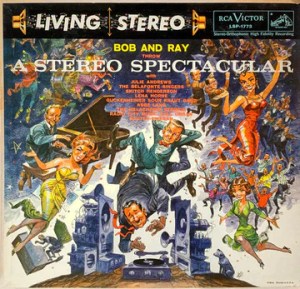
By far the two most helpful records for testing over the last two decades were Tea for the Tillerman (going all the way back to 1984) and Bob and Ray Throw a Stereo Spectacular. We wrote about their uniquely valuable contributions to our audio progress in this commentary.

Led Zeppelin II is probably the main record our current listening panel uses to dial-in the Dynavector 17Dx Karat cartridges we mount three or four times a year so that every record is always  being played with a relatively fresh cartridge. (We are dealers for Dynavector and would love to get you one to try.)

The records below in bold have been especially important for our work. There should be quite a number of commentaries on the blog for each of them.

Also, at the bottom you will notice that more and more jazz and classical records are being added to the list as time permits.

Rock, Pop, etc.
  • 10cc / The Original Soundtrack
  • 10cc / Deceptive Bends
  • 801 / Live
  • Ambrosia / Self-titled
  • America / Self-titled
  • The Beatles / Please Please Me
  • The Beatles / Rubber Soul
  • The Beatles / Revolver
  • The Beatles / Sgt. Pepper’s
  • The Beatles / Magical Mystery Tour
  • The Beatles / Abbey Road

(more…)

On Waka/Jawaka Transparency Is Key

Hot Stamper Pressings of the Music of Frank Zappa Available Now

Not long ago we discovered the secret to separating the men from the boys on side one: TRANSPARENCY.

On the lively, punchy, dynamic copies — which are of course the best ones — you can follow the drumming at the beginning of ‘Big Swifty’ note for note: every beat, every kick of the kick drum, every fill, every roll.

It’s all there to be heard and appreciated. If that track on this copy doesn’t make you a huge fan of Aynsley Dunbar, I can’t imagine what would. The guy had a real gift.

Big Swifty!

The 17-plus-minute-long Big Swifty is a suite in which each section slowly, almost imperceptibly blends into the next, so that you find yourself in a completely new and different section without knowing how you got there — that is, until you go back and play the album and listen for just those transistions, which is what makes it worth playing hundreds and hundreds and hundreds of times.

Big Swifty is a jazz suite with amazingly innovative work by Sal Marquez on trumpet. He single-handedly turns this music into a work of brilliance. I can’t imagine a more talented player.

Zappa on guitar is excellent as well. Aynsley Dunbar plays his ass off, only falling short when it comes time to do his drum solo on Waka/Jawaka.

The interplay of each of these rock musicians is in the tradition of the greatest jazz artists stretching all the way back to the 50s.

And since the drumming throughout this record is so crucial to the music itself, a copy that really gets that right is one that probably gets everything right.

(more…)

The Three at 45 RPM Has Energy Like No Recording We’ve Ever Heard

Hot Stamper Pressings Featuring Shelly Manne Available Now

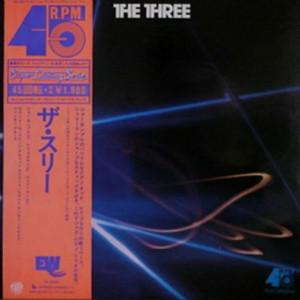
When it comes to blockbuster sound that jumps out of the speakers, the wind is at your back with The Three because this is one seriously well-recorded album. If this record doesn’t wake up your stereo, nothing will.

We call it a “blockbuster” because it does not sound very much like a jazz trio performing in a club or some such venue.

But where is the harm in that? It’s not trying to.

What it’s trying to be is huge and powerful in your home. Everything has been carefully and artificially placed in the soundfield. Shelly Manne’s cymbals are placed as far left and as far right as possible on the “stage,” making him the longest-armed drummer to have ever sat behind a kit.

The drum solo on side two is full of energy and so dynamic. Why aren’t more drum kits recorded this well?

Check out the pictures inside the fold-open cover to see all the mics that were used on the drums. That’s where that wall-to-wall, floor-to-ceiling sound comes from.

It’s a phenomenal big speaker jazz Demo Disc.

Play this one as loud as you can. The louder you play it, the better it sounds.

Speaking of Energy

The transients found on this recording are uncannily lifelike. Listen for the huge amounts of kinetic energy produced when Shelly whacks the hell out of his cymbals.

This is a quality no one seems to be writing about, other than us of course, but what could possibly be more important? On this record, the more energetic copies took the players’ performances to a level beyond all expectations. It is positively shocking how lively and dynamic the best copies of this record are.

I know of no other jazz recording with this combination of sonic and musical energy.

(more…)

On Discovered Again, Does It Sound Like the Snare Is Wrapped in a Towel on Your Copy?

Hot Stamper Pressings of Direct-to-Disc Recordings Available Now

The bulk of this commentary was written in 2008 and is based on the shootout we had just done, our first for the album. It has been amended a number of times since.

I bought my first copy of Discovered Again in 1976 upon its release. I was a big fan of the label at the time. The Missing Linc had been a revelation to me years before in terms of how good music could sound in the home (or apartment as the case may be). I wrote a bit about it here.

I credit that amazing record as well as Discovered Again as fundamentally important in helping me advance in this devilishly difficult hobby of ours. Back in those dark days of the 70s, although I was completely clueless at the time about pretty much everything having to do with vinyl and equipment, I can take some solace in the fact that everybody else was every bit as clueless as I was too.

This blog is dedicated to sharing some of what I’ve learned — with the unflagging help of my staff of course — about records and audio over the last fifty years.


The sound quality of the typical pressing of Discovered Again leaves much to be desired.

Two areas are especially lacking as a rule: the top end tends to be rolled off, and there is a noticeable lack of presence, which can easily be heard in the drum sound.

The snare sounds like it’s covered with a towel on most copies of this album.

How does that even happen?

Who knows? Even though the mastering is fixed at the live event, there are many other variables which no doubt affect the sound. The album is cut on two different lathes — M (Master) and S (Slave), and pressed in two different countries: Japan and Germany. Many mothers were pulled from the acetates and many, many stampers made from those mothers. (I saw one stamper marked number 15!)

Bottom line? You got to play ’em to know how they sound, just like any other pressing. If no two records sound the same, it follows that no two audiophile records sound the same, a fact that became clear early on in the listening.

Of course not many audiophiles are in a position to shootout six copies of Discovered Again, and I’m not sure most people would have the patience to do it. Here at Better Records we have a whole system set up to do that, so we waited until we had a pile of them, got them all cleaned up, and off to the races we went.

What Else to Listen For

Listen to the harmonics around the cymbals and bells on Git Along Little Dogies — on the best copies you can really hear the transients of the cymbals and percussion, so important to the actual sound of those instruments. (More records that are good for testing percussion can be found here.)

The stand-up acoustic bass is amazingly well recorded on this album; it’s so rich and full-bodied. You will have a hard time finding a string bass that sounds better.

Track after track, the sound is surprisingly open and airy. Dave’s keyboards throughout have wonderful presence; on the best copies they really jump out of the speakers. (A good test for midrange presence.)

(more…)

In the Market for New Speakers? See How Well They Handle the Energy of Far More Drums

Hot Stamper Pressings of the Music of Dave Brubeck Available Now

The drum solo Joe Morello lets loose on Far More Drums is one of the best on record. I was playing that song recently and it occurred to me that it is practically impossible for a screen or panel speaker of any design to reproduce the sound of those drums properly, regardless of how many subs you have.

Most of the music is not in the deeper bass anyway. It’s the whack of instruments whose energy is in the lower midrange and mid-bass that a screen speaker will struggle with.

A good large-driver dynamic speaker fed by fast electronics can handle the energy in that range with ease.

This is the album you need to take with you next time you head to your local stereo store to audition speakers.

It will help clarify the issues. Screen speakers do many things well, but drums are not one of them, at least in my experience they aren’t. If drums are important to you, do yourself a favor and buy a dynamic speaker, the bigger the better.

brubeck in the studio733

Time Further Out, like most of the classic Brubeck albums, is a big speaker record. It requires a pair of speakers that can move air with authority below 250 cycles and play at fairly loud levels. If you don’t own speakers that can do that, this record will never really sound the way it should.

(more…)