
Hot Stamper Pressings on Decca & London Available Now
Sonic Grade: F
More vinyl dreck from Speakers Corner.
Pure mud. What piano ever sounded like this?
Hot Stamper Pressings on Decca & London Available Now
Sonic Grade: F
More vinyl dreck from Speakers Corner.
Pure mud. What piano ever sounded like this?
 Hot Stamper Pressings of Living Stereo Recordings Available Now
UPDATE 2026
We no longer do shootouts for this title.
A number of other records have top quality sound for these famous pieces, so we see no reason to continue to struggle to find clean copies of LSC 2241 the way we might have done ten or twenty years ago.
If you see this title at a good price, feel free to pick it up as long as you can return it. Many of these old Shaded Dogs are noisy or groove-damaged, especially those that have dynamic, exciting music like this one.
Our old review follows:
The real stars here are NOT the 1812, but the three coupling works, which demonstrate, on this copy at least, The Real Power of the Orchestra. The remarkably rich, Tubey Magical and oh-so-rosiny Living Stereo strings and powerful, dynamic brass make this a real demo quality orchestral heavyweight.
Lizst’s Mephisto Waltz, Mendelssohn’s The Hebrides Overture, and the Tragic Overture by Brahms are the Must Own 36 minutes worth of music on the record.
A rare and wonderful early Living Stereo Shaded Dog pressing containing an outstanding performance from Reiner and the CSO on everything but the 1812.
Say what?
 Hot Stamper Pressings of Vintage Columbia Albums Available Now
An undiscovered gem from 1967 on the 360 Columbia label.
Side two of this record blew our minds with its White Hot Stamper sound.
Musically and sonically this record is nothing short of wonderful.
Who knew? You could play fifty vintage piano recordings and not find one as good as this.
Tchaikovsky, Liszt, Beethoven, Debussy, Mozart — these shorter pieces and excerpts were composed by those with the greatest gift for melody, men who’ve produced works that have stood the test of time, enchanting audiences over the centuries with works of such beauty and charm.
Here at Better Records we have never been fans of Columbia classical LPs. To be clear, the fault more often than not has to be in the mastering, not the recording. We’ve raved about so many great copies of titles in the past, only to find that the next three or four LPs we pick up of the very same titles sound godawful.
There are some amazing Bernstein recordings out there, but the amount of work it takes to find the one that sounds good is overwhelming — how can such great recordings be mastered so poorly so often?
Side One
A++, with a huge, rich, sweet, natural sounding piano. The more you listen, the more apparent it becomes that, as natural as it may seem at first blush, there are still some old school tubey colorations that make the sound not quite as lifelike as one might wish.
And the confirmation of that finding comes as soon as you flip the record over.
 Hot Stamper Pressings of the Music of Saint-Saens Available Now
UPDATE 2026
The review below was written a very long time ago, around 2010 I think. Our understanding of Witches’ Brew has changed radically over the last fifteen years, as you can see from our most recent Hot Stamper offering of the album.
In 2010 we would have struggled mightily to reproduce the Shaded Dog pressings of Witches’ Brew. We had yet to make many of the most important improvements to our system that difficult to reproduce records require in order to sound their best.
Our 2010 Review
The Decca reissue above just happens to have the material found on one of the most famous and sought-after Shaded Dog pressings in the world, Witches’ Brew (shown below), along with one track added, The Sorcerer’s Apprentice, conducted by Ansermet. (As a budget reissue, they felt they needed to give you more music in order to get you to buy performances that were no longer current.)
The Decca pressing is tonally much more natural from top to bottom. I used to think that it was the best way to hear the music on Witches’ Brew. Like so much of what happens in the world of records, it is and it isn’t.
Huh?, you say. Okay, here is what I mean. We played a handful of Witches’ Brews over the last year or two, and most of them left a lot to be desired. More than that — most of them were just plain awful. One, and only one, lived up to the hype that surrounds the record.
It was so big and so powerful that I would have had no trouble ranking it with the five best sounding classical recordings I’ve ever heard.
It was a real WOW moment when the needle hit the groove on that one.
This later Decca pressing is made from a copy tape, but it’s CORRECTLY mastered from that tape and therefore sounds worlds better than most originals and all the heavy vinyl reissues. This record I can play and enjoy. Those I cannot.
(A great deal more on the Classic Records repress of LSC 2225 can be found here and here.)

*NOTE: Unlike Concerto No. 1, The Second Piano Concerto opens very quietly, so there will likely never be a vintage pressing of the album that will get that opening to play like a CD. Expect to hear some random ticks, a small price to pay to hear this wonderful performance on top quality analog.
Richter and Kondrashin deliver the finest Liszt 1st & 2nd Piano Concertos we know of, musically, sonically and in every other way. Richter’s performance here is alternately energetic and lyrical, precisely as the work demands. The recording itself is explosively dynamic. The brass is unbelievably full, rich and powerful. You won’t find a better recording of this music anywhere.
Big and rich (always a problem with piano recordings: you want to hear the percussive qualities of the instrument, but few copies can pull it off without sounding thin). We love the BIG, FAT, Tubey Magical sound of this recording! The piano is solid and powerful — like a real piano.
Huge amounts of hall space, weight and energy, this is DEMO DISC QUALITY SOUND by any standard. (more…)


Hot Stamper Mercury Pressings Available Now
This Mercury 35mm recording was released through Philips after they’d bought the Mercury label back in the 60s.
Philips would go on to release the mostly dreadful Golden Import pressings that were made from all the most famous Mercury recordings, but of course they sounded a great deal more like Philips recordings than Mercury recordings once they had been remastered.
Some things never change. Do you like the sound Steve Hoffman brought to the DCC vinyl releases? You can be sure you will get plenty of that sound and very little of any other. We call that My-Fi. Once we learned to recognize it, something we admit took us longer than it should have, we became ardently opposed to it.
If you think that the right way to remaster records is to make them sound more like you want them to sound and less like the scores of vintage pressings sounded before, you and I are clearly in different camps. (One listen to a Hot Stamper pressing may be all that it takes to get you to switch camps.)
This album was recorded by Robert Fine and Wilma Cozart, then mastered by George Piros, all members of the legendary Mercury team, revered by the audiophile cognoscentias as true giants , and with good reason. We count ourselves among Mercury’s biggest fans.
It is instructive to note that the Philips mastering in this case is dramatically superior to the mediocre Mercury mastering by Robert Fine, which may strike you as counterintuitive, but is nonetheless a fact that cannot be denied once you have played a sufficient number of copies of each version, as we have.
Hot Stamper Pressings of the Music of Grieg Available Now
UPDATE 2026
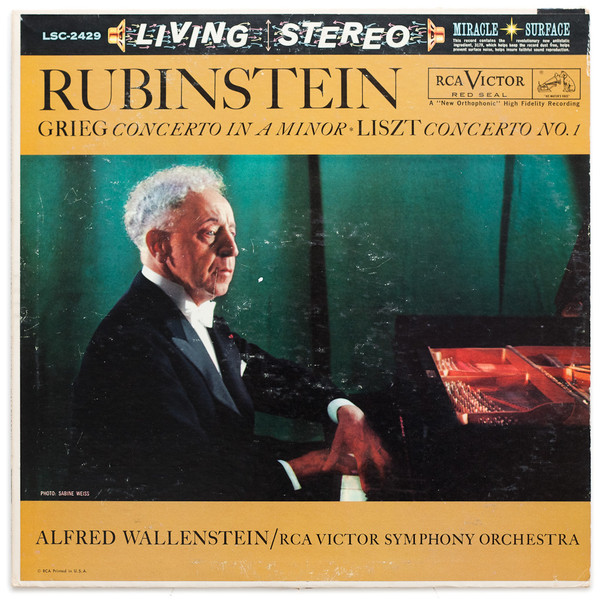
This is a very old review of LSC 2429, which we ourselves may no longer agree with.
If you see this record in the bins for cheap, give it a try, but don’t pay a lot on our say-so.
Our two favorite recordings of the Grieg Piano Concerto are the Decca with Lupu and Previn from 1973 and Rubinstein’s for RCA in 1962. Either one should be superior to the Living Stereo Shaded Dog we review here.
The strings are RICH in the best Living Stereo tradition, but unlike so many classical pressings we play, the tubey magical string tone comes with virtually no tube smear. The textures and overtones are fully intact.

Hot Stamper Pressings of Living Stereo Titles Available Now
We ran into a number of copies of this title that had what we like to call “old record sound,” which is surprisingly common on even the most revered Golden Age labels, RCA included.
No top, no real bottom, congested climaxes and a general shrillness to the sound — we’ve played Living Stereos by the dozens that have these shortcomings and many more.
Some audiophiles may be impressed by the average Shaded Dog pressing, but I can assure you that we here at Better Records are decidedly not of that persuasion.
Something in the range of five to ten per cent of the major label Golden Age recordings we play will eventually make it to the site. The vast majority just don’t sound all that good to us. (Many have second- and third-rate performances and those get tossed without ever making it to a shootout.)
The One Out of Ten Rule
If you have too many classical records taking up too much space and need to winnow them down to a more manageable size, pick a composer and play half a dozen of his works.
Most classical records display an irredeemable mediocrity right from the start. It does not take a pair of golden ears to hear it.
If you’re after the best sound, it’s the rare record that will have it, which makes clearing shelf space a lot easier than you might imagine. If you keep more than one out of ten, you’re probably setting the bar too low, if our experience is any guide.

Demonstration Quality Sound, of a sort. As I’ve said elsewhere on the site, this is not my idea of natural tonality. It’s not trying to be a realistic recreation of music performed in the concert hall. It’s a blockbuster to be impressive when played on an audio system in your home. On that level is succeeds.
The excerpt on side 1 from Pictures at an Exhibition and the complete A Night on Bare Mountain are both played with a kind of energy and attention to detail that allows these pieces to come alive right in your living room.
The entire side 2 is outstanding from start to finish.
Only the Arnold piece on this record is not particularly inspiring, although it does have excellent sound.
All in all, an amazing group of warhorses given a fresh reading by Alexander Gibson and the New Symphony Orchestra of London.