bright-sound

Below you will find a small sampling of records we played that we found to be too bright.

Keep in mind that the modern Heavy Vinyl reissue consistently has the opposite problem. They are almost always overly smooth and dull, displaying a frustrating and irritating lack of presence and clarity in the upper-midrange. The new Beatles remasters are the perfect example of just what a bad idea it was to boost the bass and cut the highs on their albums. They sound nothing like the ones we offer as Hot Stampers.

Our Hot Stamper Beatles pressings are as tonally correct as any that have ever been produced, yet they do not lack for clarity and presence in the least. Correct tonality is fundamental to the sound of our Hot Stamper LPs.

The ’83 & ’89 Reissues of Music From Big Pink Are Just Awful

Hot Stamper Pressings of the Music of The Band Available Now

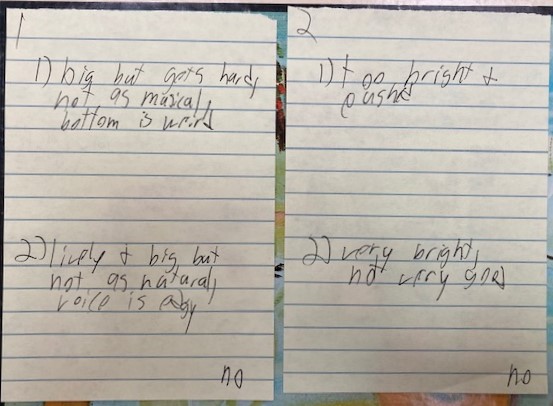
Both the pressings of Music from Big Pink mastered by Capitol with the help of the Specialty Record Corporation (SRC) are just awful sounding. They released one in 1983 and another 1989. The notes you see below are for the 1989 pressing.

The overall sound was bright and forced, with edgy vocals. Who wants a Band record that sounds like that? The MoFi CD (from 1989) is better than the MoFi record, but that’s not saying much. I wouldn’t have either one in my collection.

Earlier this year we raved about our amazing sounding Shootout Winner:

  • Here are just a few of the things we had to say about an incredible copy in our notes: “huge and breathy and weighty”…”very rich vox and toms”…”huge and rich and jumping out of the speakers”…”big and rich and spacious”
  • Forget all those vague, veiled, lifeless, ambience-free Heavy Vinyl pressings – this is the Big Pink that The Band recorded!
  • Remember when you used to play the same record over and over, never taking it off the turntable for days at a time?
  • Well here it is – this pressing captures the music in a way that will make repeated plays the joy they are meant to be

(more…)

How Do the Early Pressings of The Poll Winners Sound?

Hot Stamper Pressings of Contemporary Jazz Albums Available Now
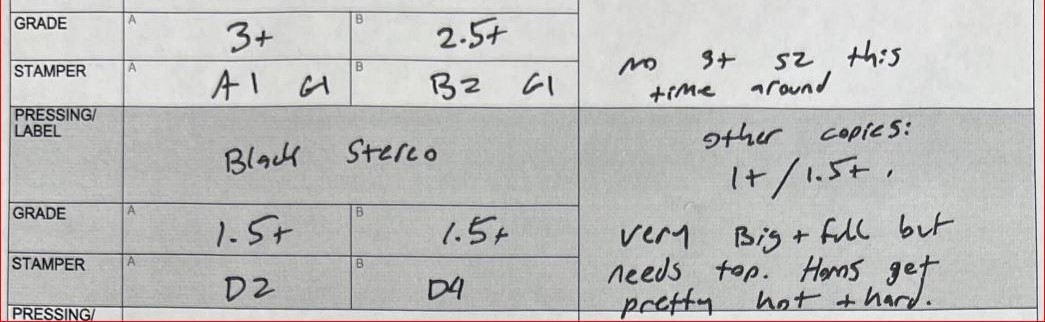
A recent Shootout Winning copy with the early stereo badge cover was described this way:

Stunning sound throughout this vintage Black Label Stereo Records pressing, with both sides earning Shootout Winning Triple Plus (A+++) grades or close to them

Roy DuNann always seems to get the real sound out of the sessions he recorded – amazingly realistic drums in a big room; Tubey Magical guitar tone; deep, note-like bass, and on and on

4 1/2 stars: “The choice of material, the interplay between the three players, and the lead work all meld together beautifully on The Poll Winners, making it a classic guitar album in a small-group setting.”

Musically, all true. Sonically, not so much. The early D1/D2 stampers on the early Black Label might be passable on side one (1+), but side two was just a mess (NFG).

Side One

Track Two

  • A bit bright and flat

Track One

  • Very clear but lacking richness, weight and depth
  • Thin, and bright up top
  • 1+

Side Two

Track One

  • Narrow stereo field
  • Weird tape hiss
  • Metallic top end
  • Very recessed and weird
  • Nope

A different Stereo Badge Cover copy sporting a Black Label won the shootout by the way. Go figure.

(more…)

Monk’s Music on Riverside 9242 Didn’t Make the Grade

Hot Stamper Pressings of the Music of Thelonious Monk Available Now

The Riverside 9242 pressing of Monk’s Music we played recently was very much not to our liking.

In fact, every copy of this record we have ever played sounded terrible. The early pressings sounded bad and the OJC sounded bad.

We give up. We’re cutting our losses. We love Monk, but why on earth would we keep throwing money down this rathole? Our notes for this copy read:

  • Dry (more records with dry sound can be found here), and
  • Bright (more records with bright sound can be found here),
  • Overall grade: No Good

Some reviewers of the audiophile persuasion prefer to review only records that sound good to them and ignore the rest. We think this does the audiophile community a disservice.

Like Consumer Reports, we like to test things. They test toasters, we test records. We put them through their paces and let the chips fall where they may.

They want to find out if the things they are testing offer the consumer good quality and value.

We want to find out if the records we are testing offer the audiophile good sound and music.

It takes a dedicated group of people and a healthy budget to carry out these kinds of tests in large numbers.

No other record dealers, record reviewers or record collectors could possibly have auditioned more than a small fraction of the records that we’ve played. We’ve been looking for the best sounding pressings of the recordings that have stood the test of time for decades. Now, with a staff of ten or more, we can buy, clean and play records at a scale that would be unimaginable for any single person to attempt.

That puts us in a unique position to help audiophiles looking for the highest quality pressings.

Yes, we have the resources, the staff and the budget. More importantly, we came up with a much scientifically reliable approach.

(more…)

VICS 1069 – In 2004 We Mistaked Finlandia on VICS for a Demo Disc

Hot Stamper Pressings of the Music of Sibelius Available Now

UPDATE 2024

We played a 4S/1S copy of this record, VICS 1069, and thought it sounded terrible.

It was flat and bright with splashy cymbals and crude brass.

Even if we assume the copy we played many years ago could have been much better than this latest pressing — which is doubtful but certainly possible — there is no reason to pursue this version of the album when there are known top quality pressings of this very same performance on Decca.


Our Old Review

DEMO QUALITY SOUND and quiet surfaces too.

I don’t know when I’ve heard this album with better sound. This one may be better than the best Shaded Dog for all I know — it’s that good.

You’ll notice that there is a copy of this very same record on the website for $1.99. That one sounds dull. I don’t think you’ll be able to find a better sounding copy of this record than the pressing we are selling here, because it really is an exceptionally good sounding record. If it weren’t, it would be more like $1.99.

(more…)

Capriccio Italien on Classic Records and How Badly I Missed the Boat

More of the Music of Peter Ilyich Tchaikovsky

More of the Music of Nikolai Rimsky-Korsakov

Years ago, around 2005 if memory serves, I played a copy of the Classic Records pressing of LSC 2323 and thought it was pretty good.

I thought it was better than the Shaded Dog copies I had compared it to, which, based on hundreds of other Classic Records titles I had auditioned, was unexpected to say the least.

Little did I know that the Shaded Dog pressings on this title are not remotely competitive with the early reissues.

The best of the Shaded Dog pressings we could find, which just happened to have a 1s side one, came in tied for last with the one 70s Red Seal pressing we thought sounded good enough to make the shootout.

(Some inside baseball: most of the Shaded Dogs and Red Seals were needle-dropped, and all but two were eliminated before the shootout. It takes time and wastes money to clean and play pressings that sound hopeless, so a quick elimination round often precedes the cleaning process.)

Back then it was tough to wrap my head around the idea that a Classic Record classical title could actually be better sounding than a Shaded Dog — it had never happened, so I knew there had to be more to the story.

Finding the time to do the serious investigation of LSC 2323 that would be necessary to get to the bottom of it was not in the cards, so I shelved the project for close to the next twenty years.

The title would have to wait until 2024 to go through a proper shooout, and when it did, naturally the Classic was part of the mix, which is the way we do things here at Better Records. Every record gets the chance to show us what it can do, to be evaluated fairly without the listener having any way to know which pressing is playing.

It turns out that side one of the Classic was passable, but side two — the side I had probably never played — was every bit as bad as most of their other classical offerings.

Side One, Second Movement (Tchaikovsky)

  • Big, but bright and compressed
  • Gets loud but opaque and hot
  • Good weight

Side One, First Movement

  • Bright and blurry bells
  • Sort of tubey but a mess
  • Grade: 1+ (passable, but no Hot Stamper)

Side Two (Rimsky-Korsakov)

  • Big but boomy and smeary
  • Brass is edgy and opaque
  • No top end or space
  • Peaks are hot and congested
  • Grade: NFG

To recap: In 2005 I was impressed with Classic’s pressing of LSC 2323. That was only twenty years ago, yet I could not have been more wrong. I thought my stereo was great — I’d owned top quality equipment since 1975 by then — thirty sodding years — so my audiophile credentials would surely dwarf those of the vast majority of forum posters who write about audiophile pressings today. How reliable should we expect their reviews to be?

(more…)

When Fisher Took Over from Goodall, He Really Let the Side Down

Hot Stamper Pressings of Recordings by Decca Available Now

Please keep in mind that, as per our usual, the record you see pictured is not the record we are discussing in this posting.

The stamper numbers you see below belong to a different album.

The quick takeaway: Stan Goodall (“E”) cut the Shootout Winning early pressings.

Then, for reasons known only to the folks at Decca, Harry Fisher (“W”) took the reins and managed to cut some side twos that were very good. Not as good, but still very good: 2+ most of the time, some slightly worse. They were not as weighty or rich, and we take a lot of points off for records that are not as weighty or rich as they should be.

By the time Decca had changed its label to the Decca in a Box design, Mr. Fisher was cutting all the pressings, and, in our experience, not doing an especially good job. We do not even offer records with grades that low.

The sound might be passable, and would probably still be better than whatever Heavy Vinyl pressings might have been made from the tapes in the last twenty years, but that’s not good enough for us here at Better Records, not at the prices we charge anyway.

We described Fisher’s sound as dry and hot on side one, and thin and very small on side two of the 5W-stamped pressing we played. We only had the one, and the reason we had even one after having heard other Boxed Decca pressings do poorly, is that it’s a good way to stay honest and to have a better baseline to work with.

If we played nothing but 3E/1E originals, most of those 1E side twos would have earned a 2+ grade, but they would have sounded much better than the 2W-graded copies, and that seriously screws up the grading scale, especially when clean originals cost us a hundred bucks or more these days.

(more…)

Houses of the Holy on Classic Records Heavy Vinyl

We can describe the sound of this miserable Bernie Grundman remaster in two words: ridiculously bright.

Honestly, what more do you need to know? It’s almost as bad as the Zep II he cut, and that record is an abomination.

Is it the worst version of the album ever made? Hard to imagine it would have much competition.

(Oh but it does – this misbegotten series out of Japan will do nicely to illustrate how brighter is not necessarily better, it’s just brighter.)

Over the years we have done many Led Zeppelin shootouts, often including the Classic Heavy Vinyl pressings for comparison purposes. After all, these Classic LPs are what many — perhaps most — audiophiles consider superior to other pressings.

We sure don’t, but everybody else seems to. You will find very few critics of the Classic Zeps LPs outside of those who write for this blog, and even we used to recommend three of the Zep titles on Classic: Led Zeppelin I, IV and Presence.

Wrong on all counts.

We don’t actually like any of them now, although the first album is still by far the best of the bunch.

(more…)

Is CTFR-1 Dark and Congested, or Flat and Bright?

Hot Stamper Pressings of Mercury Classical Records Available Now

For Mercury classical and orchestral recordings, the original RFR-1 pressings on the plum label are the way to go, right? 

In some cases, yes. The first pressings of Mercury albums often win our shootouts.

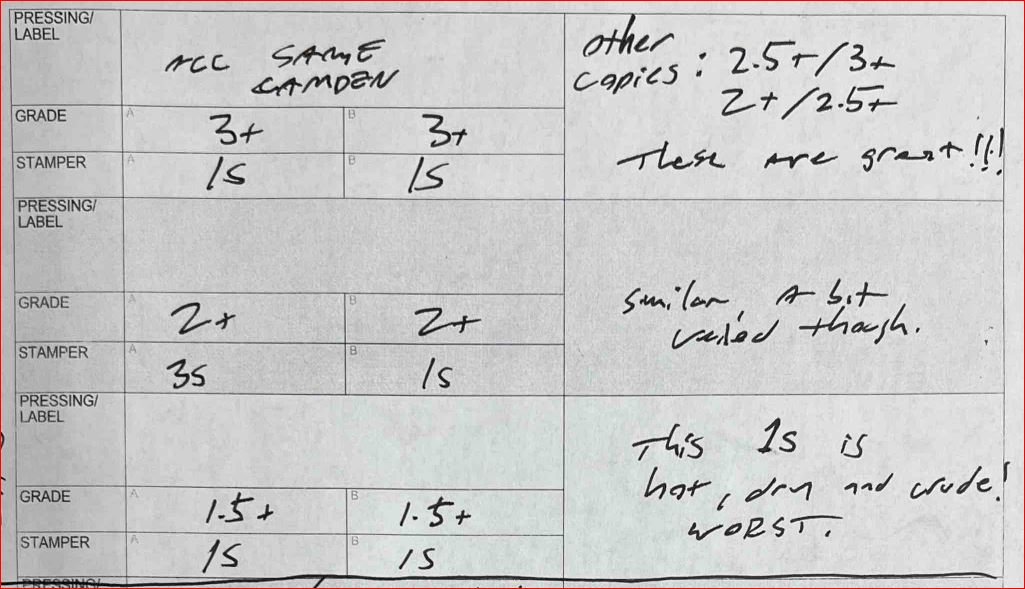
And for both sides of a copy to win a shootout, like our gold promo seen in the stamper sheet below, everything about the pressing must be right. We call records that win their shootout, earning 3+ grades on both sides, Top Shelf pressings. They are rare and special enough to have a section of their own on the site (which, as of this writing, has all of 19 records in it.)

What we find to be interesting about this specific shootout, however, is that we had two later pressings, both with the same stampers, and they sounded markedly different from each other. (Note that the stamper numbers you see below belong to a different album than the one shown above.)

If a collector were to tell you that that the CTFR pressings tend to be dark and congested, and you owned one with the exact same stampers, CTFR-1, you might be inclined to agree with this person.

But if you were the owner of the copy we played that was flat and bright, again, with CTFR-1 in the dead wax of both sides, you would think this person was 1.) Out of his mind, or, 2.) Deaf as a post, or, 3.) The owner of some very inaccurate playback equipment.

He could be all three, but in this case, an unusual one to be sure, his copy of the album doesn’t tell you anything about the sound of your copy of the album. They could match, or they could be completely different. Some records are like that. Not all that many, but definitely some.

Sample Sizes and One Man Bands

Those of us who play a variety of pressings of the same album know how easy it is to draw mistaken conclusions about records. CTFR-1 on this title is the perfect example of a record whose stampers don’t tell you much about its sound. (Even RFR-1 on side one of one copy was no better than “good,” quite a long ways from the best.)

(more…)

We Was Wrong About The Beatles Magical Mystery Tour (Circa 1985-90)

Hot Stamper Pressings of the Music of The Beatles Available Now

This is a very old and somewhat embarrassing commentary about how ridiculously wrong we were about which are the best sounding German pressings of the Magical Mystery Tour.

Today we would never consider selling a record that sounds as phony as this version of the album does, but we did back in the 90s and probably as late as the 2000s.

Bad sounding records I once liked are common enough on the blog to have their own category, with 76 entries to date. If we had the time to make listings for them, there would surely be hundreds of others. If you’ve been in the audio game for as long as we have, you should have plenty of records that fit that bill. All those old records sitting on the shelves that you haven’t played in years might not sound they way you remember them, but the only way to know that is to pull them out and play them. If you’ve been making regular audio progress, most of them should sound better than ever, but there have to be plenty that won’t. You just don’t know which are which as long as they sit on the shelf.


This German pressing has sound that is dramatically different from that found on other Hot Stamper pressings of MMT we’ve had on the site. I used to be convinced that its sound was clearly superior to the regular German MMT LPs.

Back in the late 80s and into the 90s this was the pressing that I was certain blew them all out of the water.

We know better now. We call this version the “Too Hot” Stamper pressing — the upper mids and top end are much too boosted to be enjoyable on top quality equipment.

It does have some positive qualities though. It has substantially deeper bass than any other version; in fact, it has some of the deepest bass you will ever hear on a pop recording. It can literally rattle the room when Paul goes down deep on Baby You’re A Rich Man.

It also uses a slightly different mix on some tracks and is mastered differently in terms of levels. The level change is most obvious at the beginning of Strawberry Fields, where it starts out very quietly and gets louder after a short while, unlike all other versions which start out pretty much at the same level.

The effect is pleasing, you might even say powerful, but probably not what The Beatles intended, as no other copy I’ve ever heard makes use of the same quiet opening. An unknown mastering engineer made the choice, he created a new sound for the song, probably because he didn’t like all the tape hiss at the opening, during which few instruments were playing loud enough to mask it.

With this mix the record is now more of a Hi-Fi spectacular — great for waking up sleepy stereo systems but not the last word in natural sound.

Records that are boosted on the top and bottom suffer from what we like to call the smile curve. This pressing, as well as lots of records remastered to appeal to audiophiles, have a bad case of it.

(more…)

How Do You Make a Vintage Jazz Recording Sound Wrong?

Hot Stamper Pressings of Jazz Albums Available Now

How do you make a vintage jazz recording sound wrong?

Easy. Just take out all the Tubey Magic that was captured on the master tape all those years ago by Howard Holzer and Roy DuNann.

You know the kind of Tubey Magic I’m talking about. It’s the trademark sound of every vintage Contemporary pressing ever made. It’s the defining sound of the best jazz recordings from the era. It’s the reason that jazz lovers and record collectors the world over pay big bucks for vintage pressings — because they have the sound of tubes.

When you take away that one quality — just the one, leaving everything else as it should be: the bass, the mids, the highs, the energy, the space, the size, you name it — what you are left with doesn’t sound right.

It no longer sounds the way a jazz record from 1958 would sound.

If you don’t know that sound, it’s possible that this cheap reissue pressing from 1984 might not be as bothersome for you as it was for us. But we’ve played vintage jazz records from the 50s by the hundreds. They never sound like this. The reissues might, but the best early pressings sure don’t.

Maybe This Is Your Sound?

However, if you happen to like the sound of CDs for some reason, something that is frankly hard to imagine but nevertheless seems to be true, this OJC might just be the ticket.

We’ve never liked that sound, and we sure don’t like this pressing.

Other records we’ve played that sounded like CDs to us can be found here.

We’ve only played three releases on the Music Matters label, but all three of them sounded like CDs to us — Green Street, The Magnificent Thad Jones, and Tina Brooks’ True Blue (review coming someday!).

Much of Kevin Gray‘s work has the kind of sound we associate with the compact disc. We don’t understand why everyone doesn’t hear how badly mastered his records are, but we have no trouble recognizing their many faults. They are, to one degree or another:

The OJC pressings of Harold in the Land of Jazz we played were thinner and brighter than even the worst of the 70s LPs we auditioned.

They did not make the cut for our shootout, a shootout we abandoned years ago because the early pressings we liked were just too rare, too noisy and too expensive to justify the cost and effort that would be required to make a shootout a reality.

(more…)