TAS List Commentaries

Commentaries about records on the TAS Super Disc list.

Julie Is Her Name – What a Record!

Hot Stamper Pressings of Pop and Jazz Vocals Available Now

UPDATE 2026

We were shocked to discover a knockout Four Plus copy of Julie Is Her Name way back in 2010.

Our lengthy commentary entitled outliers and out-of-this-world sound talks about how rare these kinds of pressings are and how we go about finding them. We no longer give out Four Pluses as a matter of policy, but that doesn’t mean we don’t come across records that deserve them from time to time.

Nowadays we most often place them under the general heading of breakthrough pressings. These are records that, seemingly out of nowhere, revealed to us sound of such high quality that it conpletely changed our appreciation of the recording itself.

We found ourselves asking “Who knew?” Perhaps a better question might have been “How high is up?”


Our Old Review

Beyond White Hot stamper sound on side one of this Turquoise Liberty Mono pressing – the sound is guaranteed to blow your mind. Julie is in the room with you – intimate, breathy and Tubey Magical like practically nothing you’ve ever heard. For late night listening this may be the best Sultry Female Vocal recording ever made.

Side One

This side had breathy resolution that was hard to believe, along with size and immediacy that no other side of any copy could touch. Phenomenal. (more…)

A Couple of Key Tracks to Play on Pictures at an Exhibition

LHot Stamper Pressings of Living Stereo Recordings Available Now

UPDATE 2026

This is a very old listing for Pictures at an Exhibition, so take it for what it’s worth.


This TAS List record with a Super Hot stamper side one has some of the best sound we have ever heard for the Shaded Dog Reiner/CSO Pictures, and side two, although it starts out a little weak, gets going soon enough and earns a Super Hot Stamper sonic grade as well.

Side one is open and natural in the best Living Stereo tradition, with rich lower strings that have virtually no Golden Age smear.

Turn it up and listen for the big cymbal crashes — that’s the sound we love. It’s so good it even allows me to enjoy Reiner’s performance, never one of my favorites.

Side One

A++, transparent and free from smear, not many copies are going to beat this one! A little more top would have been nice.

Listen to: Samuel Goldenburg und Schmuyle

Superb sound! The brass and strings on this part of the work are as good as it gets. No smearing of the brass — it’s clean and clear like it is in the concert hall. We’re so used to hearing it wrong that it takes a record like this to remind us how good a full brass choir can really sound. (more…)

Shootout Winning Stampers for The Planets Revealed

Hot Stamper Pressings of the Music of Holst Available Now

You may have noticed that on the few occasions when we actually do give out the stampers for the top copies of an album, we are loathe to identify the title of the record that has those Shootout Winning stampers.

As you can imagine, our huge investments in research and development make up a substantial share of the costs we bear, costs that sometimes accrue over the course of many years, decades even. Eventually these costs are passed on to our customers, accounting for some of the admittedly high prices you see on our site.

But this title is going to be an exception, with many more to follow. We are officially giving out stamper information for this London, information that took us more than a decade to acquire. Maybe even two decades.

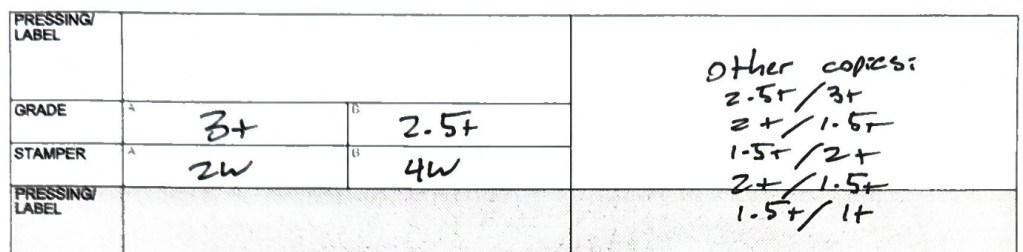
The right 2W/4W pressings of CS 6734, the Decca recording of Holst’s The Planets conducted by Zubin Mehta, are the best we have ever played. Based on our experience over the years, these are the only stampers that have any chance of winning a shootout.

Below you will find the grades for all the top copies from our most recent efforts, as well as the also-rans with those same stampers that we played.

Only two pressings earned a top grade, and each of them managed to do so on only one side. This is by far the most common result of a shootout. 3+/3+ copies are the exception, not the rule.

Whatever caused the amazing sides of the best pressings to come out differently from the not-nearly-as-good sides of the other pressings must have happened in the plating and pressing stages of manufacturing, an area that was of course not under the control of the mastering engineer who cut the record in the UK for Decca, Harry Fisher.

(more…)

The Reiner Sound Is A Demo Disc for Energy, Dynamics and Top End

Hot Stamper Pressings of Living Stereo Recordings Available Now

This review was written in 2010.

I don’t think we have found a Reiner Sound as nice as this one since then. 


UPDATE 2024

It may have taken us more than a decade and cost us a lot of money to get a shootout going for a rare and expensive title such as LSC 2183, but all it took was one killer copy to make it worth all the time and trouble it took track it down.

And when a record sounds as good as our best copy did, with a grade of at least 3+ on side one, who cares how much trouble we went through to find it?

We live for records like these.

(more…)

Two Qualities Are Hard to Come By on Dad Loves His Work

Hot Stamper Pressings of the Music of James Taylor Available Now

As usually happens in one of our shootouts, we learned that there’s so much more to this album than just great songs.

What really made this music work on the best copies was the result of two qualities we found were in fairly short supply:

Correct Tonality

Most copies have a phony MoFi-like top end boost in the 10k region that we found irritating as hell. The longer we listened the less we liked the copies that had that boost, which adds a kind of “sparkle” to cymbals and guitars that has no business being there.

Now if you’re a MoFi fan, and you like the boosted highs that that label is famous for, don’t waste your money buying a Hot Stamper copy from us. Our copies are the ones with the correct and more natural-sounding top end. The guitars will sound like real guitars and the voices will sound like real voices.

Lower Midrange and Bottom End Weight

When the vocals sound thin, bright and phony, as they do on so many copies of this album (partly no doubt the result of the grainy crap vinyl Columbia is infamous for) that hi-fi-ish sound takes all the fun out of the music.

Many tracks have background vocals and big choruses, and the best copies make all the singers sound like they are standing in a big room, shoulder to shoulder, with the full lower midrange weight that that image implies.

The good copies capture that energy and bring it into the mix with the full-bodied sound it no doubt had live in the studio. When the EQ or the vinyl goes awry, causing Taylor and crew’s voices to take on a lean or gritty quality, the party’s over.

This is one of our favorite Taylor albums here at Better Records.

It’s the last album by the man that bears any resemblance to the genius of his early work. It’s steeply, steeply downhill after DLHW. (Case in point: His specials for PBS of the last few years [make that twenty or more] are a positive cure for insomnia, with every song slowed down and all the energy drained from the material.)

But he still had fire in his belly when he made this one — one listen to Stand and Fight is all the evidence you need; the song rocks as hard as anything the guy ever did. (And it’s got plenty of cowbell, always a good sign.)

(more…)

How Good Is the Sibelius Violin Concerto on Classic Records?

Hot Stamper Pressings Featuring the Violin

Classic remastered this title in the 90s — of course they did, it’s clearly one of the better Heifetz recordings.

As expected, Classic’s remastered pressing of the Sibelius Violin Concerto (LSC 2435) was awful, as bad as LSC 1903, 1992, 2129 and others too numerous to list. 

(There is one Classic violin concerto record that is actually better than every RCA Living Stereo we have ever played — which amounts to scores of them since we have done shootouts for them all — and one of these days you will be able to read about it right here on this very blog!)

The Classic is both aggressive and lacking in texture at the same time, the worst of both worlds.

Bernie’s cutting system is what I would call Low Resolution — the harmonics and subtleties you would expect to hear are simply not there. He brightens the tonal balance, causing screechy strings whenever they get loud.

The world is full of these kinds of third-rate records. They make up the bulk record collectors’ collections as well as the ones audiophiles have sitting on their shelves.

(more…)

On This Rachmaninoff Title, the Right Reissues Clearly Have the Best Sound

More of the music of Sergei Rachmaninoff (1873-1943)

Until we heard the right later pressings, we had always been disappointed with this TAS List recording, wondering what all the fuss was about. The original Shaded Dog pressings we had played left a lot to be desired. Like many of the old records we audition, it badly lacked both highs and lows, our definition of boxy sound.

Well, now we know.

The earliest Shaded Dog pressings have consistently worse sound than the reissues we offer.

We never offered the record in Hot Stamper form because we didn’t think the sound of the originals was all that impressive, TAS List or no TAS List.

Mystery solved, and truly Hot Stampers have now been made available to the discriminating audiophile.

Harry’s list, as was so often the case, did not provide the information needed to find the pressing that captured all the qualities of the recording the way this one does.

Did Harry have a good later pressing?

Did he have an original and simply liked it more than we did?

Who knows? Like so much in the world of records, it’s a mystery.

(more…)

Suites for Solo Cello on the Later Label – Ouch!

Hot Stamper Pressings of Mercury Recordings Available Now

UPDATE 2021

The discussion here is for a Oval label copy of Suites for Solo Cello (SR 90370) we reviewed in 2010. These days the Oval label pressings from the early 60s almost never sound very good to us. We no longer buy them and we certainly don’t bother to put them in shootouts.

This record on the Oval Label would be very unlikely to qualify as a Hot Stamper pressing anymore, although we liked it just fine in 2010, as you can see from our old review.

In 2024 we actually put an Oval Label pressing of SR 90370 in a shootout and it did about as poorly as we would have expected. What a waste of time and money. Never again.

(more…)

Piano and Snare Testing with Love Over Gold

Hot Stamper Pressings of the Music of Dire Straits Available Now

UPDATE 2026

In 2017 we reviewed a copy of Love Over Gold that really knocked us out. This was sound we had never heard on the album before, so as you can imagine, we had to tell the world -s or at least that small part of the world that accepts the reality of Hot Stamper Pressings — all about it.

Since then we have noted the value of testing albums with pianos and snare drums as those seem to be key part of some recordings that are hard to get right, which of course is makes them good tests.


Telegraph Road does something on this copy that you won’t hear on one out of twenty pressings: It ROCKS. It’s got ENERGY and DRIVE.

Listen to how hard Allan Clark bangs on the piano on side one — he’s pounding that piano with all his might. No other copy managed to get the piano to pop the way it does here, so clear and solid.

Wow, who knew? Maybe this is the reason HP put the record on the TAS Super Disc List. (I rather doubt he’s ever heard a copy this good, but who’s to say?)

Best test for side two?

The snare drum on Industrial Disease. Play five copies of the album and listen on each of them for how much snap there is to the snare. It will be obvious which ones get the transient attack right and which ones don’t. (If none of them do, try five more copies!)

(more…)

Paris 1917-1938 – Side One Versus Side Two

Hot Stamper Pressings of Mercury Living Presence Records Available Now

UPDATE 2025

This listing was written all the way back in 2012 for the first Hot Stamper pressing of SR 90435 we’d ever listed as a Hot Stamper.

Note that it only had one good side, and even that side had a serious problem.

Thirteen years later in 2025 we would do a real shootout for this wonderful recording and learn something very few audiophiles know to this day — that the best stampers and the worst stampers are sometimes the same stampers.


Our 2012 Review

Super Hot Stamper sound for Eric Satie’s wonderfully eccentric Parade (and the Auric piece as well) can be found on this rare original promo copy of Mercury SR 90435, a record that was previously on the TAS List if I’m not mistaken.

It certainly deserves to be. The sound is BIG and OPEN, and like so many Mercury recordings with the London Symphony, it’s rich and full-bodied, not thin and nasally as is so often the case with their domestically recorded releases. Above all the sound is transparent, lively and dynamic.

In many ways this album would certainly serve quite well as an audiophile Demo Disc: the timbre of the wide array of instruments used is (mostly) Right On The Money.

Check out the lengthy and humorous producer’s notes for the sessions below. And people think The Beatles discovered experimental sounds in the studio.

The Brass Lacked Weight

With one small exception: the brass doesn’t have all the weight of the real thing, and for that we have deducted one plus from our top grade of three.

Side one has classic bad Mercury sound.

So screechy, hard and thin. How many audiophiles own records like this and don’t know that the sound of one side is awful and the other brilliant?

Since so few have ever commented publicly about such matters — and even supposedly knowledgeable audiophile reviewers never bother to even bring up the subject of one side versus the other — one must conclude that this is a subject that has yet to pierce the consciousness of most of our audiophile brethren, especially the ones who haven’t yet discovered this site.

Now’s a good time to start. Dig in, you may be surprised by what you find.

(more…)