TAS List Not-So-Good

These records have no business being on anything called a list of “Super Discs.”

Another Fine Entry for Our Heavy Vinyl Hall of Shame

Hot Stamper Pressings of Orchestral Spectaculars Available Now

UPDATE 2026

It just so happens that I had the time to listen to this work from start to finish twice just last night, 2/11/2026. Saw it performed live just a few months back at Atlanta Symphony Hall.

This wonderful work never gets old.  Next time we do a shootout for the performance we like with Muti on EMI I hope you will see your way to picking up a copy. You won’t regret it.


The Classic Records repressings of Pictures at an Exhibition — whether at 33, 45, or any other speed, on one disc or four –are all godawful sounding.

(Yes, we have auditioned both versions, for as long as we could stand them, which wasn’t long as the sound was painfully bad. The details can be found below.)

Everything that was bad about the worst original Shaded Dog pressings not only hasn’t been fixed, it’s been made even worse!

Yes, we admit to having played a good pressing of LSC 2201 in 2024, but there are just too many bad pressings of the album to bother doing a shootout for it. It’s hard to justify the cost when so few have the sound we are looking for.

The shrillness, the hardness, the sourness, the loss of texture to the strings, the phony boosted deep bass — this is the kind of sound that makes my head hurt and my skin crawl. After a minute or two of listening to sound this bad I’ve had it.

And can you believe that HP put this miserable remastered pressing on his TAS Super Disc List? Sad but true.

(more…)

Time Out Is a Classic Case of Live and Learn

Hot Stamper Pressings of the Music of Dave Brubeck Available Now

When we did a shootout for this album way back in October of 2007, we took the opportunity to play the Classic Records 200 gram pressing. Maybe we got a bad one, who knows, but that record did not sound remotely as good as the real thing. (6 eye or 360, both can be quite good. Skip the Red Label ’70s reissues.)

The piano sounded thin and hard, which was quite unexpected given the fact that we used to consider the Classic LP one of their few winners and actually recommended it. Another example of we was wrong.

As we said in our shootout: “We dropped the needle on the Classic reissue to see how it stacked up against a serious pressing. Suffice it to say, the real Time Out magic isn’t going to be found on any heavy vinyl reissue!”

If I were in charge of the TAS Super Disc List, I would not have put this record on it.

(more…)

The Absolute Sound Thinks this Is Some Kind of Super Disc?

Hot Stamper Pressings of Top Quality Jazz Albums Available Now

Is there something “super” about it?

If there is we sure as hell missed it!

We described one of the better OJC copies from our second-ever shootout for Dolphy’s Out There album this way:

This copy (the first to hit the site in over four years) was doing just about everything right: it’s rich, full-bodied and Tubey Magical, yet still super open and spacious.

Admittedly somewhat generic, but good records tend to do pretty much all the same things well in our experience, so why complicate things unnecessarily?

Note that the best OJC pressings were dramatically better sounding than any of the earlier pressings we played, the ones mastered by Rudy Van Gelder.

At best the earlier stereo pressing was passable, and the mono original with the blue cover was just plain awful on side one (NFG) and passable on side two. Do you think the old school mono jazz collectors even noticed there was a world of difference between the two sides? I sure don’t.

But the 2016 remastered pressing (according to Discogs, we thought it was 2015 as you can see) puts them all to shame with ridiculously bad sound on side one, sound so bad we didn’t even bother to play side two. What would be the point? Whoever mastered this record was as clueless as they come, and then some.

(more…)

Gaite Parisienne Is Just More Smeary Dreck from Classic Records

More of the Music of Jacques Offenbach

Sonic Grade: F

The last time I played the Classic I thought it was nothing but a smeary mess, as awful as their awful Scheherazade. If I were to play it today, I’m guessing it would join the other Classic Records entries in our audiophile hall of shame.

Here are some other records we played and found had smeary strings. Orchestral recordings with smeary strings do not last long on our turntable.

I love Arthur Fiedler‘s performance with the Boston Pops and the 1954 two track RCA Living Stereo sound, but finding an original Shaded Dog pressing in clean condition under $500 with the right stampers is all but impossible nowadays.

If you want to go that way, more power to you. 

This 1954 2-track recording is RCA’s first stereo recording of the work. 1954. Can you believe it? A few mics and two channels and it blows away most of the classical recordings ever done! Some old record collectors and tube lovers say classical recording quality ain’t what it used to be. This record proves it.

Here are some other records that are good for testing string tone and texture.

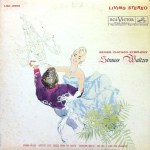
Are the Strauss Waltzes on the TAS List Any Good?

UPDATE 2026

The original, favorable review for this album you see further down is from at least ten years ago and probably more like fifteen.

When we revisited the copies we had of this title more recently, we felt the sound was badly lacking in many ways, with no real extension up top nor much weight to the bottom, the very definition of boxy sound.

Many of the vintage classical records we audition these days have sound that we liked well enough in the past but now no longer meet our standards.

Those pressings might sound fine on an old school stereo (or its modern equivalent), but we have something very different to play our records on, courtesy of the many revolutionary changes in audio that have dramatically altered the quality of analog playback over the last twenty five years.

We much prefer Boskovsky’s performances for Decca for waltzes and the like, by Strauss or anyone else.

TAS List Thoughts

We wanted to like the record, it’s on the TAS List for cryin’ out loud, shouldn’t it at least be pretty good?

It very well may be amazingly good, we can’t say it is or it isn’t. In order to be more sure of our opinion, we would need a great deal more data to back it up. We would need to have a large number of copies on hand, clean them all and play them in order to make it possible to find the killer stamper that may be hiding in the pile, assuming one might be.

(more…)

Cat Stevens on 2 Heavy Vinyl 45 RPM Discs, Part 1 – Is This the Truest Tillerman of Them All?

About ten years ago we auditioned and reviewed the 2011 edition of Tea for the Tillerman pressed by Analogue Productions, the one that came on a single Heavy Vinyl 33 RPM LP.

I wrote a very long commentary about the sound of that record, taking it to task for its manifold shortcomings, at the end of which I came to the conclusion that the proper sonic grade for such a record is F as in Fail. My exhaustive review asked the not-very-subtle question, this is your idea of analog?

Our intro gave this short overview:

Yes, we know, the folks over at Acoustic Sounds, in consultation with the late George Marino at Sterling Sound, supposedly with the real master tape in hand, and supposedly with access to the best mastering equipment money can buy, labored mightily, doing their level best to master and press the Definitive Audiophile Tea for the Tillerman of All Time.

It just didn’t come out very well, no matter what anybody tells you.

Recently I was able to borrow a copy of the new 45 cutting from a customer who had rather liked it. I would never have shelled out my own money to hear a record put out on the Analogue Productions label, a label that has an unmitigated string of failures to its name. But for free? Count me in!

The offer of the new 45 could not have been more fortuitous. I had just spent a number of weeks playing a White Hot Stamper Pink Label original UK pressing in an attempt to get our new Playback Studio sounding right.

We had a lot of problems. We needed to work on electrical issues. We needed to work on our room treatments. We needed to work on speaker placement.

We initially thought the room was doing everything right, because our Go To setup disc, Bob and Ray, sounded super spacious and clear, bigger and more lively than we’d ever heard it. That’s what a 12 foot high ceiling can do for a large group of musicians playing live in a huge studio, in 1959, on an All Tube Chain Living Stereo recording. The sound just soared.

But Cat Stevens wasn’t sounding right, and if Cat Stevens isn’t sounding right, we knew we had a Very Big Problem. Some stereos play some kinds of records well and others not so well. Our stereo has to play every kind of record well because we sell every kind of record there is. You name the kind of music, we probably sell it. And if we offer it for sale, we had to have played it and liked the sound, because no record makes it to our site without being auditioned and found to have excellent sound.

But I Might Die Tonight

The one song we played over and over again, easily a hundred times or more, was But I Might Die Tonight, the leadoff track for side two. It’s short, less than two minutes long, but a lot happens in those two minutes. More importantly, getting everything that happens in those two minutes to sound not just right, but as good as you have ever heard it, turned out to be a tall order indeed.

(more…)

Julie Is Her Name – A Boxstar Bomb from Bernie

Hot Stamper Pressings of Pop and Jazz Vocals Available Now

One question: Where’s the Tubey Magic?

We would never have pointed you in the direction of this awful Boxstar 45 of Julie Is Her Name, cut by Bernie Grundman in 2009, supposedly on tube equipment. I regret to say that we actually sold some copies, but in my defense I can honestly and truthfully claim that we never wrote a single nice thing about the sound of the record. That has to count for something, right?

We found the Tubey Magic on his pressing to be non-existent, as non-existent as it is on practically every Classic Record release he cut. If you have his version you are in for quite a treat when you finally get this one home and on your table. There is a world of difference between the sound of the two versions and we would be very surprised if it takes you more than ten seconds to hear it.

(more…)

Balalaika Favorites on Classic Records Is Unpleasantly Hard and Sour

It’s been quite a while since I played the Classic pressing of SR 90310, Balalaika Favorites, but I remember it as unpleasantly hard and sour.

Many of the later Mercury reissues pressed by Columbia had some of that sound, so I was already familiar with it when Classic’s pressing came out in 1998 as part of the just-plain-awful-sounding Mercury series they released.

I suspect I would hear it that way today. Bernie Grundman could cut the bass, the dynamics, and the energy onto the record. Everything else was worse — not just worse, but wrong — 99% of the time.

The fast transients of the plucked strings of the Balalaikas was just way beyond the capabilities of his colored and crude cutting system.

Harmonic extension and midrange delicacy were qualities that practically no Classic Records Heavy Vinyl pressing could claim to have.

Or, to be precise, they claimed to have them, and whether they really believed they did or not, they sure fooled a lot of audiophiles and the reviewers who write for them.

(more…)

Vienna 1908-1914 on Mercury Is No Better than Passable (SR-90316)

Hot Stamper Pressings of Mercury Living Presence Records Available Now

The various pressings we played of Mercury SR 90316 were not awful sounding by any means, but they were not especially good sounding either.

The strings tended to be shrill on the copies we had on hand.

We felt it best to abandon our plans to do a shootout for it. We will probably end up selling our stock on Discogs.

The sound of some pressings of this album might be passable, even to some degree enjoyable, especially when played on an old school system, but they are not worth bothering with on the high quality modern equipment we use.

Many Mercury recordings suffer from shrill strings, and to be honest we have certainly heard much worse, but for the money we charge even the copies that might win a shootout would not represent a good value for our customers, not once we factor in the high cost of the records and the time it would take to clean and play them all.

If you see a copy for cheap and aren’t that particular about sound quality, by all means pick it up, assuming the music appeals to you.

(more…)

When I Wrote this Years Ago I Was Being Far Too Charitable

Hot Stamper Pressings of the Music of Chet Atkins Available Now

It’s been quite a while since I played the Classic pressing, but I remember it as nothing special. Like a lot of the records put out by this label, it’s tonally fine but low-rez and lacking space, warmth and, above all, Tubey Magic.

When I wrote that years ago I was being far too charitable.

A remastered pressing of a Chet Atkins recording from 1959 that lacks Tubey Magic is one that is failing fundamentally to understand why it has any reason to exist.

The premise of the modern Heavy Vinyl pressing, as its legions of defenders constantly remind us, is to allow the listener to hear the music as it was meant to be heard — with two added bonuses: better vinyl, and affordable, non-collector prices.

(The dirty little secret of the mid-fi collector market is that affordability, not sound quality, is at the heart of it. The knock on our records is that they are expensive, but how is that relevant to the sound quality of the pressings we offer? A better sounding pressing is a better sound pressing, regardless of its price.)

These newly remastered pressings are meant to offer the music lover the opportunity to hear the true sound of the master tape. This elusive holy grail they will stop at nothing to acquire can be summed up in three words: Master Tape Sound. Or so they think.

(The fact that vanishingly few audiophiles have ever heard a master tape or would know oen if they heard one is an inconvenient truth that must not be allowed to interfere with their righteous desire to own whatever pressing purports to offer it.)

But I digress. Back to Chet Atkins in 1959. Let me sum up my position this way, with a nod to the Brits:

A Living Stereo recording that lacks Tubey Magic is one that has completely lost the plot.

(more…)