*Experimenting with Records

Revolutions in Audio Can Make a Huge Difference on Problematic Recordings

UPDATE 2026

In 2008 we did our first big shootout for Life Beyond L.A. which allowed us to discover a copy with sound quality we had simply never heard for the album, the kind of sound we had no idea could exist until we heard it.

In 2005 we had attempted the same shootout and abandoned. The difference between the best domestic pressings and the Nautilus Half-Speed were not big enough to justify the price we would have had to charge for the best copies.

We probably owned an exceptionally good sounding pressing of the Nautilus, something we also had no way of knowing, but the main problem we faced in 2005 was an inferior approach to record cleaning and playback equipment that was not up to the task.

Our ability to do shootouts advanced dramatically from 2005 to 2007.

Life Beyond L.A. is just one example of a shootout that couldn’t be done in 2005 but ended up being a smashing success in 2008.

Our Commentary from 2008

This White Hot Stamper pressing of Life Beyond L.A. from some years ago had the kind of sound you would never expect to find in the grooves of this album. It was a THRILL to hear it, especially at the volumes at which we were playing the record.

The transparency and openness were off the charts, unmatched by any other copy in our shootout. We’re big fans of this band here at Better Records — we love their take on complex, big production arty rock.

It’s also yet another example of the value of taking part in the myriad revolutions in audio.

If you never want your prized but sonically-challenged records to sound any better than they do right now, this minute, don’t bother to learn how to clean them better, play them back better or improve the acoustics of your room.

(more…)

Side One Had Tubey Colorations Missing from Side Two

Hot Stamper Pressings of Vintage Columbia Albums Available Now

An undiscovered gem from 1967 on the 360 Columbia label.

Side two of this record blew our minds with its White Hot Stamper sound.

Musically and sonically this record is nothing short of wonderful.

Who knew? You could play fifty vintage piano recordings and not find one as good as this.

Tchaikovsky, Liszt, Beethoven, Debussy, Mozart — these shorter pieces and excerpts were composed by those with the greatest gift for melody, men who’ve produced works that have stood the test of time, enchanting audiences over the centuries with works of such beauty and charm.

Here at Better Records we have never been fans of Columbia classical LPs. To be clear, the fault more often than not has to be in the mastering, not the recording. We’ve raved about so many great copies of titles in the past, only to find that the next three or four LPs we pick up of the very same titles sound godawful.

There are some amazing Bernstein recordings out there, but the amount of work it takes to find the one that sounds good is overwhelming — how can such great recordings be mastered so poorly so often?

Side One

A++, with a huge, rich, sweet, natural sounding piano. The more you listen, the more apparent it becomes that, as natural as it may seem at first blush, there are still some old school tubey colorations that make the sound not quite as lifelike as one might wish.

And the confirmation of that finding comes as soon as you flip the record over.

(more…)

Have You Ever Noticed that Sometimes the Highs Come Back on Some Pressings?

More of the music of Sergei Rachmaninoff (1873-1943)

This side one is interesting., I would say that it starts out Super Hot (A++) and within a few minutes becomes White Hot (A+++). The piano is a bit veiled at the start, but within a relatively short period of time that subtle loss of transparency disappears and the piano is RIGHT THERE.

This is not unusual in our experience.

The first track on many records can sound dull, and by the second track the highs come back and the tonality is right from top to bottom. Who knows why?

We speculate that the vinyl did not have time to fully heat up the edge of the record, but that’s speculation, something that has almost no value in our (yours and mine) quest for better sounding records. 1A, 1B, first off the stamper, who gives a flying you-know-what. You have to play the record to know how it sounds.

The rest is BS, proffered mostly by those who are simply too lazy (or busy; some folks do have real jobs!) to do the work of cleaning and playing multiple copies of an album in order to have the evidence they need to support their opinions.

We much prefer real knowledge supported by real evidence, not the other kind.

(more…)

This Pressing of Carmen Had Dry Strings on One Side, Rich Strings on the Other

Hot Stamper Pressings on Decca and London Available Now

My notes for side two on a copy we recently auditioned read:

Could use more tubes.

Strings could be a bit smoother.

Needs a bit more weight down low.

My notes for side one:

Side one had all of this and more!

Some Common Issues with Londons and Deccas

Many London and Decca pressings lack weight down low, which thins out the sound, easily heard in the lower strings, which sound washed out.

On some sides of some copies the strings are dry, lacking Tubey Magic. This is decidedly not our sound, although it can easily be heard on many London pressings, the kind we’ve played by the hundreds over the years.

If you have a rich sounding cartridge, perhaps with that little dip in the upper midrange that so many moving coils have these days, you will not notice this tonality issue nearly as much as we do.

Our 17Dx is ruler flat and quite unforgiving in this regard. It makes our shootouts much easier, but brings out the flaws in all but the best pressings, exactly the job we require it to do.

Here are some other records that are good for testing string tone and texture.

(more…)

Finding Good Companies to Invest In Is a Lot Like Finding Good Sounding Records to Play

Important Lessons We Learned from Record Experiments

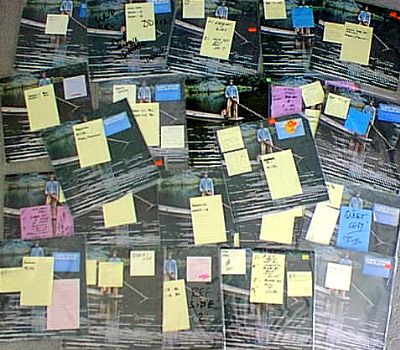
Which of the copies pictured below sound good and which ones don’t?

If you turn over enough of these “rocks,” you — and you alone — will know.

There are some amazing sounding winners in this pile. If you conduct your shootouts following the  tried and true methods we describe on the blog, you will be able to hear One Man Dog and every other album you love sound better than you ever dreamed possible.

Pictured below are just a small fraction of the rocks we’ve turned over in the 20 years since we began doing shootouts.

(more…)

Why Did Suite No. 2 Sound Better than Suite No. 5?

Hot Stamper Pressings of the Music of J.S. Bach Available Now

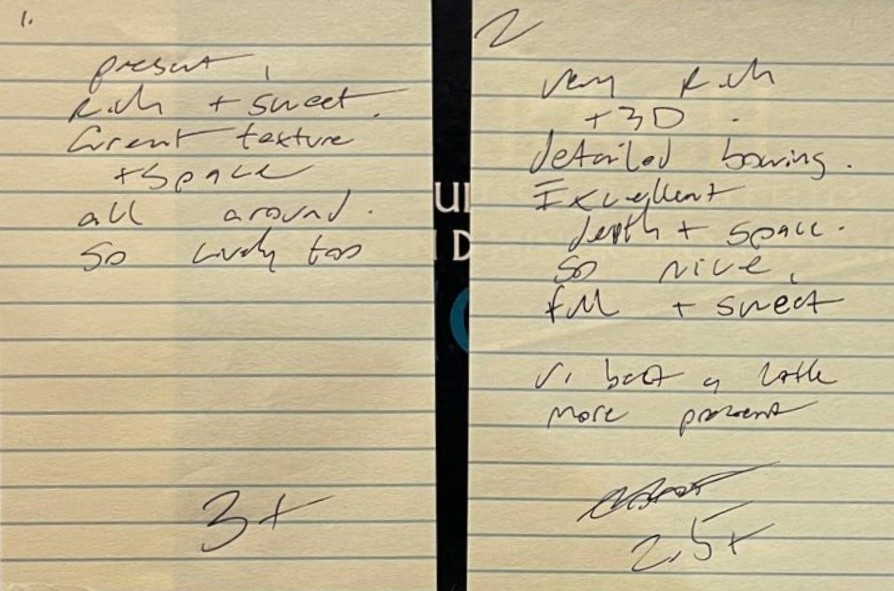
We described our most recent Shootout Winning pressing of SR-90370, Bach’s Suites Nos. 2 and 5 for Solo Cello this way:

An early Mercury label pressing of Starker’s legendary 1963 recording of Bach’s sublime music for solo cello with INCREDIBLE Shootout Winning Triple Plus (A+++) grades or close to them.

The bass-boosted, muddy, veiled and ambience-challenged sound of the typical modern Heavy Vinyl remaster is nowhere to be found here.

I would bet money that whatever version is currently available has plenty of shortcomings along those lines, which may be acceptable to the mid-fi crowd but is positively ruinous on the high-fidelity systems that our customers have (or why on earth would they keep paying these prices?)

Some Mercury pressings from the 50s have absolutely amazing sound – we should know, we’ve played them by the score

Side one was killer in every way, and the way we know that is we played a bunch of copies and nothing could beat it. This side one took top honors for having exactly the sound we described above.

  • Present
  • Rich and sweet
  • Great texture and space all around
  • So lively too

Side two is another matter. We came across a side two that was slightly better than the side two you see here.

(more…)

Put Us to the Test! We Can Tell a Good Record from a Bad One, Digital or No Digital

Skeptical Thinking Is Key to Finding Better Sounding Records

And we don’t need to know anything about how it was made in order to judge it!

For those of you who did not follow this story from a few years back, you may want to catch up here.

Although it’s behind a paywall, you can get a free test drive easily enough.

Now that you are up to date on the overall contours of this mess, here is another one of the many thoughts I have had concerning the revelation that Mobile Fidelity has been secretly sourcing at least some of their masters digitally since 2015.

Back in August of 2022, I wrote what you see below to Geoff Edgers, the reporter who exposed this ridiculous mess. (I toned it down quite a bit. The original version was not suitable for publication.)

Earlier that same year he had visited me at my studio, where I played him the awful Dire Straits first album that MoFi remastered, one of the worst half speeds ever made (review coming, but you can get a good idea of my take on it here).

By August of 2022 he was starting to see just how crazy the world of audiophiles actually is, and the more he learned about some of these people, the crazier they seemed. And he was not wrong about that.

My letter (with a few additions):

Jim Davis (of MoFi) is not one to be trusted and would have loved to cover up this whole thing if he could have figured out how to do it. It got away from him, and as far as I’m concerned, good.

And you heard how shitty their Dire Straits record is. Who cares if it’s digital? The sound is bad. Why bother trying to figure out the reasons this crappy label doesn’t know how to make good records? It’s just a fact. Accept it.

Many of MoFi’s now-exposed records were on Fremer and Esposito’s own lists of the best sounding analog albums.

Of course they were. I defy you to find me two “audiophile experts” who are wrong more often than these guys!

From the article:

One of the reasons they want to excoriate MoFi is for lying,” says Howarth. “The other part that bothers them is that they’ve been listening to digital all along and they’re highly invested in believing that any digital step will destroy their experience. And they’re wrong.

These people who claim they have golden ears and can hear the difference between analog and digital, well, it turns out you couldn’t.

The best ears? Are you kidding me? In their dreams. These guys give every indication that they are virtually devoid of critical listening skills. The evidence supporting this reality has been laid out in this very blog in scores of commentaries over the course of more than twenty years.

(more…)

Shootout Winning Stampers for The Planets Revealed

Hot Stamper Pressings of the Music of Holst Available Now

You may have noticed that on the few occasions when we actually do give out the stampers for the top copies of an album, we are loathe to identify the title of the record that has those Shootout Winning stampers.

As you can imagine, our huge investments in research and development make up a substantial share of the costs we bear, costs that sometimes accrue over the course of many years, decades even. Eventually these costs are passed on to our customers, accounting for some of the admittedly high prices you see on our site.

But this title is going to be an exception, with many more to follow. We are officially giving out stamper information for this London, information that took us more than a decade to acquire. Maybe even two decades.

The right 2W/4W pressings of CS 6734, the Decca recording of Holst’s The Planets conducted by Zubin Mehta, are the best we have ever played. Based on our experience over the years, these are the only stampers that have any chance of winning a shootout.

Below you will find the grades for all the top copies from our most recent efforts, as well as the also-rans with those same stampers that we played.

Only two pressings earned a top grade, and each of them managed to do so on only one side. This is by far the most common result of a shootout. 3+/3+ copies are the exception, not the rule.

Whatever caused the amazing sides of the best pressings to come out differently from the not-nearly-as-good sides of the other pressings must have happened in the plating and pressing stages of manufacturing, an area that was of course not under the control of the mastering engineer who cut the record in the UK for Decca, Harry Fisher.

(more…)

Three Top Copies Make for One Tough Shootout

Hot Stamper Pressings of the Music of Cat Stevens Available Now

Our good customer Michel wrote to us about his experience playing three Hot Stamper pressings of Mona Bone Jakon, two of which were our new favorite imports (hence the shootout winning grades) and one domestic LP that came close to them in sound  quality. Close, but no cigar.

At the bottom of the post you can see the notes for one of the knockout copies he bought.

Hi Tom,

Well, I’ve been going at it for about an hour and a half.

3 Hot Stamper copies… NWHS US 2.5/2.5… WHS UK 2.5/3… WHS UK 3/2.5.

Using both UK 3+ White Hots, I went back and forth and back and forth again with side one. The 3+ side one is definitely the winner. That is also my favorite side.

The more I listened, the more the 2.5+ side one sounded like a wanna-be 3.0! It was straining to get there, but simply could not. Everything really dialed in with the 3+ side.

There seemed to be less vocal strain on the sound with the 3+.

The amazing openess, clarity, warmth, natural tonality, extended bass that reverberates throughout my house and beyond are simply phenomenal. These ever so deep reverberating bass notes are simply divine on this 3+.

What a pleasure to listen to. I don’t think I own many records that can produce the sound that this one does.

(more…)

Anatomy of a Failed Shootout

Hot Stamper Pressings of the Music of Beethoven Available Now

By the early 2000s we had finally come to the conclusion that the RCA pressings of the Beethoven 7th offered the best combination of sound and performance we could find.

By 2024 we had enough copies — seven in total — to do a shootout. The best copy we were able to salvage from this debacle is described, perhaps too generously, below.

This Decca-recorded, Shaded Dog pressing of Beethoven’s Symphony No. 7 debuts on the site with big, spacious, and lively Double Plus (A++) Living Stereo sound or close to it.

Side one is doing just about everything right – it’s rich, clear, undistorted, open, and has depth and transparency to rival the best recordings you may have heard, and side two is not far behind in all those areas.

The full stamper sheet shown below makes clear what happens when your luck just plain runs out. The Soria pressings were by far the best — they were the only ones to earn 3+ on either side — but side two of all three copies we played was defective, rendering them all but worthless.

When RCA recut the record for their regularly priced Living Stereo release, LSC-2536, the dropoff in sound quality was profound, a fact readily seen from our notes. (“Rich but bright, side two is worse.”)

(more…)