Robert Brook has a blog which he calls
A GUIDE FOR THE DEDICATED ANALOG AUDIOPHILE
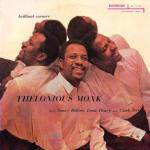
Below you will find a link to the shootout Robert recently conducted for Thelonious Monk’s amazing Brilliant Corners album on OJC.
Robert Brook has a blog which he calls
A GUIDE FOR THE DEDICATED ANALOG AUDIOPHILE
Below you will find a link to the shootout Robert recently conducted for Thelonious Monk’s amazing Brilliant Corners album on OJC.
 Hot Stamper Pressings of Aja Available Now
Go ahead, take a guess.
If you guessed the Cisco LP from 2007, one of the worst sounding versions of the album ever pressed, you win a prize!
When I go searching the web to find out something about a record, occasionally I come across something I had no idea existed.
Look what I found today: a survey of various pressings of Aja!
Aja is an album I think I know pretty well. I’ve been playing it since the day it came out in 1977 and still listen to it regularly.
Play the video and tell me if you think you are learning anything useful from the guy. Does he seem to understand much about the sound of the pressings he is reviewing?
I didn’t think so. If you know much about records you should be appalled at the nonsense coming out of this guy’s mouth. This video will no doubt garner many ten of thousands of hits, but that is to be expected.
Phony record gurus like this guy — as opposed to authentic record gurus like us — have found a home in every corner of the web, spewing out bad advice for those foolish enough to take it.

Hot Stamper Pressings of the Music of Pink Floyd Available Now
It doesn’t to me, but I admit to some bias when it comes to Dark Side of the Moon. I must have played more than a hundred different pressings over the last forty-odd years.
Year after year I was sure I understood exactly which copies had the best sound, and again and again I was proved wrong. (To be clear, I proved myself wrong. Shootouts have a way of doing that.)
We only found out what the best sounding versions were about five or six years ago [make that ten]. We did that by doing shootout after shootout with every version we could lay our hands on, starting around 2005. We even did a shootout for two different Mobile Fidelity pressings many years ago, which we think makes for some good reading to this day.
It’s especially good reading for those who don’t appreciate how dramatic pressing variations can be for even quality controlled limited editions. The comparison of the two MoFi’s centers around the idea that midrange tonality is by far the most important quality to listen for on Dark Side, and that, surprisingly to some audiophiles, but obviously not to us, there are MoFi pressings with a correct midrange and there are some without.
Is this fellow listening for midrange tonality? If you watch the video and he says he is, then you can let me know! And if not, you can ask him in the comments why he wasn’t. Maybe he just likes the chiming clocks and the deep bass of the heartbeat.
 The LOST Beatles Album | Cancelled By Apple – Should It Be Re-released?
Click on the link above to see an interesting and informative video that we think is well worth watching.
Allow me to make a few points:
As to the question posed above, my vote would of course be no. The new Beatles albums are awful sounding. Here are a few of rour eviews detailing their many shortcomings:
After playing those three, we gave up on the idea of playing the rest of the set.
The Mono Box (in analog!) was even worse. We played one record, heard truly awful sound, and that was all she wrote.
Mushy Sound Quality
Andrew Milton, the Parlogram Auctions guy, offers opinions about the sound quality of the various pressings he reviews. Naturally we are skeptical of reviewers’ opinions for reasons that should be clear to readers of this blog.
We have no idea how he cleans his records or how carefully he plays his records, or even what he listens for.
Frankly, even if we knew all those things it wouldn’t mean much to us. So many reviewers like so many bad sounding modern records that we’ve learned not to take anything they say seriously.
The comment about the 1G stampers being “mushy” that Andrew makes about 19 minutes in is one we take exception to. Part of the problem with his comment is that we can’t really be sure what he means by “mushy.” If it means smeary or thick, that has not been our experience with the best cleaned originals.
Not sure how much of this video you can stand — nothing could interest me less than watching a couple of vinyl enthusiasts spouting off on what they think about some random records sitting in a local store’s bins.
But one or two bits caught my eye. I thought I might take the opportunity to share my take on them with you.
Is there any value to the comments of these two collectors? If you care about what music they like, perhaps. Anything about what to look for on the label or jacket that might correspond to better sound? If it’s there I sure didn’t see it, but I admit to speeding through most of it, so I can’t say for sure.
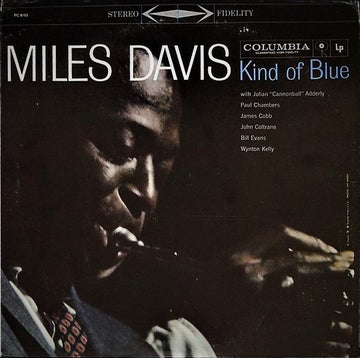
The first bit I refer to above is at 18:42. The album in question is the legendary Kind of Blue. At this point the unseen helmet-cammed audiophile picks up the record, recognizes the cover, and proceeds to pull the record out to see what era the pressing is from.
Drat! The disappointment in this audiophile’s voice is palpable as he drops the record back in the bin with his dismissive comment that “it’s a later pressing.”
But we here at Better Records would be falling all over ourselves to get our hands on that later pressing.
Those late pressings can and often do win shootouts. We would never look down our noses at a Red Label Columbia jazz LP, and neither should you.
UPDATE 2025
As good as the best pressings on the Red Label can sound, it has been years since one won a shootout. Here is our commentary for a recent 70s copy that went up on the site, one that earned a Super Hot grade on both sides.
They tend to sell for four or five hundred dollars these days. Why so much you ask? Because they beat the pants off of every so-called audiophile pressing of the album ever made. The testimony of one of our customers does a good job of describing the differences.
In addition, it turns out that at least nine out of ten of the copies with the red label are not remotely as good as the ones that earn Super Hot grades. The good ones are so rare that we only pick them up locally since practically none of the ones we find on the web have the right stampers. Trying to find the right red label needle in the haystack is more trouble than it’s worth, so don’t expect to see many coming to the site.
Our intrepid audiophile explorer does much the same thing about 23 minutes in. It seems pretty clear to us that he has no respect for such reissues, another example of one of the most common myths in record collecting land, the myth that the original pressing is always, or to be fair, usually better.
This is simply not true, and those of our customers who have purchased White Hot Stamper pressings from us that turned out to be reissues know exactly what I am talking about. This is especially true for the records we sell by The Beatles. No original pressing has every won a shootout. [With one exception.]
Let’s get back to Kind of Blue.
Is the 50s original always better, is the 70s reissue always better, is the 60s 360 pressing always better?
No to one, two and three.
Why? Because no pressing is always better. All pressings are unique and should only be judged on their merits, and you do that by playing them, not by looking at their labels. For us this truth is practically axiomatic. It is in fact the premise of our entire business. Over the course of the 28 years we have been selling records we have never found any compelling evidence to invalidate it.
The day that someone can accurately predict the sound quality of a specific record by looking at the label or cover is a day I do not expect to come, ever.
UPDATE 2025
The above is somewhat misleading. With enough clean 6-Eye pressings on hand to play in a shooout, one of them will win.
That being the case, we have created two lists for those who would like to know which Columbia labels win shootouts — one for 6-Eye winners and one for 360 Label winners.
Ken Fritz turned his home into an audiophile’s dream — “the world’s greatest hi-fi”.
What would it mean in the end?
Geoff Edgers has written a highly entertaining story about an extremely misguided audiophile who went “searching for perfect sound” in ways that practically guaranteed he would never find it.
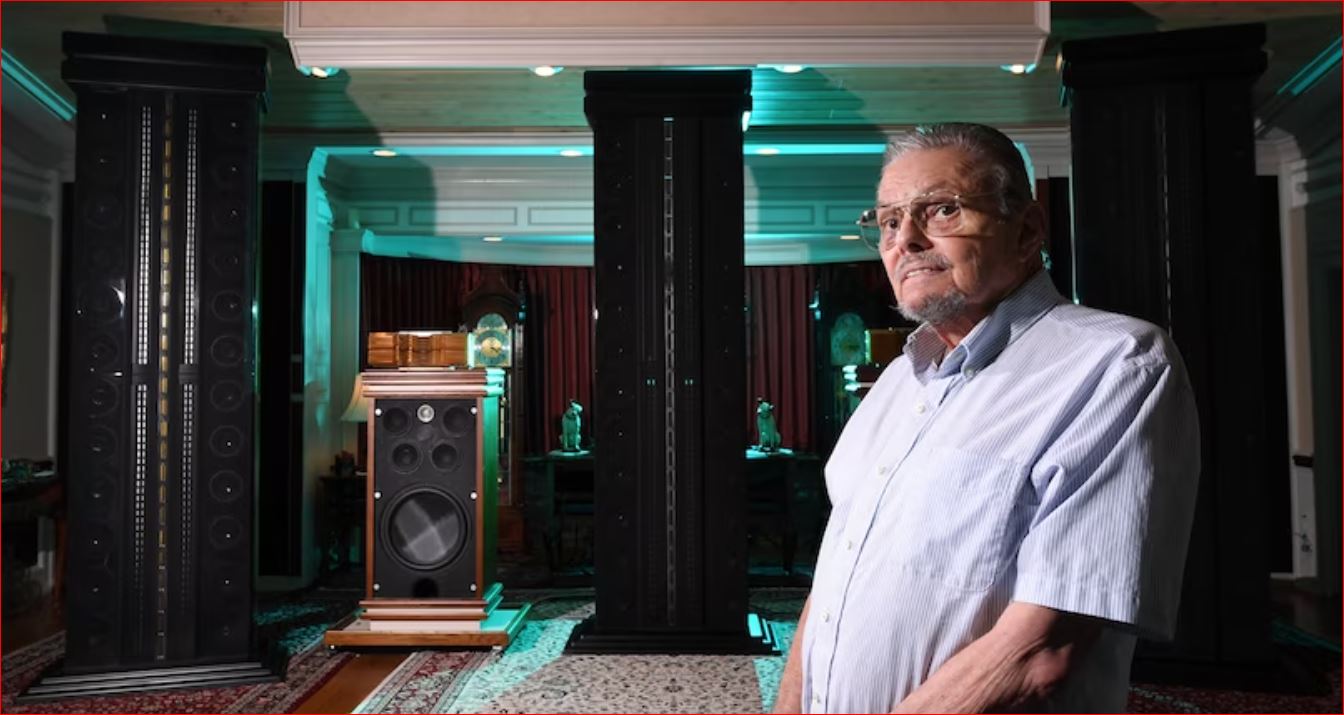
There are a number of lessons to be learned from this fellow’s mistakes.
Just to take one obvious example, this picture of some of the records in his collection speaks volumes, at least it does to me.
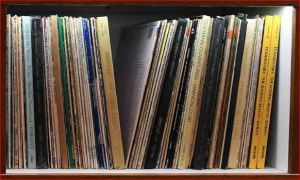 He built a million dollar stereo to play records like these?
No amount of money spent on equipment can make most of these titles sound good, and failure to appreciate that fact is just one of the many fatal errors the late Mr. Fritz made in his approach to both records and audio.
He mistakenly thought he was at the “I know everything” stage, but that is just the prelude to the stages of knowledge where real understanding and progress begin, not end.
My own stereo history may be of some value in helping to shed light on these issues. Like everyone else, I started at the bottom. Thank god I didn’t have a million dollars to waste back then because I clearly didn’t understand audio any better than the late Mr. Fritz did.
Like him and practically every audiophile I’ve ever come in contact with, I sure thought I did. Having suffered myself from a serious case of pretentious-knowledge syndrome, it’s easy for me to spot the signs in others. (My understanding is that you can’t sign up on the Hoffman Forum without first proving your know-it-all bona fides.)
Why So Uncomfortable?
In a recent letter I received about the Dynavector 17dx cartridge we use, this question was posed:
Why is it that audiophiles are so uncomfortable with the idea that they might be wrong? I mean, you can’t improve if you think you are already right.
I answered as follows:
I was no different back when I started. For about my first ten years in high-end audio, roughly 1975-85, I bought the most expensive equipment that I could afford, as long as it sounded good to me and was well-liked by those whose ears I trusted.
Is the audiophile of today doing anything different?
What would you be doing if you hadn’t stumbled on a guy with some credibility — he sold you some records that sounded amazing, so he must know something — who turned you on to some audio stuff that sounds great and, better yet, didn’t cost that much?
And how did this guy — me — come to find out about all this stuff in the first place? Well, I’ll tell you.
 Hot Stamper Pressings of the Music of The Cars Available Now
He sure ought to be!
Based on what I’ve just read, if Rhino Records is looking for a cheerleader, they could hardly do better than Mr. Youman.
I stumbled upon this fellow’s review of The Cars first album on Positive Feedback just a few days ago.
Not sure I would even call it a review. It comes across to me as more of a PR release.
I don’t think Positive Feedback cares either way. They need content, and apparently they consider this content.
The New Rhino High Fidelity Series – The Cars And John Coltrane Kick It Off in Grand Style!
One thing I have noticed about PF is that they do not seem to employ editors of any kind. My friend Robert Pincus writes for them — here is his review of a Dillards album that no one would be likely to buy from us at our prices but is probably worth picking up for the five or ten dollars a record store might charge. There are plenty of typos throughout his reviews and others I have read.
You’re on your own with PF. And they are good with however many exclamation marks you may want to use. Four in one paragraph? Bring it on they say!
The following paragraph from Youman’s review contains a ridiculous mistake that any knowledgeable editor should have noticed. Can you spot it? If so, email me at tom@better-records.com
Mastered by George Marino, the 1978 original would seem hard to beat, as the level of detail and attack is quite impressive. It absolutely rocks, and I would be very happy if this was my one and only copy. The 1980 Nautilus, which was half speed mastered by Jack Hunt, is surprisingly very much like the original with some minimal improvement in transparency and dynamic punch. Most would be hard pressed to hear the difference. Of course, the super quiet Japanese vinyl might be contributing to this. We also have the 2009 Mofi, which was half speed mastered by Shawn Britton. In my system, I found it to be dark and somewhat veiled. Bass was just too prominent to my ears. It was almost impossible to sit through the entire Mofi after hearing the OG and the Nautilus. I am a huge Mofi fan, so this was very disappointing.
When someone as clearly lacking in critical listening skills as this fellow has the temerity to compare “the” original and the Nautilus remaster (reviewed here) and declare “Most would be hard pressed to hear the difference,” it rubs me the wrong way.
I want to sit such a person down and say that it’s unlikely that anyone with two working ears and a halfway-decent stereo would not hear the difference.
You can hardly hear it, that seems clear, but why insult those of us who love The Cars and can tell good sound from bad?
The reference to Giant Steps below is yet more evidence of this fellow’s inability to recognize a bad record when he hears it:
Let’s return to that Rhino catalog and all that it could possibly offer to the audiophile enthusiast. We need to send our wish lists and raise our hands if not bring out the megaphones! Of course we have the Led Zeppelin catalog, but that has been debated ad nauseum on several internet websites and forums. It seems that those in control will not allow it. Can you imagine a Kevin Gray mastering for Led Zeppelin II? There have been several very good reissues for the Black Sabbath catalog, but the original UK pressings are still the ones to beat based on my own comparisons with various other collectors. Lets [sic] get those original analog UK tapes and hand them over to Kevin! I also have a copy of the 45 RPM John Coltrane, Giant Steps released by Rhino in 2008. Some argue that this is best pressing ever and by a wide margin! One of the top ten jazz releases of all time as ranked by many jazz experts. Bernie Grundman did a fantastic job on that reissue but there was only a limited production of 2500 copies. Lets [sic] take another shot at those tapes as part of the new Rhino High Fidelity series!
We make the case that Bernie’s recutting of Giant Steps for Rhino is possibly the worst sounding version of the album ever, and perhaps by a wide margin! He already had his shot, the patient did not survive the operation, what good would it do to put another bullet in the corpse?
Jazz experts may rank it one of the top releases of all time — I certainly would — but it is unlikely they have ever heard Rhino’s bloated, thick, dull, lifeless and altogether unsatisfactory pressing of the album. We gave it an a F and felt that we were being too kind. There is some consolation to be had though: The limited production meant that only 2500 people had to suffer through it upon release. (According to Discogs, these days the average price paid for a copy is $225. We may charge a lot for records, but we charge a lot for good sounding records, not bad sounding records, and that should count for something, shouldn’t it?)
And Kevin Gray already ruined the album once for Rhino, so why would anyone want to hand him the tapes to do it again? Is he now a better mastering engineer than he was in the mid-2000s? What evidence to support this proposition could you possibly supply to those of us who question his competence? The shockingly bad sounding records he’s cut recently — Stand Up, Moondance and Rickie Lee Jones are three that spring to mind — make a mockery of the very idea that this guy knows anything about high-fidelity records.
More comments from the above paragraph of the exploding head variety:
There have been several very good reissues for the Black Sabbath catalog…
Have there? Would someone please name one? We would love to hear it.
but the original UK pressings are still the ones to beat based on my own comparisons with various other collectors.
Then buddy, you need to get out more.
The UK pressings we have played are not competitive in the least with the best domestic originals. Maybe there are some new reissues that are comparable to the UK pressings, but that is clearly setting the bar much too low. For our last shootout, we noted:
 Basic Audio Advice — These Are the Fundamentals of Good Sound
A fundamental tenet of conservatism is that we must accommodate ourselves to the world that exists, not the world we might want to pretend exists, or the world we would like to exist.
The laws of physics are laws — not theories, not recommendations — and they operate independently of how convenient we may find them.
It follows from this — if you will allow me to make the case — that not everybody with a stereo can play Rudy Van Gelder’s recordings properly, and some people cannot play Tarzan at all. (More on that below.)
There is a fellow, rl1856, who made some comments on Robert Brook’s blog, addressing the Tone Poets pressings of RVG’s recordings vis-a-vis vintage pressings that RVG mastered. (Emphasis added.)
rl1856 writes:
An original RVG 1st or 2nd pressing has a visceral, “edge of the seat” feeling that is missing in the TP [Tone Poets] and BN [Blue Note] Classic reissues. The RVG has a tighter stereo spread, and is voiced so that the listener feels they are very close to the musicians. The TP and Classic remasters have a more distant perspective. The soundstage is wider, but the added apparent distance between musician and listener significantly reduces the impact of the music. OTOH, the reissues have greater extension at frequency extremes, and reproduce more micro detail than original pressings. We know that RVG used a surprising amount of EQ when mastering his LPs back in the day. So we need to ask ourselves, what do we want ? A better version of what we are familiar with, including EQ compromises, or a more accurate representation of what was actually captured on the master tape in RVG’s studio ? The answers may be mutually exclusive.
My system: Linn LP12 ITTOK LVII, SoundSmith Denon 103D, Audio Research SP10MKIII, Luxman MA 88 monoblocks, or Triode TRV 845PSE, or Mac 240, KEF LS50. Resolving enough to easily hear differences in LP quality.
When an audiophile reveals that his equipment is simply not capable of reproducing the sound of live music, I think that we can safely ignore whatever opinions he may have offered about the sound of the records he is discussing.
It’s obvious that the records were played with unacceptably low fidelity, which means he has all the credibility of a blind man judging paintings.
If this person wants to make the case that he is in fact able to reproduce music with acceptable fidelity, we would need to know more about his system and room in order to take his claim more seriously.
 Hot Stamper Pressings of the Music of Paul Simon Available Now
Click on the link below to read the story behind an interview conducted by a well-known reviewer of an engineer who was tasked (by whom I wonder?) with remastering Graceland on Heavy Vinyl.
He apparently had never played an original Sterling-mastered copy of Graceland. Either that, or this engineer thought the original “needed improvement,” the kind supplied by taking a hatchet to the sound of the original tape.
Analogplanet Visits Sterling Sound and Interviews Mastering Engineer Ryan K. Smith
The interviewer apparently does not know how bad the new version sounds, but we had no trouble recognizing its awfulness here at Better Records. As a public service, we soon set about describing what we heard when we put this remastered piece of junk to the test.
Up against a properly-mastered, properly-pressed early pressing, it earned a failing grade.
Is it the worst version of the album ever pressed on vinyl? Hard to imagine it would have much competition.
The title of our review gives away the game:
The reviewer who interviewed the remastering engineer responsible for this and no doubt many other awful sounding records has never been able to tell a good record from a bad one, and he carries on that tradition with Graceland.
Ryan Smith, the hack who cut this album, has done quite a lot of work for Analogue Productions. We can’t say we’ve played many of his recuts, but the ones we have played are hopelessly bad, with the overly smooth sound so much in vogue today.
We played his recut of Scheherazade, and rather than just give it the failing grade it deserved, we explained how any audiophile could go about using its mistaken EQ in order to recognize what is wrong with it, and of course, others like it.
(Contrary to popular opinion, it is no better than Bernie Grundman’s bad sounding version from the 90s, the one he cut for Classic Records.)
One of my good customers read this rave review from this same reviewer for the Texas Hurricane Box Set and made the worst mistake any audiophile can make: he believed it.
“His overdriven Stratocaster sound is one that guitar aficionados never tire of hearing live or on record, especially when it’s well recorded. … Yet again, Chad Kassem sets high the box set reissue bar delivering a “must have” package for SRV fans, every bit the equal of the one Doors fans have come to cherish. …every one of these records betters the originals and by a considerable margin. It is not even close…You’ve never heard these albums sound like this. That is a 100 % guaranty. …this is an impeccably produced box set physically and especially sonically. It’s the best these albums have ever and probably will ever sound.” — Music = 9/11; Sound = 10/11 — Michael Fremer
Sure, he’s out $400, but on the bright side he’s now learned a lesson he is very unlikely to forget.
 Hot Stamper Pressing of Miles’s Albums Available Now
The MoFi of KOB may be a joke, but don’t bother telling this guy, who appears to be rather new to this whole “reviewing” thing.
He has a record store in Phoenix and a youtube channel called The “In” Groove, wherein he proffers advice to audiophiles about records. Unsurprisingly, he tends to favor audiophile pressings. No doubt he sells lots of them in his store.
To quote the man himself, “I do a review of the best sounding copy’s [sic] of Miles Davis – Kind Of Blue. What are the copy’s [sic] you should own?”
Obviously, literacy is not his strong suit, so writing about records is out, replaced by endless talking about records on another one of these insufferable content-light videos.
Everything of interest this gentleman has to say could be written on the back of a napkin and read in the span of the average TV commercial, but that would require stringing together lots of words and arranging them so that they make some kind of sense. It’s so much easier to chat about vinyl while seated in front of some very expensive and no doubt awful sounding (judging by the results of this “shootout”) McIntosh electronics. (I am on record as being opposed to this approach to audio, and have been proselytizing for the benefits of low power amps for more than twenty years.)
Regardless of what he thinks he is doing, in no way does this fellow actually review the best sounding copies, because he’s too inexperienced and ill-informed to even bother with the ’70s Red Label reissue pressings, some versions of which happen to be among the best pressings we’ve heard, a subject we discuss here.
Our Kind of Blue Obsession
KOB is an album we have been obsessed with for a very long time, along with a great many others.