Other LPs to Improve Your Playback

Lincoln and Doug Produced The Audiophile Sgt. Pepper of Its Day

Hot Stamper Pressings of the Music of Lincoln Mayorga Available Now

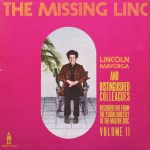
When I was selling audio equipment back in the 70s (Audio Research, Fulton speakers), The Missing Linc this was a favorite Demo Disc in our store.

With a big speaker like the Fulton J, the bass drum at the end of track two would shake the walls. At the time I had never heard a record with bass that went remotely that deep. (The album came out in 1972. I’m guessing I probably first heard a copy in ’75 or ’76 when I bought my Fultons, which would have been sometime in my early twenties.)

Every bit as amazing to me was the string quartet on side 2. You could actually hear the musicians breathing and turning the pages on their music stands, just as if you were actually in their “living presence.” No recording I had ever owned allowed me to hear that level of natural detail.

This is one of the albums that made me realize how good audio in the home could be.

(more…)

Port’s Rule and The Song of the Volga Boatman

More Records that Helped Me Make Progress in Audio

The track that started us down the road to our first Sauter-Finegan shootout is, to this very day, our Number One Test Track of All Time, a little ditty known as the Song of the Volga Boatman.

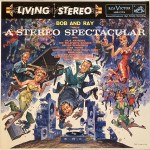
We first heard it back in the 90s on Bob and Ray Throw a Stereo Spectacular, which is still the version we test with, but this album of forward-looking big band contains that track  as well as 10 others, all with truly amazing sound.

Why is the Song of the Volga Boatman our ultimate test track?

The simplest way to understand it is that all the instruments are being played live in the studio, and all of them in the huge soundfield are real and acoustic — string bass, drums, horns of every size and type, woodwinds, percussion, tubular bells, etc.

In addition, the arrangements given to this roomful of players is so complex and lively that if anything sounds “funny,” to use the precise audiophile nomenclature, it really calls attention to itself.

Port’s Rule states: If it isn’t easy for your Test Discs to sound wrong, they are not very good Test Discs.

Wrong is the natural order of things.

Getting it right is where the work comes in to play.

And it should seem more like play than work or you are unlikely to get very far with it. (That’s another one of Port’s Rules, sometimes referred to as music does the driving.)

When the stereo is right from top to bottom, this song is right from top to bottom, and every other record we know the sound of will have the sound it’s supposed to have.

It seems simple and in some ways it is.

We’ve been getting the Song of the Volga Boatman to sound bigger and better now for years, through scores and scores of changes. At our current stage of audio evolution, at the very loud levels we play it at, it’s shocking how big, powerful and real it seems. It has more of the “live music” qualities we prize than almost any other studio recording I can think of.

(more…)

These Records Helped Us Dramatically Improve Our Playback

Some of the Most Important Albums We Employed to Tune, Tweak and Improve Our Stereo, Room, Table Setup, Electrical Quality and More

The records on this list (limited to rock and pop for the most part but we’re working on adding in the classical and jazz) all have one thing in common: I made practical use of them to improve my equipment, room treatments, table setup, electrical quality and whatever else that I could think of that might result in higher quality playback.

Were it not for my desire — obsession may be the better word, and it’s certainly a better operating principle — to get the wonderful music on these albums to improve with each passing year, Hot Stamper pressings would be at most a niche part of my collection. Worse, and a thought some may find too unpleasant to contemplate, Hot Stampers might have then accounted for only a small part of Better Records’ business.

By the mid-2000s when we started down this road for real, the stereo needed to evolve dramatically. It needed to become much more revealing and truthful than any system I had ever heard if we were going to carry out Hot Stamper shootouts all day.

The best of the best Hot Stamper pressings are often like needles in haystacks. No one in his right mind would go to all that trouble for music that was not emotionally powerful enough to be, for all intents and purposes, practically irresistible.

If you have records you can’t wait to play every time you make a change to your equipment, room, setup, etc., you know what I am talking about.

I favor large scale dynamic speakers because they are the only ones that seem capable of reproducing the demanding recordings you see listed below.

There is no question that the artists that made these albums, in concert with remarkably talented producers and engineers, sweated every detail of these exceptional recordings. For the last five decades I (now we) have been doing all we could to get these wonderful records to sound their best.

We know how good they can sound on systems that have what it takes to play them, because these are the records we used to test, tune and tweak the new studio we built.

The more of that kind of work you do — on your system, room and electricity — the more progress you will make in this hobby. With each improvement, these are the very recordings that will sound bigger and bolder than you ever imagined.

They are the most difficult-to-reproduce albums we know of. Difficult records are the ones that will help you make more real, demonstrable progress in this hobby than any others.

Again and again it was meeting the challenge of reproducing recordings such as these that allowed us to get to the next level, and the next one, and the one after that, and they can do the same for you.

The Top Two

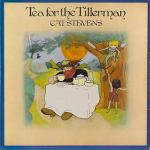
By far the two most helpful records for testing over the last two decades were Tea for the Tillerman (going all the way back to 1984) and Bob and Ray Throw a Stereo Spectacular. We wrote about their uniquely valuable contributions to our audio progress in this commentary.

Led Zeppelin II is probably the main record our current listening panel uses to dial-in the Dynavector 17Dx Karat cartridges we mount three or four times a year so that every record is always  being played with a relatively fresh cartridge. (We are dealers for Dynavector and would love to get you one to try.)

The records below in bold have been especially important for our work. There should be quite a number of commentaries on the blog for each of them.

Also, at the bottom you will notice that more and more jazz and classical records are being added to the list as time permits.

Rock, Pop, etc.
  • 10cc / The Original Soundtrack
  • 10cc / Deceptive Bends
  • 801 / Live
  • Ambrosia / Self-titled
  • America / Self-titled
  • The Beatles / Please Please Me
  • The Beatles / Rubber Soul
  • The Beatles / Revolver
  • The Beatles / Sgt. Pepper’s
  • The Beatles / Magical Mystery Tour
  • The Beatles / Abbey Road

(more…)

The Insufficiently Dedicated Will Have a Fight on Their Hands with This One

A spectacular orchestral dreadnought such as this requires mastering and pressing of the highest quality.

Herrmann’s music taxes the limits of LP playback itself, with deep organ notes (listen for the famous Decca rumble accompanying the organ if you have the deep bass reproduction to hear it); incredible dynamics from every area of the stage; masses of strings playing at the top of their registers with abandon; huge drums; powerful brass effects everywhere — every sound an orchestra can produce is found on this record, and then some.

You will hear plenty of sounds that defy description, that’s for sure. Some of the time I can’t even imagine what instrument could possibly make such a sound!

Your Hard Work Pays Off

A recording of this size and scope will bring virtually any stereo system to its knees. This is the real Power Of The Orchestra! You had better have a top quality front end if you want to play this record properly, not to mention plenty of power and big speakers.

This is not the record for the weekend budget audiophile. If you haven’t put in the years of effort and invested the tens of thousands of dollars in equipment and room treatments it takes to play records of great difficulty such as this one, your system is probably not up to the challenge this album represents.

If, on the other hand, you’ve done the work and spent the money, this is the album that will show you what you have achieved.

Side One

Journey to the Center of the Earth

All those lovely harps! You can practically feel the cool air of the cave as you descend into the blackness.

The Seventh Voyage of Sinbad

Side one boasts some wonderful material from Jason and the Argonauts, including the fight with the skeletons that we all remember from our Saturday matinee movie days. Who else could have orchestrated such a film?

Side Two

The Day the Earth Stood Still

Astonishingly powerful deep bass and drum sounds!

Fahrenheit 451

One of our key tests for side two is the string tone on the Fire Engine sequence.

(more…)

Bob and Ray Were Not Enough – We Needed the Tillerman Too

Bob and Ray Throw a Stereo Spectacular is my all time favorite test disc, the one test that every change to the system must pass: by making The Song of the Volga Boatmen sound better.

The danger in making the bulk of your sonic judgments using only one record is that you never want to optimize your system for a single record, only to find out later that it now sounds better but others you play now sound worse.

Here is the story of how I made that mistake long ago (and apparently did not learn my lesson): In 2005, I fell into a exactly this kind of audiophile trap.

The Right Way

So the right way to go about testing and tweaking is to get all your hardest test records out and start playing them, making notes as you tweak and tune your system, setup, room and whatever else you can think of.

This may take a long time, but it is time well spent when you consider that, once you are done, all — or nearly all — of your records will sound better than they did before.

In my review of the 45 RPM Tillerman, I noted the following:

Recently I was able to borrow a copy of the new 45 cutting from a customer who had rather liked it. I would have never spent my own money to hear a record put out on the Analogue Productions label, a label that has an unmitigated string of failures to its name. But for free? Count me in!

The offer of the new 45 could not have been more fortuitous. I had just spent a number of weeks playing a White Hot pink label original UK pressing in an attempt to get our new playback studio sounding right.

We had a lot of problems.

We needed to work on electrical issues.

We needed to work on our room treatments.

We needed to work on speaker placement.

We Repeated Our Mistake

(more…)

Lincoln Mayorga Volume 3 – Listen for Strained and Blary Brass

Hot Stamper Pressings of Direct-to-Disc Recordings Available Now

Most copies of this album are slightly thin and slightly bright.

They give the impression of being clear and clean, but some of the louder brass passages start to get strained and blary, or glary if you like.

The good copies are rich and full.  The sound is balanced from top to bottom.

The sound is smooth, which allows you to play the album all the way through at good loud levels without fatigue.

On the best pressings, the trumpets, trombones, tubas, tambourines, and drums all have the true tonality and the vibrancy of the real thing. The reason this record was such a big hit in its day is because the recording engineers were able to capture that sound better than anybody else around [not really, but that’s what it seemed like at the time].

That’s also the reason this is a Must Own record today — the sound and the music hold up.

Just listen to that amazing brass choir on Oh Lord, I’m On My Way. It just doesn’t get any better than that. If ever there was a Demo Disc for Brass, this is one!

I used to think the Tower label copies were not as good — that the later pressings were pressed better. Now I know that it doesn’t matter what era the pressing is from: the tonal balance is the key to the best sound.

(more…)

Bob and Ray Produced Our Favorite Record for Cartridge Setup

Hot Stamper Pressings of Bob and Ray Available Now

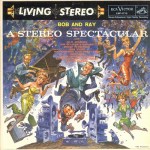
Bob and Ray Throw a Stereo Spectacular just happens to be our favorite Test Disc, eclipsing all others in the areas of naturalness and difficulty of reproduction. Any tweak or new room treatment — we seem to do them almost weekly these days — has to pass one test and one test only — the Bob and Ray Test. 

This record has the power to help you get to the next level in audio like no other.

Six words hold the key to better sound: The Song of the Volga Boatman.

For the purpose of mounting new carts, our favorite track is The Song of the Volga Boatman from LSP 1773. It’s by far the most difficult track we know of to get to sound right.

There are about twenty places in the music that we use as tests, and the right setting is the one that gets the most of them to sound their best. With every change some of the twenty will sound better and some will sound worse. Recognizing when the sound is the biggest, clearest, and most balanced from top to bottom is a skill that has taken me twenty years to acquire.

It’s a lot harder than it looks. The longer you have been in audio, the more complicated it can seem, which may be counterintuitive but comports well with our day-to-day experience very well.

All our room treatments and tweaks must pass The Bob and Ray Test as well. It’s the one record we have relied on more than any other over the course of the last ten years.

Presenting as it does a huge studio full of brass players, no record we know of is more dynamic or more natural sounding — when the system is working right. When it’s not working right the first thirty seconds is all it takes to show you the trouble you are in.

If you don’t have a record like that in your collection, we highly recommend you find one.

It will be invaluable in the long run. The copy we have is so good (White Hot, the best we have ever played), and so important to our operation here, that it would not be for sale at any (well, almost any) price.

(more…)

This Buck Dance Had Highs Like No Other

Hot Stamper Pressings of Living Stereo Recordings Available Now

[This review was probably written in 2010 or thereabouts.]

It’s been nearly two years but the waiting is over — we’ve found another copy of the famous Bob and Ray on Living Stereo with DEMONSTRATION QUALITY SOUND! Without a doubt this is the best sound I have ever heard for side one of this album. The sound here is so amazing I’m willing to go out on a limb and make the following recklessly bold statement. Buck Dance on this pressing has the most extended, natural and harmonically correct high frequencies I have ever heard from my speakers (or anyone else’s for that matter). 

And the crazy thing about it is, when played against an actual original pressing of Music for Bang, Baa-room and Harp, this copy, which one would assume is made from a dub, SOUNDS FAR BETTER.

Now of course we don’t have ten copies (or even two copies) of LSP 1866 which would allow us to find one with an even better Buck Dance than the one heard here on Bob and Ray, which means we cannot be definitive in any way about the disparity in sound between the two albums.

We can only judge the records we have in hand, not the ones we might have heard years ago or — even worse — speculate about the sound of records we have not actually played, recently or otherwise.

So we will stick to the facts, and the facts of this side one are that it is ABSOLUTELY AMAZING sounding.

But not perfect. We had three Bob and Rays and one of them was a bit more transparent. One of the them had more deep bass. (That first crack of thunder on side one is an obvious test for bottom end; it can really rattle the room on the right copy.)

So let’s be fair and say that overall this copy earns a grade of A++, having two shortcomings, but that Buck Dance earns a grade of A+++, having NO shortcomings!

(more…)

Behind the Scenes of One of My Favorite Recordings – Citizen Kane

More of the Music of Bernard Herrmann in Stock

An orchestral dreadnought such as this requires mastering and pressing of the highest quality. The music by its very nature taxes the limits of LP playback itself, with deep bass notes; incredible dynamics from every area of the stage; masses of strings playing at the top of their registers with abandon; huge drums; powerful brass effects — every sound an orchestra can produce is found on this record, and then some.

Kenneth Wilkinson was the engineer for these sessions in glorious Kingsway Hall.

It’s yet another remarkable disc from the Golden Age of Recording, in this case extending all the way into the ’70s.

You will hear plenty of sounds that defy description, that’s for sure. Some of the time I could not even imagine what exotic instrument could possibly be making the sound I was hearing. The remarkable document pictured below will show you some of them.

(more…)

Casino Royale Can Be Amazing on the Right Copy, If You’ve Got the System For It…

Hot Stamper Pressings of the Music of Burt Bacharach Available Now

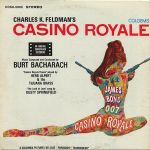
This is a record that has its share of problems, but if you’ve got the system for it (huge, heavily tweaked, fast, free from obvious colorations and capable of tremendous resolution), the best pressings are sure to impress.

Having heard the best sounding pressings I now understand why this has been such a highly regarded long-term resident of the TAS Superdisc List. The best copies are SUPERDISCS… while the average copy of this album is anything but. Who could take such harsh, grainy, thin, veiled, compressed sound seriously? What was Harry Pearson smokin’?

I can honestly and truthfully say that until we discovered the Hot Stampers for this album, I never thought this record deserved the praise Harry heaped upon it. Now I do. I once was blind but now I see, or something like that.

And by the way, does his copy sound as good as this one? Let’s face it: the late Harry Pearson was simply not the kind of guy who would sit down with five or ten copies and shoot them out.

When you listen to the average pressing of Casino Royale, you get the feeling that you’re hearing a standard-issue, boxy, lightweight, blary ’60s soundtrack. Perhaps you hear some promise in the recording, but it’s a promise that’s unfulfilled by the record on your turntable. This copy will completely redefine what you know about the sound of this music.

The space is big and the sound relatively rich (although the sound does vary quite a bit from track to track). The vocals have notably less hardness than most and the orchestra is not as brash as it can be on so many of the copies we audition. Huge amounts of Tubey Magic as well, which is key to the best sounding copies, and critical to The Look of Love.

The sound needs weight, warmth and tubes or you might as well be playing a CD.

(more…)