Half-Speed Reviews

Byrd at the Gate – Another Hyped-Up MoFi

Hot Stamper Pressings of Jazz Guitar Recordings Available Now

UPDATE 2026

This review was written about ten years ago. Since then we have heard some amazing early Black Label Riverside recordings, including some by Charlie Byrd.

Another audiophile hall of shame pressing, and yet another MoFi LP reviewed and found seriously wanting.

This is a title Mobile Fidelity ruined (what else is new?), and having just played an early Riverside LP I can see how their mastering approach was — as is so often the case — misguided to say the least.

First off, the guitar and the drums on the original are tonally right on the money. They sound like bass and drums should. They sound, in a word, correct.

Mobile Fidelity felt it necessary to brighten up both and the results are a phony sounding guitar and phony sounding drums, with tizzy cymbals thrown in for good measure.

(The Wes Montgomery MoFi title has many of the same faults, but it’s not quite as bad as this one. We’ve had Hot Stamper copies of the originals so we know they can sound superb, some of RVG’s best work.)

The old Mobile Fidelity — the pre-Heavy Vinyl Mobile Fidelity — rarely met a master tape they didn’t think needed a healthy dose of top end boost. They also apparently did not understand what an acoustic guitar sounds like. They blew it on every last one of the Cat Stevens albums, brightening up the guitars, which, as we all know from playing with the treble controls on our receivers way back when, emphasizes the “picking” of the strings at the expense of the resonating guitar body as well as the vibrating string harmonics.

What makes Byrd At The Gate a good record is the natural acoustic guitar tone. Once you screw that up, what’s left?

An audiophile record, for audiophiles who like phony sounding guitars. (Chesky anyone?)

Another reason the Mobile Fidelity is such a joke is that this recording inherently has a lot of ill-defined bass. Since Half-Speed mastering causes a loss of bass definition, their pressing is even WORSE in this respect. Bad guitars, bad drums and bad bass — that pretty much covers everybody in the trio. (more…)


Let’s Dance – MoFi Reviewed

Hot Stamper Pressings of the Music of David Bowie Available Now

I admit I used to like the MoFi pressing. It’s decent, probably better than the average domestic copy I suppose, but c’mon, this album is about punchy bass and drums. Since when does any Half-Speed mastered LP have punchy bass and drums?

Blurry blobby bloated bass and sloppy blurry cardboard drums is more like it. Compressed and lifeless too.

MoFi did two of the greatest Bowie albums of all time, Ziggy and Let’s Dance, and neither one can hold a candle to the real thing. If you want to settle for a mediocre imitation of either or both of those albums, stick with Mobile Fidelity.

If you want to hear the kind of Demo Disc sound that Bowie’s records are capable of, try a Hot Stamper.

(more…)

A Tale of Two MoFi Deja Vu’s

Hot Stamper Pressings of the Music of Crosby, Stills, Nash and (Sometimes) Young

UPDATE 2026

A commentary from a long time ago about two different MoFi pressings of the same title, Deja Vu. We stopped playing Mobile Fidelity records like this a long time ago and the only ones we play these days are ones that are sent to us for free from customers or friends. Mobile Fidelity made some good records back in the old days. As I wrote not long ago, I owe them a debt of gratitude.

But the records we’ve auditioned that they’ve been making more recently had me asking: How is this company still in business?


Sonic Grade: F (or not!)

Just for fun about 10 years ago [make that 20] I pulled out a MoFi pressing of Deja Vu I had laying around. I hadn’t played their version in a long time. I could have gone a lot longer without playing it, because what I heard was pretty disappointing. Playing their record confirmed all my prejudices. The highs sizzled and spit. The heart of the midrange was recessed and sour.

Know what it reminded me of? A bad Japanese pressing.

(Since most of them are pretty bad I could have just said a typical Japanese pressing, but that’s another story for another day.)

And if that’s not bad enough, the bass definition disappeared. Bass notes and bass parts that were clearly audible and easily followed on our Hot Stamper copies were murky, ill-defined mud on the MoFi.

If you own the MoFi you owe it to yourself to hear a better sounding version. You really don’t know what you’re missing.

But Then, A Few Years Later We Played This Copy…

Here is what we had to say at the time:

Hot Stamper Sound on the MoFi pressing of Deja Vu, can it be possible? I have NEVER heard the MoFi sound this good, not even close. This just KILLS the other copies I’ve heard. I wrote a scathing review of their badly mastered pressing which you can read below, and I still stand behind every word, because this copy is not your average MoFi. The average one still sucks. What we are selling here is a FLUKE. Here is the story from our Hot Stamper shootout we just did.

This week we picked up a very clean looking MoFi pressing and decided to throw it in the shootout just for fun. We were shocked — this one actually sounded good! Not as amazing as our best Hot Stampers, but much better than we had expected. We checked our old copy and heard the same bad sound described above. 

Pressing variations exist for audiophile records as well, and here was another example. It just goes to show that nothing short of playing a record will tell you how it sounds — except for reading our website. Who besides us could spend so much time playing so many bad records? It’s a dirty job, but we’re happy to do it. Hearing one amazing record makes up for playing 10 bad ones, so we’ll keep at it.

Keep in mind that the only way you can never be wrong about your records is to simply avoid playing them. If you have better equipment than you did, say, five or ten years ago, try playing some of your MoFi’s, 180 gram LPs, Japanese pressings, 45 RPM remasters and the like. You might be in for quite a shock.

It’s all good — until the needle hits the groove. Then you might find yourself in need of actual Better Records, not the ones you just hoped were better.

(more…)

Star Wars, Close Encounters and Other Multi-Miked Messes

Decca and London Hot Stamper Pressings Available Now

This Mobile Fidelity LP contains the music of Star Wars and Close Encounters, conducted by Zubin Mehta. The MoFi pressing is far more transparent than the London pressings we have auditioned of the album, even the ones Half Speed mastered by Stan Ricker himself.

Yes, he cut the original Londons! At Half Speed! (We’ve also played some later pressings not mastered by Stan, of course. We don’t pretend to be able to predict which version would sound the best.)

It’s still one of the better MoFi remasters, all things considered. The music, to these ears, has always been hi-fi-ish schlock, and the recording itself is too multi-miked to be taken seriously. It sounds far too much like a bad Phase IV recording, and we know whereof we speak when it comes to Phase IV, good or bad. We’ve played them by the score.

This famous record from the Top Seven of the TAS Super Disc List has the same problem, but I never hear anybody mention it. Why that is I cannot imagine, other than our favorite explanation for just about everything that seems to fly under the audiophile radar, or perhaps a better description would be flying over the heads of the self-appointed audiophile cognoscenti, our old standby, reviewer malpractice.

Bottom line, a loser, but the original Londons in our experience are even worse!

(more…)

A MoFi that Beggars Belief

Katy Lied is bad enough to have earned a place in our Mobile Fidelity hall of shame.

By the time I was avidly collecting Mobile Fidelity records in the late 70s, this title had already gone out of print, one of the first to do so. My guess is that even the guys running MoFi knew when they had a turkey on their hands and mercifully let this one go out of print and out of its misery.

Yes, the sound is so bad that even the brain trust at MoFi could hear it. 

Compressed and lifeless (almost as lifeless as the screen speakers so popular at the time), it’s hard to imagine any version sounding worse than this one. (Which is why it’s on this list.)

And yet I continued to play my copy, for enjoyment of course, oblivious — I must have been oblivious, right? — to the bad sound.

Why? That’s hard to say, but here’s a stab at it.

The vinyl was exceptionally quiet for one thing, and for another, as an audiophile I knew this MoFi pressing had been made with tender loving care, using a putatively superior process, Half-Speed mastering, from the original master tapes, and had been pressed in Japan on the quietest, flattest vinyl in the world. What could possibly go wrong?

My old story about One Man Dog gets to the heart of it.

I didn’t understand records very well and I sure didn’t understand the value of doing shootouts — or even how to do them — using multiple copies of the same album.

(more…)

It Took Us Until 2012 to Finally Beat the Audiophile Pressing We Swore By

Hot Stamper Pressings of the Music of Supertramp Available Now

UPDATED 2026

We have not had very good luck with domestic pressings of this album for quite a few years now. The German pressings are also not very good, earning at most 1.5+ and more often than not a lower grade. (Hey, we had to be sure.)

The Canadian audiophile pressings are comparable, 1.5+ or close to it, not good enough to bother with when the right UK pressings are so much better.

The listing below is from 2012. Since that time we have been able to find and play a great many British pressings of the album, and they always win our shootouts now.

But the domestic pressings can also do very well, just not well enough to win shootouts these days, a clear case of live and learn.


Our Understanding from 2012

TWO AMAZING SIDES, including an A+++ SIDE ONE! It’s not the A&M Half Speed, and it’s not a British pressing either. It’s domestic folks, your standard plain-as-day A&M pressing, and we’re as shocked as you are. Hearing this copy (as well as an amazing Brit; they can be every bit as good, in their own way of course) was a THRILL, a thrill that’s a step up in “thrillingness” over our previous favorite pressing, the A&M Half Speed. [!]

(more…)

Getting Who’s Next Exactly Backwards

Hot Stamper Pressings of the Music of The Who Available Now

A classic case of live and learn.

What follows is the commentary for the Canadian One Sided Half-Speed that we had auditioned around 2000. It came in a regular jacket, not the one you see pictured, and was part of a big overstock batch I had gotten my hands on a number of years before.

Getting It Exactly Backwards

Half of this record is Half-Speed Mastered! There’s an interesting story behind this album. Those of you who’ve been collecting audiophile records for a long time may remember that Who’s Next was released as an MCA Masterphile Half-Speed Mastered pressing produced in Canada. I remember liking it back in the day, which had to be 15 years ago at least. But they are very rare and I haven’t played one in many years.

I ran into some sealed Canadian pressings of Who’s Next, and when I cracked one open to play it I noted it had Masterphile written in the deadwax on one side. Apparently they had made so few Masterphile pressings that the metal work was still useable and they decided to press some “regular” records with one of the stampers.

And I remember I used to tell people that the good side, side one, was the Masterphile side. Then three or four years ago [circa 2000], I had occasion to play the record. Lo and behold, side one was bright and phony, and side two was rich and sweet, like the good Track Label pressings! I had gotten it exactly backwards.

(more…)

How to Make All Your Records Sound Like MoFi’s – For Free!

Hot Stamper Pressings of the Music of The Doors Available Now

The Doors debut album is yet another obvious example of MoFi’s predilection for a sucked-out midrange.

Scooping out the middle of the midrange has the effect of creating an artificial sense of depth where none had ever been.

Play any original Bruce Botnick engineered album by Love or The Doors and you will notice immediately that the vocals are front and center.

When the DCC Doors first album was released on vinyl, we noted that the vocals were finally back where they belonged. After having lived with the MoFi for so many years, we’d almost forgotten.

And now of course we can’t tolerate the smear and opacity of the DCC. We like to think we’re simply setting higher standards these days.

The midrange suckout effect is easily reproducible in your very own listening room.

Pull your speakers farther out into the room, and also farther apart, and you can get that MoFi sound on every record you play. I’ve been hearing it in the systems that audiophiles — who made the mistake of inviting me into their homes — we’re proud of for decades.

Once you know what that effect sounds like, and have done the work to fix it in your own system, it takes mere moments to recognize it in any other system.

Fixing a problem is practically the only way to hear what actually is a problem.

(more…)

So at 45 RPM – One Side Bad, Another Awful, What’s a Mother to Do?

Hot Stamper Pressings of the Music of Peter Gabriel Available Now

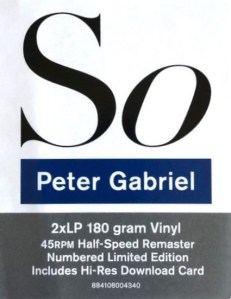
In 2016 a version of So came out using this currently popular vinyl format:

2 180g discs / 45 RPM / Deluxe, Numbered, Limited Edition /Half Speed mastered

As of this writing, there are 15 copies on Discogs, the cheapest of them starting at $139.77.

Sounds like it must be pretty good for that kind of money!

This So release was mastered by a fellow named Matt Colton, who has been doing this kind of work for a very long time, judging by the fact that he has 3,775 technical credits under his name on Discogs.

That did not stop this particular 2 LP set from being one of the worst sounding albums we have played in quite a while.

Let’s take a closer look at the specifics. We played sides one and four of the two-disc, four-sided album. That was more than enough to evaluate the sound quality.

(more…)

MoFi Sure Added Plenty of Sparkle to These Acoustic Guitars

Hot Stamper Pressing of the Music of Ry Cooder Available Now

UPDATE 2026

This review is from many years ago, the last time we had a copy of the album in stock to play. Hard to imagine I would not still agree with it though.


As you probably know, the MoFi of Jazz goes for big bucks nowadays — $500 and up. Is it worth it? 

You’ve got to be kidding. It’s a nice record as far as it goes, but it suffers from the same shortcomings as just about every Mobile Fidelity pressing we bother to play these days (with some obvious exceptions of course).

We have a test pressing, and knowing that the MoFi is the standard against which many audiophiles prefer to judge our Hot Stampers, we listened to it first before going about our comparison test.

Our MoFi copy is actually tonally correct, which was a bit of a surprise. (Yours of course could very well be otherwise.)

Right away we could hear exactly what people like about it, the same thing that has always impressed audiophiles about half-speed mastered records: their often outstanding transparency.

Jazz on MoFi has zero-distortion, utterly clear, spacious, see-through sound.

But listen past that and what do you hear?

Don’t those guitars seem to have that MoFi Tea-for-the-Tillerman “sparkly” quality you hate: all pluck and no body, all detail and no solidity?

Nothing has any weight.

Nothing sounds natural.

Nothing sounds real.

It’s pretty, maybe, but it sure ain’t right.

It’s the kind of sound that shouts out to the world “Hey, look at me, I’m an audiophile record! See how I sound? So clear! So clean!”

Which isn’t bad for about two minutes, and then it’s positively insufferable.

(more…)