Doing Shootouts

If you would like to acquire better sounding pressings, please consideer taking our advice for conducting your own record shootouts, the only reliable way we know of to find them.

If you have five or ten copies of a record and play them over and over against each other, the process itself teaches you what’s right and what’s wrong with the sound of the album.

Once your ears are completely tuned to what the best pressings do well that the others do not do as well, using a few specific passages of music, it will quickly become obvious how well any given pressing reproduces those passages.

It may be a lot of work, but it sure ain’t rocket science, and we’ve never contended it was. From the start we’ve explained how to go about finding Hot Stampers for yourself. If you follow our lead, the quality of your collection is almost certain to improve.

Who Can’t Hear Differences in Sound from Side to Side on Most Records?

rimskscheh_2446Hot Stamper Pressings of the Music of Rimsky-Korsakov Available Now

Both the Chesky [1] and Classic reissue pressings of LSC 2446 are just plain terrible. Embarrassingly, the latter is found on the TAS List.

There is a newly [2013, time flies!] remastered 33 RPM pressing of the album garnering rave reviews in the audiophile press. We didn’t like that one either.

It fails the violin test that we wrote about here.

Please note that in many of the reviews for the new pressing, the original vinyl used for comparison is a Shaded Dog pressing. In our experience almost no Shaded Dog pressings are competitive with the later White Dog pressings, and many of them are just plain awful, as we have noted previously on the site.


UPDATE 2024

Now that we know which stampers have the potential to sound the best in our shootouts, the Shaded Dog originals have lately been winning top honors, although the White Dog pressings can still sound quite good, just not as good.


The “original is better” premise of most reviewers renders the work they do practically worthless, at least to those of us who take the time to play a wide variety of pressings and judge them on the merits of their sound, not the design of their labels.

[A fairly embarrassing example of live and learn.]

rimskscheh_cheskyMissing the Obvious

The RCA White Dog with the best side two in our shootout had a very unmusical side one. Since reviewers virtually never discuss the sonic differences between the two (or more) sides of the albums they audition, how critically can they be listening? Under the circumstances how can we take anything they have to say about the sound of the record seriously?

The sound is obviously different from side to side on most of the records we play, often dramatically so (as in the case of Scheherazade), yet audiophile reviewers practically never seem to notice these obvious, common, unmistakable differences in sound, the kind that we discuss in every listing on the site. If they can’t hear the clear differences in sound from side to side, doesn’t that call into question their abilities at the most basic level?


(more…)

Listening For the Spirit and Enthusiasm of the Musicians

Hot Stamper Pressings of the Music of The Beatles Available Now

UPDATE 2026

The discussion below, brought about by a Hot Stamper shootout we conducted for Revolver quite a number of years ago (2007!), touches on many issues near and dear to us here at Better Records.

Some of the things we learned about Revolver all those years ago are important to our Hot Stamper shootouts to this very day, including, but not limited to:

  • Pressing variations,
  • System upgrades,
  • Dead wax secrets,

and the quality we prize most in a recording:

  • LIFE, or, if you prefer, energy.

At the end of the commentary we of course take the opportunity to bash the MoFi pressing of the album, a regular feature of our Beatles Hot Stamper shootouts. We’re not saying the MoFi Beatles records are bad; in the overall scheme of things they are mostly pretty decent. What we are saying is that, with our help, you can do a helluva lot better.

Our help doesn’t come cheap, as anyone on our mailing list will tell you. You may have to pay a lot, but with us you get what you pay for, and we gladly back up that claim with a 100% money back guarantee for every pressing we sell.


The Story of Revolver, Dateline October 2007

(Incidentally, 2007 turns out to have been a milestone year for us here at Better Records.)

White Hot Stampers for Revolver are finally HERE! Let the celebrations begin! Seriously, this is a very special day for us here at Better Records. The Toughest Nut to Crack in the Beatles’ catalog has officially been cracked. Yowza!

(more…)

Doing Shootouts for Other Genres of Music

Record Collecting for Audiophiles from A to Z
Jack contacted us recently about doing shootouts for the kinds of records that we rarely do shootouts for:

Hello Tom,

I am thinking about opening an online record store based on the same hot stamper methodology as Better Records, only I focus on genres that you do not cover, such as rap, metal, punk, hardcore, post-punk, noise and other niche genres.

Thus I am trying to get a sense of what it would take to make this project work. Did you have a reputation in the audiophile community prior to starting Better Records that drove people to your store?

The other question I am wondering is about equipment. Do you think that one has to have extremely high-end equipment (e.g., $5000 tone arms and the like) to properly tell whether a record is a hot stamper?

Finally, do you think that your methodology could work on LPs released post-1990, when there are far fewer variants of an album available? Any insight you could offer would be much appreciated.

Regards, Jack

Jack,

You need to follow our approach to the letter. The basics of it can be found here.

For a deeper dive, here is where you will find more helpful advice on doing your own shootouts

This would be a good budget to start with:

(more…)

Advice for Testing So-Called “Hot Stampers”

What Are Hot Stamper Pressings and How Can I Find My Own?

UPDATE 2026

You might find the comments at the end of this one interesting.


Contemplating trying a money-back-guaranteed Hot Stamper pressing? Our good customer ab_ba has some advice on one of the best ways to go about it. He writes:

Pick out a Hot Stamper on the better-records site. (Choose something you know well, that you already have a few copies of. Pick a Super Hot Stamper, so it’s not absurdly expensive.)

First, see how it compares to your other copies. If it’s not as good, send it back, full refund, no questions asked.

Next, look at the matrix number on the Hot Stamper, and buy three copies on discogs in NM or VG+ condition with the same matrix. Or, go hunt around your local shop for same.

Then, once you get them, clean them to the best of your ability and then do another shootout. Just do it quick – you’ve got 29 days.

If you prefer one to your Hot Stamper, send back the Hot Stamper. No questions asked, and thank Tom for the matrix number.

I’ve done this a couple of times, and every time, I’ve kept the Hot Stamper. Wasted my time and money is all I did. That, and convinced myself Tom’s records are worth what he charges, in that I can’t get records that sound that good for less money.

Dear ab_ba,

Good advice, let’s hope some audiophiles take it. They might just find the world of better sound that’s waiting for them the way you did.

And if not, then they get their money back, no harm, no foul.

Thanks for writing,

TP

(more…)

Which Is More Important – The Label or the Stamper Numbers?

Hot Stamper Pressings Featuring the Violin Available Now
In this case, since the label is different but the stampers are the same, it’s the label that tells you how good your pressing may — heavy accent on the may — sound.

Lately we’ve been having exceptionally good luck with the early label pressings of many of the London violin concerto records we’ve done shootouts for, especially those performed by Ruggiero Ricci.

However, the notes you see below do not belong to the wonderful Sibelius record pictured here.

They belong to another London record. We give out lots of bad stampers on this blog, but almost never do we give out the good ones. (When we do give out the best stampers, we usually keep the title a mystery, as is the case of the record here. To see the other titles whose Shootout Winning stampers have been revealed, please click here. The list to date is short but not to worry, more are on their way.)

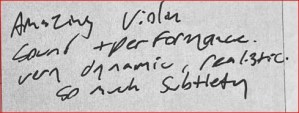
The amazingly good sounding pressing on the early label took the recording to another level. Our shootout notes read:

  • Amazing violin sound and performance.
  • Very dynamic and realistic.
  • So much subtlety.

Scroll down to see out Key Takeaways from this shootout.

(more…)

Every Last One of These Bartok Records with Ansermet Was No Good

Hot Stamper Pressings of the Music of Bela Bartok Available Now

Every last one of our London pressings of Concerto for Orchestra was a disaster: smeary strings, blary brass and painfully shrill throughout, with no top or bottom to speak of, the very definition of boxy sound.

The entire group of CS 6086 we had on hand — whether on Blueback or Whiteback, we had a good selection of both — were much too unpleasant to be played on high quality modern equipment.

Why had I been buying them for years?

I made the mistake of assuming that the phenomenally talented Decca engineering and producing team who worked on this project could be relied upon to produce a top quality recording of the Concerto for Orchestra.

As it turns out, my guess turned out to be wrong.

I had made the mistake of believing in the infallability of experts.

I talk about the team of producers and engineers seen below in listing after listing, raving about the amazing sound of the recordings produced by them in the 50s and 60s, many of which are right at the top of the best sounding recordings I have ever had the privilege to play.

(more…)

Your Shootout Questions Answered – Part One

Hot Stamper Pressing of the Music of The Rolling Stones Available Now

Robert Brook wrote to me recently with some questions.

Hi Tom,

I read your recent post about Sticky Fingers and the European TML reissues you included in shootouts.

It raised a question for me that I’ve been wanting to ask you for a while now.

The fact that the UK TML earned an A+ to A++ grade and that, with just a one copy sample, you wouldn’t consider that pressing to have shootout winning potential, suggests to me that the US pressings you favor will grade at A++ or higher.

In other words, if you put a shootout together of [redacted stamper] pressings and whatever else you like, does every copy in the shootout grade at least A++ / A++? Are the right stampers that reliable?

I guess I’ve always assumed that even if you put together a shootout with this or any other title, and even if you only include pressings that have won or placed high in the past, at least a couple of them would end up graded no higher than A+ or A+ to A++.

And if that is correct, wouldn’t it be worth buying more UK TML’s to see if any emerge that could win a shootout?

With Revolver, for instance, why not just do shootouts with [redacted numbers] if those are the ones that win the shootouts? Why even bother with [later pressings]?

Robert,

All good questions! I could go on for days with this kind of inside baseball stuff. I’ve been living it full time for more than twenty years, and it obviously interests you because you are actually trying to hone your shootout skills and figure out how many of what pressings you need to get one going, etc., etc.

Not many others are doing what you are doing in a serious way, so how helpful anyone will find this information is hard to know. Under the circumstances, I should have kept my answers shorter rather than longer but I could not resist going into more detail than might have been advisable. Feel free to skim if you like.

Why not put more TML pressings into shootouts?

If they had pressed plenty of them and they’d ended up sitting in record bins all over town for twenty bucks a pop, we could get a bunch in and see if we could figure which stampers, if any, are able to reach the Super Hot stamper level.

(more…)

When We First Started Doing Shootouts, They Would Sometimes Go on for Days

Hot Stamper Pressings of the Music of Neil Young Available Now

Our first Hot Stamper listing for After the Gold Rush from back in 2005 talked about what a struggle it was doing them at first.

Back then, with not much in the way of staff, I often had to put the records on the table one at a time and do all the listening and note-taking myself.

For our first Hot Stamper listing I wrote:

A record like this might go through 4 or 5 stages of cleaning and listening and cleaning again. I spent many hours listening to the various copies I played over the course of two days, first one track, then another, this copy, then that one. There’s no other way to do it. There’s no shortcut. There’s no substitute for hard work.

If you can call it that. It ain’t too hard playing a great album over and over again. Some people — myself included — might even call it fun. And now I love this album more than I ever did. I feel like I have come to know it. I’m positively thrilled to finally know how good it really is!

Isn’t that why we audiophiles go through all this shite, as the Brits say? When I hear a piece of familiar music sound better than I ever thought I would hear it, better than I ever imagined it, it’s everything to me. It’s the biggest thrill I know of in audio. It’s what I live for. If you like that feeling, this is the record for you!

I don’t know how long it’s going to be before I find another copy that sounds like this one, but I’m guessing it’s going to be a long time. How many bad domestic rock records did I have to play in order to find a record that sounds like this? A hundred? More?! Who knows? It was a lot, that’s for damn sure.

Speaking of Thrills

We admit to being thrillseekers here at Better Records, and make no apologies for it.

The better the system and the hotter the stamper, the bigger the thrill.

(more…)

For a Better Approach to Finding Higher Quality Pressings, Sweat the Details

Please Consider Taking Some of Our Audio Advice

When it comes to doing shootouts, half the battle is just being able to play the record right.

Our approach is simple enough. We precisely adjust the arm and cartridge for every title by ear, then compare the various pressings — properly cleaned of course — under carefully controlled, blinded conditions, with as much scientific rigor as we can bring to the proceedings.

In some ways it may in fact be analogous to rocket science, which we would define as the process of discovering all the details that need to be sweated and then sweating the hell out of them.

It’s the opposite of theoretical physics. One doesn’t need to be a novel thinker or have big ideas to do audio well.

Obsessively working through the basics of table setup, tweaks, room treatments and electrical quality will take your system to levels beyond those you have ever imagined.

And, you sure don’t need a bloody microscope to check your stylus rake angle, unlike some audiophile reviewers who insist that such devices are essential.

Your ears, if they are any good at all, will do the job just fine, and probably much better.

(more…)

Jazz Giant and Tube Versus Transistor Tradeoffs

Hot Stamper Pressings of Contemporary Jazz Albums Available Now

In a commentary from more than ten years ago we weighed the tradeoffs in the sound of the originals versus the reissues.

This superb sounding original Black Label Contemporary pressing of Benny Carter’s swingin’ jazz quartet is the very definition of a top jazz stereo recording from the late ’50s recorded and mastered through an All Tube Chain.

There’s good extension on the top end for an early pressing, with TONS of what you would most expect: Tubey Magic and Richness. If that’s what you’re looking for, this copy has got it!

We prefer the later pressings in most ways, but this record does something that no later pressing we have ever played can do — get Benny’s trumpet to sound uncannily REAL.

If you want to demonstrate to your skeptical audiophile friends what no CD (or modern remastered record) can begin to do, play side two of this copy for them. They may be in for quite a shock.

The sound of the muted trumpet on side two is out of this world. 

It’s exactly the sonic signature of good tube equipment — making some elements of a recording sound shockingly real.

(more…)