Japanese Vinyl

Compromised Recordings – If It’s About the Music, the Choice Is Clear

Skeptical Thinking Is Key to Finding Better Sounding Records

UPDATE 2026

This commentary was written circa 2006. The Hot Stamper world was very different in those days. A few dozen had been done starting in 2004, and probably not nearly as well as they should have been, truth be told.

This was unexplored territory, a new world. At the time we had no way of knowing how much there was to learn and how much time and effort would go into learning it.

Thousands of shootouts later we have a pretty firm grip on how to go about finding the best sounding pressings of the greatest music ever pressed on vinyl. Those recordings, with sound that is dramatically superior to those that have come along since, are why this blog exists. (The blog also allows me to promote 100+ personal favorites that I think should be more popular with my fellow audiophiles.)


Our Story, Circa 2006

Years ago one of our good customers wrote to tell us how much he liked his Century Direct to Disc recording of the Glenn Miller big band, one of the few truly amazing sounding direct discs that offered music actually worth listening to. This was an actively touring big band, not a group of studio cats trying to make a record out of some charts somebody managed to cook up.

And you can read all about the killer copy we discovered a few years back here, complete with our shootout notes. (The notes can also be seen at the bottom of this post.)

Which brought me to the subject of Hot Stampers. (For those new to the idea, here are the short versions of what they are and how one goes about acquiring them.)

Hot Stamper pressings of jazz or popular music are almost always going to be multi-track, tape recordings with plenty of overdubbing and processing, about as far from purist live-in-the-studio performances recorded directly to disc as you can get.

They will invariably suffer a great many compromises, especially when compared to the approach of an audiophile label trying to eliminate all sources of distortion in the pursuit of higher fidelity. In the case of direct to disc recordings, this means the losses that result from the use of analog tape.

But when they do that, they almost always fail.

(more…)

A 45 RPM Audiophile Pressing to Put Them All to Shame

Hot Stamper Pressings of the Music of Prokofiev Available Now

This Japanese 45 RPM remastering of our favorite recording of Prokofiev’s wonderful Lt. Kije Suite has DEMONSTRATION QUALITY SOUND. For starters, there are very few records with dynamics comparable to these. Since this is my favorite performance of all time, I can’t recommend the record any more highly. 

Most of what’s “bad” about a DG recording from 1978 is ameliorated with this pressing. The bass drum (drums?) here must be heard to be believed. We know of no Golden Age recording with as believable a presentation of the instrument as this.

The drum is clearly and precisely located at the back of the stage; even better, it’s as huge and powerful and room-filling as it would have been had you attended the session yourself. That’s our idea of hi-fidelity here at Better Records.

(more…)

We Drop the Needle on Another Sad Excuse for an Audiophile Pressing

More on the Subject of Half-Speed Mastering

This is an A&M Audiophile Sampler, made in Canada and pressed on Japanese vinyl .

There is a bit of a story behind this title. It’s not the kind of record we normally would buy, or even bother to play truth be told.

A customer had emailed us saying it sounded great. It was cheap so we grabbed one for fun. Our notes read:

  • Sucked out middle
  • Clean and hard (maybe like a CD?)
  • This sucks

Hard to imagine one of our customers liked the sound of this pressing, but I assure you that one of them did, so make of that what you will.

(more…)

Letter of the Week – “To think I spent all those years playing a record that was bright and edgy, none the wiser to matrix numbers and pressing variations.”

Hot Stamper Pressings of the Music of Michael Jackson Available Now

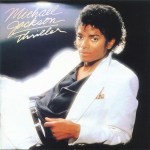
Our good customer who goes by the handle ab_ba on the web wrote to us about his experience with the White Hot Stamper pressing of Michael Jackson’s Thriller he recently acquired.

Part one of his letter can be found here.

Here he tells us about the shootout he conducted, which included a “pricey Japanese pressing” and a pressing that the forums recommended as the “holy grail.”

A few weeks later, on the eve of the closing of the return window, I shot it out against the best of my other copies. They range from the copy I grew up with, one of the few records from childhood that I held onto, to a pricey Japanese pressing in great shape (purchased long ago, when I thought Japanese pressing were where it’s at), to some copies I’ve picked up over the years because they looked to be in good shape and they were just five bucks, and a pressing that the forums told me was the “holy grail.”

None stacked up to the white hot stamper. In fact, they really weren’t even close. Here’s what I found:

The copy I grew up with is bright and edgy. To think, I spent all those years playing and re-playing a record that was bright and edgy, none the wiser to matrix numbers and pressing variations.

Some other lucky kid back then was surely listening to the copy I now own. I wonder if he ever said to himself, “wow, there’s something about this record. It sounds really special.”

The pressing with a sought-after matrix code had phenomenal bass, but the vocals were recessed. I’d so easy to be impressed with those huge drums on Billie Jean, but that alone is not enough to tell you it’s a great pressing. A lot of pressings seem to get that right.

My Japanese pressing was clear and full. But too smooth. The guitars don’t bite. Also, it fatigued me by about halfway through the side. This is energetic music. It might exhaust you, but it doesn’t have to fatigue you. This is an example of where if you don’t have a white hot stamper to compare it to, you’ll just assume your version sounds as good as it can get.

Dear ab_ba,

Most Japanese pressings cater to the sound a mid-fi system would need to sound good and a hi-fi system would find disastrous. They are almost always made from dubbed tapes, which are then brightened up in the mastering phase since that is the sound that appeals to the Japanese market for some reason unknown to me. (Old school audio equipment — horn speakers and vintage tube electronics — would be my guess.)

(more…)

Obscured By Cloudy Japanese Vinyl

Hot Stamper Pressings of the Music of Pink Floyd Available Now

When I was just getting up to speed in audio and exploring the world of music available on vinyl in the 70s, many of the stereo stores I frequented carried Japanese pressings. They were widely believed to have superior sound relative to their domestic counterparts — in this case, the mass-produced pressings I would see at the Tower Records right across from the Sports Arena in my hometown of San Diego. I went there at least once a week, probably more like two or three times.

Tower was far and away the best place to go record shopping in those days. The store was huge and they had dramatically more stock than Licorice Pizza or The Wherehouse.

They also had a separate section for Half-Speed mastered pressings from a number of labels, which of course was the first place in the store I would visit, digging through the bins to see what new remastered titles may have been produced for audiophiles searching for the ultimate in sound quality.

Of course, I identified as just such a person. In terms of sound quality, and with the extremely limited knowledge I had acquired at the time, I believed I set a high standard for the sound of the records I bought. I was willing — eager even, you could even say excited — to pay whatever premium price I had to for a record that was sure to deliver superior sound quality. To me, in the late 70s, that meant two things: direct to disc recordings, and Half-Speed mastered pressings.

(There was a another category of records that did not fall into the above two, best exemplified by American Grammaphone and the Fresh Aire series, but the less said about those schlocky releases the better, other than to point out that some of their titles are TAS list carryovers from HP’s time running the Super Disc list, specifically Fresh Aire 2 and 3, both best avoided.)

And, like any other open-minded individual, when it came to Japanese vinyl I was willing to give a few a spin.

However, the more of them I bought, the more clear it became to me that even the best of them sounded mediocre (veiled, smeary and dubby from second generation tapes) and more often than not they were just plain awful. (Second generation tape issues being the main problem, of course, with the additional insult of poor tonality, the result of being mastered using wacky equalization, typically with added brightness where none was needed.)

Pink Floyd

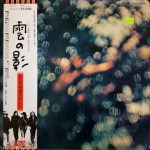
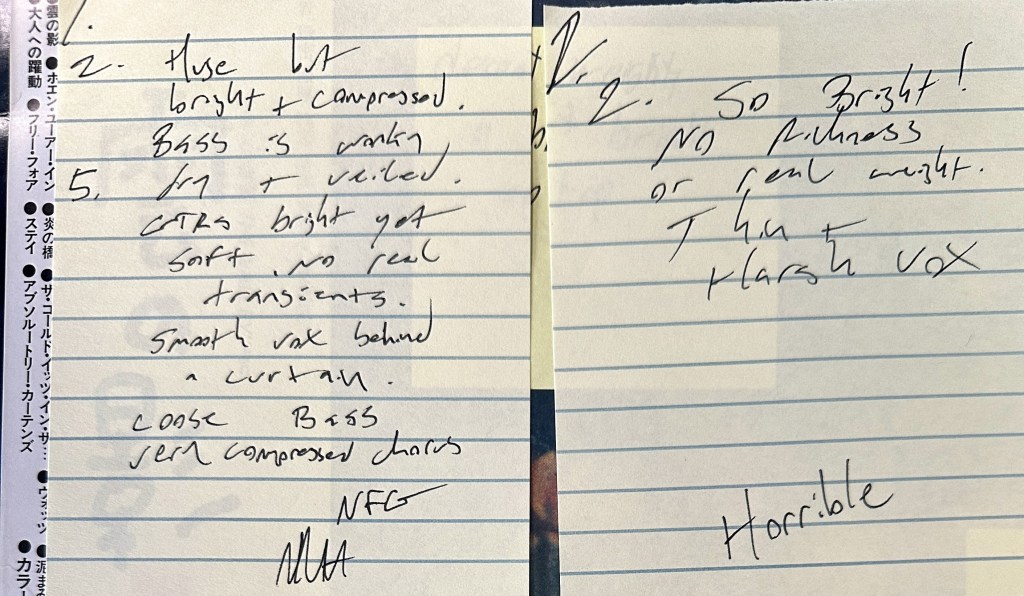
The notes for the Pink Floyd album you see below, Obscured by Clouds, were written sometime in March of 2025 as part of the shootout we conducted for the album.

If we assume it would be an audiophile who would be attracted to this pressing, perhaps for its quieter playing surfaces, perhaps operating under the assumption that the Japanese engineers mastering the record would be more likely to do a better job as well, then what we have here is a textbook case of an audiophile bullshit pressing.

One that sounds nothing like the album is supposed to, based on having played a number of exceptionally good sounding copies, all British and all on the Green Harvest label, mastered from good tapes, sometimes by the legendary Harry T. Moss. We feel we are more than qualified to make these judgments. If we can’t make them, nobody can.

Discogs allows us to glean some information regarding the desirability of this Japanese reissue with the record buying public currently in the market for Pink Floyd vinyl who register on their site.

(more…)

Breakfast in America – An A&M Half-Speed Mastered Disaster

Hot Stamper Pressings of the Music of Supertramp Available Now

Sonic Grade: F

This title is yet another Half-Speed we think belongs in our audiophile hall of shame.

It’s better suited to the stone age stereos of decades past. I should know — my system in 1976 was one-tenth as revealing as the one we use now.

But this pressing is so awful even my old system could not be fooled by this kind of audiophile BS sound. The console you see pictured might be the ideal system to play it. Hard to say, I haven’t heard one of those since the 60s.

It is just ridiculous that someone would consider marketing this kind of sound to audiophiles.

So washed out, brittle, thin and lifeless, it practically defies understanding that anyone with two working ears ever considered calling this piece of crap an “audiophile” record.

But are today’s remastered records marketed to those looking for superior sound any better? Not the ones we’ve played recently. (If you know of any good ones, please drop us a line.)

Is this A&M pressing the worst version of the album ever made? It’s hard to imagine it would have much competition.

(more…)

An RCA Direct Disc with Bad Music & Bad Sound, Like Most Audiophile Albums from the ’70s

Hot Stamper Pressings of the Music of The Beatles Available Now

The records being marketed to audiophiles these days may have second- and third-rate sound, but at least they now have good music. That’s progress, right?

It is progress, because this RCA direct to disc recording is the kind of crap that used to qualify as an “audiophile record” when I was starting out in the mid-70s. These records were displayed on the walls of all the hi-fi stores I used to frequent back in the day.

They cost a lot more than regular records did too. Many were pressed in Japan, and I vaguely recall that the retail prices were in the range of $15 to $18. That’s $77 to $92 in today’s money. Can you imagine paying that for a record with such poor sound and music?

The Beatles Medley is particularly misguided. These guys have no idea what to do with the music of The Beatles.

A record such as this clearly belongs in our audiophile hall of shame, which is a general catchall section for the many bad sounding records that have been marketed to audiophiles over the last fifty years. We’ve played and reviewed more than 300 to date, which of course is but a mere fraction of the many thousands of questionable pressings that have been produced since the 70s. There has always been a mid-fi collector market, and no shortage of enterprising types to take advantage of it.

It turns out that many of the most shameful offenders for sound are more recent releases that have only come our way in the last few years. Here are some of their stories.

(more…)

Universal Japan and the Economics of Buying a Pig in a Poke

Skeptical Thinking Is Critical to Finding Better Records

One of my good customers sent me this email shortly after this series came out, circa 2000:

I noticed that Universal Japan has come out with several new titles, stuff I’m interested in, like Stevie Wonder / Innervisions… Stan Getz, James Brown… and many others — that are on acousticsounds.com.

Generally, for these somewhat expensive heavy vinyl releases (relative to used prices), I’m trying to stick with stuff where your site has favorable comments regarding the sound quality, but you don’t seem to carry these new items.

Do you think they are bad, or you just have not had a chance to check them out yet?”

I replied as follows:

We have a longstanding antipathy toward records pressed in Japan that were not recorded in Japan. (Here is one of the exceptions because the mastering was done by the real mastering engineer, using the real tape, here in America. There are also some excellent direct to disc albums that were recorded here in the states and subsequently pressed in Japan.)

Japanese pressings almost NEVER sound good to these ears. The only report I’ve heard concerned Aja, which was that it was awful, bright as bright can be.

A Japanese pressing that’s too bright? Shocking. Say it isn’t so.

We are going to be carrying almost no new releases of Heavy Vinyl pressings from now on.

They just don’t sound good to us and we don’t want to waste our time playing bad records when there are so many good ones sitting around that need a loving home.

If you pay $30 for Heavy Vinyl reissues and only one out of five sounds good — an optimistic estimate if you ask me — you’re really paying $150 for the one good one, right?

This makes no sense to me. And since the real odds are one out of ten, it’s really $300 for the good one.

(more…)

Led Zeppelin on Prestigious Japanese Limited Edition Vinyl

Hot Stamper Pressings of the Music of Led Zeppelin Available Now

A classic case of live and learn. In 2006 I finally woke up to how ridiculously bad these Japanese pressings I was selling back in the 90s actually were.

It’s what real progress in audio is all about, in this case about ten years’ worth. Those are ten years that really shook my world, and by 2007 we had discovered much better cleaning technologies and given up on Heavy Vinyl and audiophile bullshit pressings such as these, whew!

Our story from 2006:

I used to sell the German Import reissues of the Zep catalog in the 90s. At the time I thought they we’re pretty good, but then the Japanese AMJY Series came out and I thought they were clearly better.

I couldn’t have been more wrong. I now realize those Japanese pressings are bright as bright can be. Now, not-too-surprisingly, the German pressings sound more or less right (on some of their titles).

They tend to be tonally correct, which is more than you can say for most Zep pressings, especially some of the Classics [linked here], which have the same brightness issue (as well as many other problems).


UPDATE 2024

Only one of the German-pressed Zeppelin records is good enough to win shootouts, the only title of theirs on German vinyl that we buy these days. Of course we tried them all, at no small expense I might add, because there were a great many pressings cut by many different engineers over the course of decades that were pressed in Germany, and the only way we could judge them was to buy them and have them shipped over. In the end only one had the big, bold, dynamic sound we were after.

(more…)

Grossman & Renbourn Direct to Disc – Updated

Hot Stamper Pressings of Direct-to-Disc Recordings Available Now

Many years ago we described the East World Direct-To-Disc Japanese import LP you see pictured this way:

Lovely acoustic music; the best cuts are the first two tracks on side two. They sound like a classic Vanguard recording from the 60s. One of the best East World titles.


UPDATE 2025

In preparation for a possible shootout, we got another copy of the record in and were much less impressed in 2025 than we were in 2010, which was probably the last time we had played the record.

It was somewhat veiled and dry. The sound wasn’t bad, it was actually fairly good, but that’s a long way from amazing. If we’re going to offer you an acoustic guitar recording, it’s going to have to be amazing sounding because there are a lot of amazing sounding vintage acoustic guitar albums from the 50s to the 70s to compete with.

And to compare it to a classic Vanguard recording is just ridiculous.

Vanguard produced some the most natural recordings in the history of the recorded music. East World produced some decent, modern and somewhat artificial-sounding recordings of mostly forgettable music in the 70s. We had no business comparing the two of them.

We obviously had a long way to go in audio before we got straightened out on that point. We’re always banging on about making audio progress so that you can recognize and collect better sounding records, and this East World pressing is the perfect example of us taking our own advice.

Our stereo had improved so much over that span of fifteen years that it was now obvious to us how second-rate this Japanese Direct-to-Disc actually was.

If you have any Direct-to-Disc recordings still sitting on your record shelf, pull some of them down and see how well the sound — and the music — hold up. Chances are good that a number of them might soon be finding a new home in the trade-in pile, in order to clear more space for better records.

(more…)