This Mobile Fidelity LP contains the music of Star Wars and Close Encounters, conducted by Zubin Mehta. The MoFi pressing is far more transparent than the London pressings we have auditioned of the album, even the ones Half Speed mastered by Stan Ricker himself.
Yes, he cut the original Londons! At Half Speed! (We’ve also played some later pressings not mastered by Stan, of course. We don’t pretend to be able to predict which version would sound the best.)
It’s still one of the better MoFi remasters, all things considered. The music, to these ears, has always been hi-fi-ish schlock, and the recording itself is too multi-miked to be taken seriously. It sounds far too much like a bad Phase IV recording, and we know whereof we speak when it comes to Phase IV, good or bad. We’ve played them by the score.
This famous record from the Top Seven of the TAS Super Disc List has the same problem, but I never hear anybody mention it. Why that is I cannot imagine, other than our favorite explanation for just about everything that seems to fly under the audiophile radar, or perhaps a better description would be flying over the heads of the self-appointed audiophile cognoscenti, our old standby, reviewer malpractice.
Bottom line, a loser, but the original Londons in our experience are even worse!
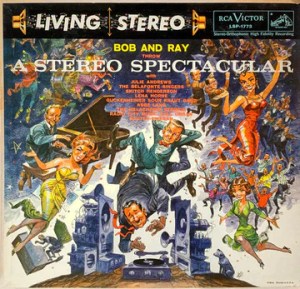
With STUNNING Shootout Winning Triple Plus (A+++) grades or close to them from start to finish, this TAS-approved Living Stereo pressing could not be beat
Originally produced as a sampler record for the Living Stereo line, it is an absolute MustOwn for serious audiophiles looking to take their system to the next level
Our reference copy here at Better Records is so vital to our operation that it would not be for sale at any (well, almost any) price!
4 stars: “The gleefully cacophonous Guckenheimer Sour Kraut Band takes the prize for providing the most unusual musical selection, but the overall program is extremely diverse [and] the comedy and music are enjoyable.”
Bob and Ray Throw A Stereo Spectacular just happens to be our favorite Test Disc, eclipsing all others in the areas of naturalness and difficulty of reproduction. Any tweak or new room treatment — we seem to do them almost weekly these days — has to pass one test and one test only: The Bob and Ray Test.
This record has the power to help you get to the next level in audio like no other.
In the past we’ve complained about “Rudy Van Gelder’s somewhat over the top echo-drenched brass,” but on a copy such as this there is nothing to complain about!
All that reverb on the brass sounds RIGHT. If you have a top quality front end (and the system that goes with it), this recording will be amazingly spacious, three-dimensional, transparent, dynamic, and open.
Copies of this album are sometimes so sour or dull (or both) that they go right in the trade pile. Add to that the difficulty of finding copies that are scratch-free and not too noisy and you have one tough shootout. Inner Groove Distortion caused by the non-anti-skate-equipped turntables of the day is a chronic problem with vintage jazz records, and this title is typically no exception — except in this case!
A Must Own Jazz Record
This Demo Disc Quality recording should be part of any serious Jazz Collection.
Unless your system is firing on all cylinders, even our hottest Hot Stamper copies — the Super Hot and White Hot pressings with the biggest, most dynamic, clearest, and least distorted sound — can have problems .
Your system should be thoroughly warmed up, your electricity should be clean and cooking, you’ve got to be using the right room treatments, and we also highly recommend using a demagnetizer such as the Walker Talisman on the record, your cables (power, interconnect and speaker) as well as the individual drivers of your speakers.
This is a record that’s going to demand a lot from the audio enthusiast, and we want to make sure that you feel you’re up to the challenge. If you don’t mind putting in a little hard work, here’s a record that will reward your time and effort many times over, and probably teach you a thing or two about tweaking your gear in the process.
I once adjusted my anti-skate while playing this very album, at the time dialing it in to what I thought was a “T.”
Over the years I’ve found that the best test for fine anti-skate adjustment is massed strings, and not just at the end of a side but right at the part of the record in which the anti-skate has been engaged. This will vary with different arms.
When you have all the rosiny texture, the high-end harmonic extension, the least shrillness and the widest and deepest staging, you are there — assuming that tracking weight, azimuth and VTA are correct as well.
Four variables to mess with admittedly is a bitch, but having the right record to test with is absolutely critical as well. Maybe we should call it five variables.
And if I only had one record to bring to someone’s house in order to evaluate their equipment, this would certainly be a top choice. If you can make this record sound the way it should, your stereo is cookin’. If you are having problems, this record will show them to you in short order.
A stunning True Stereo pressing with some of the best Beatles sound money can buy – superb work from Ken Scott here
Demo Disc quality sound for “I Am The Walrus,” “Strawberry Fields Forever,” “Baby You’re A Rich Man” and more
You won’t believe how powerful the sound is – it’s big, rich, open and lively beyond all expectation
A longtime Top 100 album and psych rock masterpiece that knocks us out every time we do the shootout
Any list of the best rock and pop albums of 1967 would have to have this record on it, along with its predecessor, Sgt. Pepper, released in May of the same year if you can believe it
Drop the needle on “Fool On The Hill” and you’ll see why we get so worked up over top copies that sound as good as this one does. This is a STUNNING recording, but you need a killer Hot Stamper pressing to appreciate just how well recorded the album is.
Lately I have been listening to this piece of music from start to finish over and over again, at this point easily ten times through, immersed in the glorious display of more orchestral color than one could possibly imagine in a single piece of music (including The Planets I dare say), in all of 35 minutes no less.
What triggered this behavior you ask? Hearing it performed live a few months back (5/2026?) planted the seed, and rediscovering the CD in my collection allowed me to get obsessed with it, something I tend to do when a piece of music is as full of life as this one is. We describe Muti’s performance of the work this way:
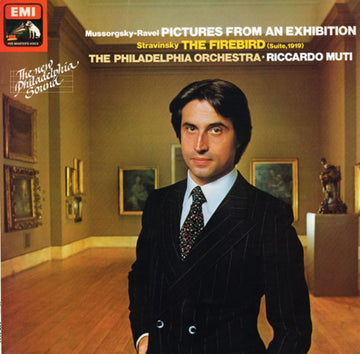
The EMI import pressing you see here gives you the complete Pictures at an Exhibition with a top performance and superb sonics.
Pictures is a piece of music that has been recorded countless times. I’ve played scores of different recordings starting at about the age of twenty, but the only one that still satisfies is this one, Muti’s 1979 recording with the Philadelphia Orchestra. Much like Previn and the LSO’s performance of The Planets, he brings out musical qualities in the work better than any other conductor with which I am familiar.
If I were limited to only one record to test a system with, it would be hard to choose a better one than a top copy of the Muti on EMI. (It’s almost, but not quite, all you would need.)
My advice would be to go and find yourself a clean UK pressing as quickly as possible.
It may eventually become your favorite orchestral recording of all time the way it has become mine, at the tender age of 72 in my case!
In the meantime, check out the wonderful performance recorded by the Oslo Philharmonic available on youtube. If you have big speakers hooked up to your TV and are willing and able to play them good and loud, you are in for a treat.
The performance is easily one of the best I’ve ever heard, although a bit slower and more measured than ideal. However, it would clearly be superior to those on offer by second- and third-rate orchestras, of which there are many in my experience.
Here is the precision and energy that is surely missing from those performances, as well as most recordings truth be told, whether analog or digital. (The CD on EMI by the way is excellent and highly recommended.) As I said, the pacing is a bit slow, but the ability to see all the players and their instruments is a huge bonus on a powerful work such as this.
List of Instruments (AI Assisted)
Woodwinds: 3 Flutes (1 doubling piccolo), 3 Oboes (1 doubling English horn), 2 Clarinets, 1 Bass Clarinet, 2 Bassoons, 1 Contrabassoon, and 1 Alto Saxophone (featured prominently in The Old Castle).
Brass: 4 Horns, 3 Trumpets, 3 Trombones, 1 Tuba, and 1 Euphononium (or Saxhorn, often performed on Euphonium or Tuba for the Bydło soloist movement).
This Shaded Dog pressing of LSC 2129 had practically no smear on either the violin or the orchestra.
Try to find a violin concerto record with no smear.
We often say that Shaded Dogs, being vintage All Tube recordings, tend to have tube smear.
But what about the 70s transistor mastered Red Label pressings – where does their smear come from?
Let’s face it: records from every era more often than not have some amount of smear.
And we can never really know what accounts for it.
The key thing is to be able to recognize it for what it is.
(We find modern records, especially those pressed at RTI, to be quite smeary as a rule. They also tend to be congested, blurry, thick, veiled, and ambience-challenged. For some reason most audiophiles — and the reviewers who write for them — rarely seem to notice these shortcomings.)
Of course, if your system itself has smear it becomes that much harder to hear the smear on your records. Practically every tube system I have ever heard had more smear than I could tolerate – it comes with the territory. And high-powered transistor amps are notoriously smeary, opaque and ambience-challenged. Our low-powered, all-transistor rig has no trouble showing us the amount of smear on records, including those that have virtually none.
Keep in mind that one thing live music never has is smear of any kind. Live music is smear-free. It can be harmonically distorted, hard, edgy, thin, fat, dark, and all the rest, but one thing it can never be is smeary.
That is a shortcoming unique to the reproduction of music, and one which causes many of the pressings we sell to have their sonic grades lowered.
About ten years ago we played a copy of Blue that put us in the presence of a piano the likes of which we had never heard on the album before.
We found it on the track The Last Time I Saw Richard.
This is not the thin and hard-sounding instrument that accompanies Joni on every pressing you have ever had the misfortune to audition, hoping against hope that someday you would find that “elusive disc” with sound worthy of such extraordinary music.
No, this piano had real weight; it has body; and it was surrounded by real, three-dimensional studio space. No vinyl pressing we had ever played up to then has managed to capture the sound of the piano on this record any better. Exactly no copies.
For those of you with a certain Heavy Vinyl pressing in your collection, we can only say that the piano on this copy will show you everything that is wrong with the piano on that one.
The piano had no smear, allowing both the percussive aspects of the instrument and the extended harmonics of the notes to be heard clearly and appreciated fully.
Pianos are very good for testing your system, room, tweaks, electricity and all the rest, not to mention turntable setup and adjustment.
I discovered If Only I Could Remember My Name sometime in the 90s, probably from reading about it in The Absolute Sound. When I was in my twenties and buying records regularly, the album was already out of print; I know because I went looking for it an nobody seemed to stock it.
The (awful sounding) Super Saver came out in 1975 and probably was deleted before long due to a lack of demand.
Once I had heard the record, it quickly became a go-to Test and Demo Disc, mostly for the song Traction in the Rain. The autoharp on that track is one of the most amazing things I have ever heard, on any album. The exceptional resolution and harmonic coherency of the multiple electrostatic arrays I was using for the mids and highs of my speaker system were perfectly suited to reproduce that instrument, as well as the complete track with Crosby’s delicate, breathy vocal being another key element to the sound.
I listened intently for the notes that got louder and softer as the autoharp was strummed. The more different each note sounded, the more micro-dynamics I knew I was reproducing. I tweaked and tested my system for months, even years with this track. (Nowadays I might put it on the list of records that sound so good they’re not actually ideal for testing, but that’s another story for another day.)
I didn’t know enough to buy other copies and compare them to mine. I just knew it was a great sounding record that I could blow people’s minds with as a big speaker demo disc.
This copy was giving us the sound we were looking for on this classic of Electric Blues guitar, with both sides earning killer Nearly Triple Plus (A++ to A+++) grades, just shy of our Shootout Winner – fairly quiet vinyl too
A superb pressing with hard-rockin’ energy, rich, solid bass, open top end, and freedom from congestion
This is one of the best copies to hit the site – good SRV albums are getting tough to find nowadays
“[SRV] wanted to add soul and R&B inflections to his basic blues sound, and Soul to Soul does exactly that. [T]he Curtis Mayfield-inspired closer, ‘Life Without You,’ captures Vaughan at his best as a composer and performer. It’s such a seductive number – such a full realization of his soul-blues ambitions…”
Vaughan’s guitar playing is as fiery as ever, and the addition of keyboards and saxophone here gives the music broader scope and range than was possible on his previous albums.