This TAS List record with a Super Hot stamper side one has some of the best sound we have ever heard for the Shaded Dog Reiner/CSO Pictures, and side two, although it starts out a little weak, gets going soon enough and earns a Super Hot Stamper sonic grade as well.
Side one is open and natural in the best Living Stereo tradition, with rich lower strings that have virtually no Golden Age smear.
Turn it up and listen for the big cymbal crashes — that’s the sound we love. It’s so good it even allows me to enjoy Reiner’s performance, never one of my favorites.
Side One
A++, transparent and free from smear, not many copies are going to beat this one! A little more top would have been nice.
Listen to: Samuel Goldenburg und Schmuyle
Superb sound! The brass and strings on this part of the work are as good as it gets. No smearing of the brass — it’s clean and clear like it is in the concert hall. We’re so used to hearing it wrong that it takes a record like this to remind us how good a full brass choir can really sound.(more…)
This Mobile Fidelity LP contains the music of Star Wars and Close Encounters, conducted by Zubin Mehta. The MoFi pressing is far more transparent than the London pressings we have auditioned of the album, even the ones Half Speed mastered by Stan Ricker himself.
Yes, he cut the original Londons! At Half Speed! (We’ve also played some later pressings not mastered by Stan, of course. We don’t pretend to be able to predict which version would sound the best.)
It’s still one of the better MoFi remasters, all things considered. The music, to these ears, has always been hi-fi-ish schlock, and the recording itself is too multi-miked to be taken seriously. It sounds far too much like a bad Phase IV recording, and we know whereof we speak when it comes to Phase IV, good or bad. We’ve played them by the score.
This famous record from the Top Seven of the TAS Super Disc List has the same problem, but I never hear anybody mention it. Why that is I cannot imagine, other than our favorite explanation for just about everything that seems to fly under the audiophile radar, or perhaps a better description would be flying over the heads of the self-appointed audiophile cognoscenti, our old standby, reviewer malpractice.
Bottom line, a loser, but the original Londons in our experience are even worse!
I once adjusted my anti-skate while playing this very album, at the time dialing it in to what I thought was a “T.”
Over the years I’ve found that the best test for fine anti-skate adjustment is massed strings, and not just at the end of a side but right at the part of the record in which the anti-skate has been engaged. This will vary with different arms.
When you have all the rosiny texture, the high-end harmonic extension, the least shrillness and the widest and deepest staging, you are there — assuming that tracking weight, azimuth and VTA are correct as well.
Four variables to mess with admittedly is a bitch, but having the right record to test with is absolutely critical as well. Maybe we should call it five variables.
And if I only had one record to bring to someone’s house in order to evaluate their equipment, this would certainly be a top choice. If you can make this record sound the way it should, your stereo is cookin’. If you are having problems, this record will show them to you in short order.
Lately I have been listening to this piece of music from start to finish over and over again, at this point easily ten times through, immersed in the glorious display of more orchestral color than one could possibly imagine in a single piece of music (including The Planets I dare say), in all of 35 minutes no less.
What triggered this behavior you ask? Hearing it performed live a few months back (5/2026?) planted the seed, and rediscovering the CD in my collection allowed me to get obsessed with it, something I tend to do when a piece of music is as full of life as this one is. We describe Muti’s performance of the work this way:
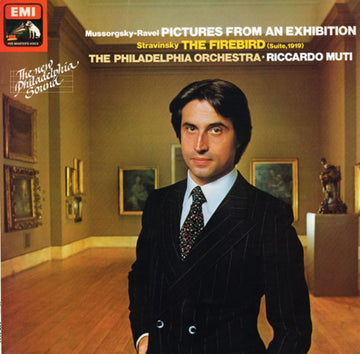
The EMI import pressing you see here gives you the complete Pictures at an Exhibition with a top performance and superb sonics.
Pictures is a piece of music that has been recorded countless times. I’ve played scores of different recordings starting at about the age of twenty, but the only one that still satisfies is this one, Muti’s 1979 recording with the Philadelphia Orchestra. Much like Previn and the LSO’s performance of The Planets, he brings out musical qualities in the work better than any other conductor with which I am familiar.
If I were limited to only one record to test a system with, it would be hard to choose a better one than a top copy of the Muti on EMI. (It’s almost, but not quite, all you would need.)
My advice would be to go and find yourself a clean UK pressing as quickly as possible.
It may eventually become your favorite orchestral recording of all time the way it has become mine, at the tender age of 72 in my case!
In the meantime, check out the wonderful performance recorded by the Oslo Philharmonic available on youtube. If you have big speakers hooked up to your TV and are willing and able to play them good and loud, you are in for a treat.
The performance is easily one of the best I’ve ever heard, although a bit slower and more measured than ideal. However, it would clearly be superior to those on offer by second- and third-rate orchestras, of which there are many in my experience.
Here is the precision and energy that is surely missing from those performances, as well as most recordings truth be told, whether analog or digital. (The CD on EMI by the way is excellent and highly recommended.) As I said, the pacing is a bit slow, but the ability to see all the players and their instruments is a huge bonus on a powerful work such as this.
List of Instruments (AI Assisted)
Woodwinds: 3 Flutes (1 doubling piccolo), 3 Oboes (1 doubling English horn), 2 Clarinets, 1 Bass Clarinet, 2 Bassoons, 1 Contrabassoon, and 1 Alto Saxophone (featured prominently in The Old Castle).
Brass: 4 Horns, 3 Trumpets, 3 Trombones, 1 Tuba, and 1 Euphononium (or Saxhorn, often performed on Euphonium or Tuba for the Bydło soloist movement).
This Shaded Dog pressing of LSC 2129 had practically no smear on either the violin or the orchestra.
Try to find a violin concerto record with no smear.
We often say that Shaded Dogs, being vintage All Tube recordings, tend to have tube smear.
But what about the 70s transistor mastered Red Label pressings – where does their smear come from?
Let’s face it: records from every era more often than not have some amount of smear.
And we can never really know what accounts for it.
The key thing is to be able to recognize it for what it is.
(We find modern records, especially those pressed at RTI, to be quite smeary as a rule. They also tend to be congested, blurry, thick, veiled, and ambience-challenged. For some reason most audiophiles — and the reviewers who write for them — rarely seem to notice these shortcomings.)
Of course, if your system itself has smear it becomes that much harder to hear the smear on your records. Practically every tube system I have ever heard had more smear than I could tolerate – it comes with the territory. And high-powered transistor amps are notoriously smeary, opaque and ambience-challenged. Our low-powered, all-transistor rig has no trouble showing us the amount of smear on records, including those that have virtually none.
Keep in mind that one thing live music never has is smear of any kind. Live music is smear-free. It can be harmonically distorted, hard, edgy, thin, fat, dark, and all the rest, but one thing it can never be is smeary.
That is a shortcoming unique to the reproduction of music, and one which causes many of the pressings we sell to have their sonic grades lowered.
We made a crack about the Starker Mercury recordings below which we gernerally no longer agree with, although I am sure there are some pressings which have bloated sound. Those are the ones that don’t win shootouts.
On this pressing we were a bit surprised at how natural the cello sounded — more like the real instrument and less like the typical recording of it.
Normally when recording the cello, the microphones are placed fairly close to the instrument. This often results in what’s known as the “proximity effect,” which simply describes a boost in the lower frequencies relative to the more linear response of the microphone when placed at a distance.
The famous Starker cello recordings on Mercury — you know the ones, the originals and even the reissues sell for hundreds and hundreds of dollars — suffer from this effect, which audiophiles seem to prefer. (The Mercury heavy vinyl reissues, at least the ones I’ve played, were ridiculously fat and bloated in the bottom.)
Audiophiles did not seem to mind much, judging by the apparently strong sales and the rave reviews I read. Bass shy systems, and that means most of the systems owned by audiophiles, probably benefited from the bass boost.
Systems with lots of large woofers — at least in our case — would of course make the sound of these pressings positively unbearable. That indeed was our experience.
This Japanese 45 RPM remastering of our favorite recording of Prokofiev’s wonderful Lt. Kije Suite has DEMONSTRATION QUALITY SOUND. For starters, there are very few records with dynamics comparable to these. Since this is my favorite performance of all time, I can’t recommend the record any more highly.
Most of what’s “bad” about a DG recording from 1978 is ameliorated with this pressing. The bass drum (drums?) here must be heard to be believed. We know of no Golden Age recording with as believable a presentation of the instrument as this.
The drum is clearly and precisely located at the back of the stage; even better, it’s as huge and powerful and room-filling as it would have been had you attended the session yourself. That’s our idea of hi-fidelity here at Better Records.
Listen for fullness and solidity, especially in the piano, although a rich, full sounding clarinet is a joy here as well.
Some of the copies we played in our shootout lacked the weight and solidity to balance out the qualities of transparency and clarity.
The resulting sound is less natural, with the kind of forced detail that CDs do so well, and live music never does. There is a balance to be found.
The right VTA will be critical in this regard. When you have all the space; the clearest, most extended harmonics; AND good weight and richness in the lower registers of the piano, you are where you need to be (keeping in mind that it can always get better if you have the patience and drive to tweak further).
On many copies the strings are dry, lacking some of the Tubey Magic heard on the better copies.
This is decidedly not our sound, although it can easily be heard on many London pressings, the kind we’ve played by the hundreds over the years.
If you have a rich sounding cartridge, perhaps with that little dip in the upper midrange that so many moving coils have these days, you will not notice this tonality issue nearly as much as we do.
Our 17Dx is ruler flat and quite unforgiving in this regard.
It makes our shootouts much easier, but brings out the flaws in even the best pressings, exactly the job we require it to do.
We discussed the issue in a commentary entitled Hi-Fi beats My-Fi (if you are at all serious about audio).
Here are some of the other records we’ve discovered that are good for testing string tone and texture.
Wow, what a find! Dances of Old Vienna is a WONDERFUL sounding record with vintage Decca / London sound. Even as late as 1968 Decca was still able to produce recordings that are tonally correct from top to bottom and full of Tubey Magic.
There is not a trace of hyped-up sound to be found on this record. It’s unbelievably spacious and three-dimensional, with depth to rival any recording you may own.
The sound is especially spacious partly because the recording is of a fairly small ensemble, playing in a lively hall, exactly the kind of venue in which this music was meant to be heard.



 Hot Stamper Pressings of the Music of Claude Debussy Available Now

 Hot Stamper Pressings on Two of Our Favorite Labels, Decca & London