1962-rev

Presenting a select group of reviews and commentaries for albums recorded or released in 1962, a great year for analog.

Brahms / Piano Concerto No. 1 – What to Listen For

Hot Stamper Pressings of of the Music of Brahms Available Now

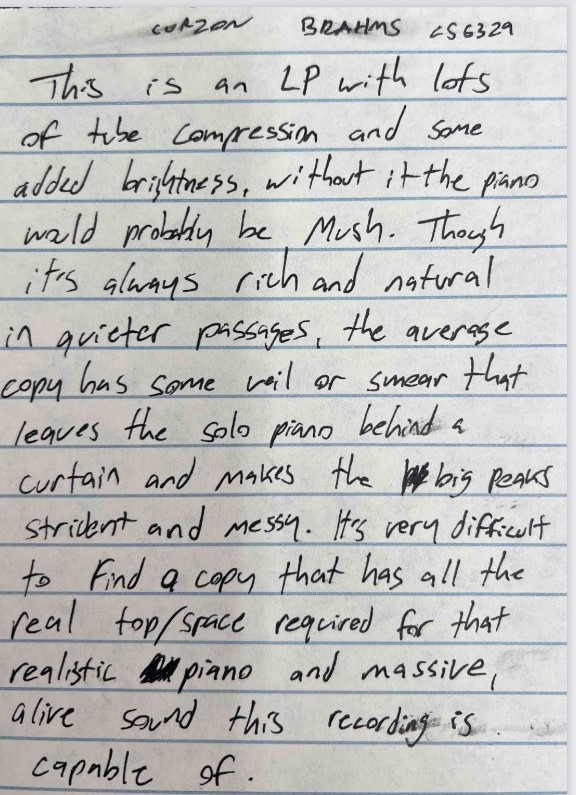
Our general notes for the recording seen below explain why the typical copy in our shootout fell short.

This is an LP with lots of tube compression, and some added brightness.

Without the added brightness, the piano would probably be mud.

The added brightness and compression results in a piano that always sounds rich and natural in the quieter passages.

The average copy also has some veiling or smearing that make the solo piano parts sound like they are coming fom behind a curtain. On these copies, the big peaks can often get strident and very messy.

It’s difficult to find a copy that has all the top end extension and space required to reproduce both a realistic piano and the massive live sound the orchestra is capable of.


All of which adds up to a difficult shootout in which relatively few copies had the sound we were looking for.

Production and Enginneering

(more…)

If You’re Looking for the Best Sound on Standard Coltrane, Look No Further

Hot Stamper Pressings of the Music of John Coltrane Available Now

As you may have guessed by now, remastered is a bit of a dirty word around these parts.

Most remastered records we play, from The Beatles to John Coltrane to ZZ Top, sound to us like pale imitations of the real thing, whether the real thing is an original or a vintage reissue from back in the day.

But only a fool could fail to appreciate how correct and lively the best copies of this remastered record sound, and we’re no fools here at Better Records. We judge records by one and only one criterion: the quality of their sound.

We pay no mind to labels, record thicknesses, playback speeds, mastering speeds or anything else you can read about on audiophile websites.

We’re looking for the best sound. We don’t care where it comes from.

On that basis we’re awarding side two of this recent shootout winning copy the award for the best sound on Standard Coltrane.

No other pressing of the album could do what this side two was doing. And the good news is that side one was nearly as good, making this the best copy to ever hit the site.

Side One

So dynamic, present and lively, with a rich sax and clear, solid piano. Great energy.

Side Two

Even better, with tighter, bigger bass.

Let’s give RVG a hand, the tonality on this side is HTF: Hard To Fault.

Only a small percentage of the many remastered records we’ve played over the years can make that claim in our experience.

(more…)

Don’t Waste Your Money on this Living Stereo with Munch from 1962

More of the Music of Franz Schubert

Some audiophiles buy albums based on their labels. For example, this Shaded Dog pressing of LSC 2522 from the Golden Age of RCA Living Stereo might appeal to a certain kind of audiophile who seeks out clean copies LSCs on the original label.

More than that, he might limit himself to the most sought-after 1S Indianapolis pressings. Hooray! What could be better?

However, many records from this era simply do not sound good, and this is one of them. We have never heard a good sounding copy of LSC 2522, and we’ve played plenty of them over the decades that we’ve been auditioning Golden Age Classical records for sale.

This Shaded Dog might be passable on an old school system, but it was too unpleasant to be played on the high quality modern equipment we use.

There are quite a number of other records that we’ve run into over the years with similar shortcomings. Here are some of them, a very small fraction of what we’ve played, broken down by label.

  • London/Decca records with weak sound or performances
  • Mercury records with weak sound or performances
  • RCA records with weak sound or performances, including many on the coveted Shaded Dog label

(more…)

Shaded Dogs with 12s Stampers Are Not the Way to Go on LSC 2566

Hot Stamper Pressings of the Music of Edvard Grieg Available Now

One set of stampers for the Shaded Dogs we played in our most recent shootout sounded consistently subpar, 12s/12s.

The sound was blary on both sides. (More records with blary sound can be found here.)

Although the Shaded Dog originals with the right stampers will always win our shootouts, the White Dog reissues still sound quite good to us, just not as good.

This Shaded Dog might be passable on an old school audio system, but it was too unpleasant to be played on the high quality modern equipment we use.

There are quite a number of other vintage classical releases that we’ve run into over the years with similar shortcomings. For fans of vintage Living Stereo pressings, here are some to avoid.

Some audiophiles may be impressed by the average Shaded Dog pressing, but I can assure you that we here at Better Records are decidedly not of that persuasion.

Something in the range of five to ten per cent of the major label Golden Age recordings we play will eventually make it to the site. The vast majority just don’t sound all that good to us. (Many have second- and third-rate performances and those get tossed without ever making it to a shootout.)

(more…)

Keeping the Players Together on Jazz Impressions of Black Orpheus

guarajazzi_wtlf_1406113104

Hot Stamper Pressings of Jazz Recordings Featuring the Piano

Another in our series of listening exercises here discussing the importance of transparency, ambience and resolution.

The arrangement of the players is straightforward, with the bass hard left, drums hard right (with leakage well to the left on the cymbals, but that’s another story), and Guaraldi on piano in the center. (The first track of side two reverses this arrangement; why, I have no idea.)

Here’s the crazy thing about this recording: The best copies really connect up — tie together — the space each of the players is in. I heard it during the shootout, and I can’t recall if it actually happened more than once or twice, but I know I heard it. They are all live, they are all on the same soundstage, but on most copies you would hardly know it.

They sound like they are playing in booths, the ambience never extending very far in any direction. The best copies have so much ambience that one player’s space extends all the way to the edge of the other player’s space. The effect, though rare, is nothing less than magical.

The piano is solid, mostly clear and not hard. Not many copies present the piano this way — correctly in other words. The amazing snare of Colin Bailey in the right channel is LIVELY and fun like you’ve never heard before.

There is no sacrifice in fullness, richness or Tubey Magic in the presentation, and that is the right sound for this music.

No Breakup on the Piano

I would be willing to bet that 90% or more of all the early pressings still in playable condition have some breakup on the piano. The old arms and carts of the day simply could not track the groove the way modern arms and carts can, and ended up damaging the record.

We are happy to report that this copy has no breakup on the piano at all.

The best copies bring out the contribution of the bass player better, the bass being essential to the rhythm of the music. On some, the bass is so tight and note-like you can see right into the soundstage and practically watch Monte Budwig play.


Further Reading

The Original Is Better? Sez Who?

Hot Stamper Pressings that Sound Their Best on the Right Reissue Available Now

Which albums sound better on the right vintage reissue pressing?

These do.

Just to take one example: The original Reprise pressing of Jazz Waltz, whether in mono or stereo, has never sounded very good to us. The mono is quite a bit worse than the stereo – no surprise there – but both must be considered poor reflections of the master tape.

We sold one many years ago, describing it this way: “Beautiful original with decent sound — rich, smooth and sweet.” Which it was, but from us that’s little more than damning it with faint praise.

The Discovery pressing is so much bigger, clearer and livelier it’s almost hard to imagine it and the 1962 Reprise original were both made from the same tape.

Something sure went wrong the first time around — I think it should be safe to say at least that much.

Does the Original Always Have the Best Sound?

Not for those of us who play records rather than merely collect them.

(more…)

Dvorak / Symphony No. 9 – The Best on Record

More of the Music of Antonin Dvorak

  • This big, lively, and dynamic UK Decca pressing boasts superb Double Plus (A++) grades on both sides – fairly quiet vinyl too
  • The sound of the hall the Vienna Phil recorded in is huge, so wide and deep, spacious and open – the perspective is above all natural
  • Tons of energy, loads of rich detail and texture, superb transparency and excellent clarity – this pressing is the very definition of Orchestral Demo Disc Sound
  • “It is a great symphony and must take its place among the finest works in the form produced since the death of Beethoven.” – The New York Times
  •  When you hear how good this record sounds, you may have a hard time believing that it’s a budget reissue from 1970. Even more extraordinary, the right copies are the ones that win shootouts
  • There are about 150 orchestral recordings we’ve awarded the honor of offering the Best Performances with the Highest Quality Sound, and Kertesz’s with the Vienna Phil. certainly deserves a place on that list.

Presenting yet another remarkable Demo Disc from the Golden Age of Vacuum Tube Recording Technology, in this case 1961, with the added benefit of mastering courtesy of the more modern equipment of the ’70s, in this case 1970. (We are of course here referring to the good modern equipment of 50+ years ago, not the bad modern mastering equipment of today.)

(more…)

Dvorak / Symphony No. 9 – Probably a Good Speakers Corner Release

More of the music of Antonin Dvorak (1841-1904)

The one recording of this work that seemed to us to have the best balance of sound and performance was conducted by Istvan Kertesz. His recording with the Vienna Philharmonic in 1961, his debut for Decca as a matter of fact, is the one that ended up winning our shootout of a dozen pressings or so.

You may be aware that Speakers Corner remastered this recording  in the ’90s. We carried it and recommended it highly at the time.

Now that we have much better equipment and much higher standards than we did then, we probably would not like it as well. Still, if you can pick one up for cheap, something close to the thirty bucks we used to charge, it might not be such a bad deal.

I will be happy to give Speakers Corner credit for knowing which recording of the work was most deserving of remastering. They make a lot of mistakes, but this is not one of them.

Unsurprisingly, we prefer a later mastering of the recording, not the original.

Here are more reviews of music conducted by Kertesz, a man whose work we very much admire.

(more…)

Live At The Village Gate on Audio Fidelity Heavy Vinyl

Hot Stamper Pressings of Jazz Albums Available Now

An Audiophile Hall of Shame pressing. It’s yet another Disastrous Heavy Vinyl release with godawful sound.

What a murky mess. Hard to imagine you couldn’t find a common domestic pressing that wouldn’t sound better.

I mention throughout this blog that, starting in the ’90s, the records put out by Cisco, DCC, S&P and finally Audio Fidelity had to fight their way through Kevin Gray’s opaque, airless, low-resolution cutting system. We discuss that subject in some depth here.

Compressed, thick, dull, opaque, and almost completely lacking in ambience, this record has all the hallmarks of a Modern Heavy Vinyl Reissue pressed at RTI.

The average ’70s pressing on the Atlantic Red and Green label will kill this audiophile piece of junk, and it’s unlikely to cost you more than ten bucks. Whatever you do, don’t waste your money on this incompetently remastered reissue.


For 35 years we’ve been helping music loving audiophiles the world over avoid bad sounding records.

To see the records with bad sound or bad music we’ve reviewed that weren’t marketed to audiophiles, click here.

It’s yet another public service from Better Records, the home of the best sounding records ever pressed. Our records sound better than any others you’ve heard or you get your money back.

(more…)

Surfer Girl Takes MoFi Spit to a New Level

Hot Stamper Pressings of the Music of The Beach Boys Available Now

An audiophile hall of shame pressing and another MoFi LP reviewed and found wanting.

I played the MoFi pressing of this record many years ago, some time back in the early 90s if memory serves, and at the time I could hardly believe that the good people of MoFi would release a record that was so ridiculously SPITTY. The sibilance is positively out of control, the result of their wacky cutting system and phony EQ and who knows what else.

But then I remembered that there has never been a title produced by these people with sound so bad that they would have cancelled its release. {This is a classic case of begging the question. I really have no idea why some of their titles that exist only on test pressing — Pearl for one — never saw the light of day. It is possible that it was cancelled because it sounded worse than even the hard-of-hearing Powers That Be at MoFi could tolerate. Doubtful, but possible.)

(more…)