*Experimenting with Records

Experimenting with records is the only way to learn much about them of any real value.

An Insult to Aaron Copland on Reference Records

Hot Stamper Pressings of Orchestral Music Available Now

Yet another Reference Record we’ve reviewed and found wanting.

In all the years I was selling audiophile records, one of the labels whose appeal made no sense to me whatsoever (along with their long-forgotten TAS list brethren, American Gramaphone and Telarc) was Reference Records.

Back then, when I would hear one of their orchestral or classical recordings, I was always left thinking, “Why do audiophiles like these records?”

I was confused, because at that time, back in the 80s, I had simply not developed the listening skills that today make it so easy to recognize the faults of their recordings.

I made the mistake of thinking that other audiophiles with more advanced equipment and more refined listening skills must be hearing something I was not.

I had trouble putting my finger on what I didn’t like about them, but now, having worked full time (and then some!) for more than twenty years to develop better critical listening skills, the shortcomings of their records, or, to be more accurate, the shortcomings of this particular copy of this particular title, took no time at all to work out.

My transcribed notes for RR-22:

  • Lean tonality
  • No real weight
  • No Tubey Magic
  • Blurry imaging when loud
  • No real depth
  • Bright tonal balance

Is this the sound you are looking for in an audiophile record?

Shouldn’t you be looking for audiophile quality sound?

Well, you sure won’t find it here.

On our current playback system, this Reference Record is nothing but a joke, a joke played on a much-too-credulous audiophile public by the ridiculously inept and misguided engineers and producers who worked for Reference Records.

This is a reference for something? For what?

As I wrote about another one of their awful releases, if this is your idea of a reference record, you are in real trouble.

It would be hard to imagine that anyone who has ever heard a good vintage classical recording — here are some of our favorites — could ever confuse this piece of audiophile trash with actual hi-fidelity orchestral sound.

(more…)

Leonard Cohen Sure Sounds Better than He Used to

Hot Stamper Pressings of the Music of Leonard Cohen Available Now
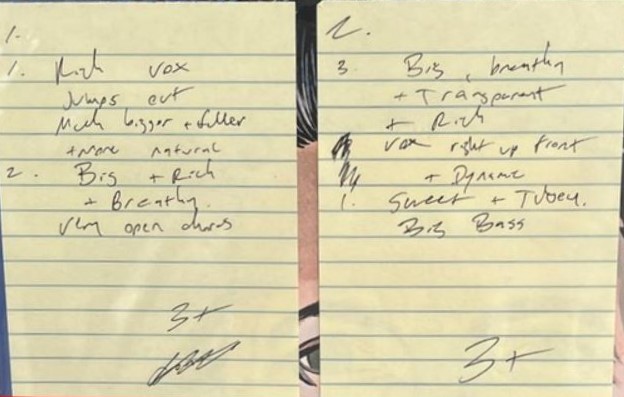
Insanely good Shootout Winning Triple Plus (A+++) sound on both sides AND fairly quiet vinyl – the best copy to ever hit the site bar none.

Unbeatable richness and freedom from artificiality in the midrange allowed this one to tower over the rest of the field.

As you can see from the notes, both sides of our most recent White Hot stamper shootout winning copy were doing everything right. We marvelled at these specific qualities in the sound:

Side One

Track one

    • Rich vocals
    • Jumps out
    • Much bigger and fuller and more natural

Track two

    • Big and rich and breathy
    • Very open chorus

Side Two

Track three

    • Big, breathy and transparent and rich
    • Vocals are right up front and dynamic

Track one

    • Sweet and tubey
    • Big bass

Midrange presence is one of the most important qualities of any rock or pop recording we might be evaluating, and for a Leonard Cohen album it is absolutely essential.

You want Cohen to be front and center, neither recessed in space nor behind a veil.

The notes for track three on side two say it all:

Vocals are right up front and dynamic

That is what gets this music to sound the way it is supposed to. You can be very sure that no Heavy Vinyl remastered pressing is going to put Leonard Cohen front and center. They practically never do. (Here is an especially offensive remaster with a bad case of recessed vocals. Funny how none of the audiophile reviewers noticed. What does that say about the quality of their playback, or the standards to which they hold their records?)

DIY Advice

To aid you in doing your own evaluations, here is a list of records that we’ve found to be good for testing midrange presence.

This is exactly why we do shootouts. If you really want to be able to recognize subtle (and not so subtle!) differences between pressings, you must learn to do them too.

And make sure to take notes about what you are hearing, good and bad.

We love Cohen’s albums here at Better Records. No, they’re not audiophile spectaculars, but much like the best Dylan recordings, when they work the sound fits the music perfectly.


UPDATE 2025

In previous listings we had noted:

The vocals are right up front and fairly dry, throwing the words and phrasing into high relief.

But we would no longer agree with the vocals being dry. On the best copies they are rich, full-bodied and tubey.

What does that say about the quality of our playback? How about: It’s better now than it used to be!

(more…)

You Say You Want a Revelation? Well, You Know…

Record Collecting for Audiophiles – A Guide to the Fundamentals

We get letters from time to time chiding us for charging what strikes some people as rather large amounts of money for records that we would be the first to admit do not have much in the way of Collector Value, the assumption being that collectible records are of course worth the high prices they command in the marketplace, if for no other reason than that their prices are set by the market.

The writers of these letters are convinced that our Hot Stamper pressings, for some reason or another, are a very different animal. They simply can’t be worth the seemingly outrageous prices we ask for them.

Let’s be honest: if you don’t like our prices, you have plenty of other sources for the records we sell. And it’s unlikely that anyone would charge as much as we charge for what appears to be the same pressing, although it does happen.

(The phrase “appears to be” in the sentence above is at the heart of our business model. It is also foundational to much of what you need to know in order to collect better sounding records. The 6000 entries on this blog are dedicated to helping you understand everything that follows from that premise.)

Customer Satisfaction Is Everything to Us

Some of our customers seem to be inordinately pleased with their purchases. We know that because they’ve told us so.

  • One of our customers paid $700 for a copy of Aja and — mirabile dictu — he’s actually glad he did.
  • Another customer wrote to tell us how much he liked the copy of Let It Be we sent him:

“I would have paid $15,000 for this feeling had I known it was there.”

  • Was our Hot Stamper pressing of Deja Vu a bargain at $800? This customer thought it was.

Revelatory Sound Quality Can Be Yours

Some of our customers have found the sound of our Hot Stamper pressings to be nothing less than a revelation, especially the customers who’ve taken the time to compare them to the Heavy Vinyl or Half-Speed mastered pressings of the same titles they owned.

This prompted some of them to swear off the modern masterings they used to like. This, as you can imagine, warmed our hearts no end.

Our How-To Guide Is Free

If you want to do the work yourself and avoid the cost of buying our Hot Stamper pressings, we are behind you all the way.

We even tell you how to go about it.

You can buy records from us, or you can learn to do your own shootouts.

The one thing you can’t do is buy a ready-made superior sounding remastered copy of anything, no matter what anyone may tell you.

After 36 years in the audiophile record business, having conducted thousands upon thousands of Hot Stamper shootouts — using the process which allowed us to discover the best sounding pressings of countless titles in every genre of music — we can tell you with confidence that records don’t work that way.

(more…)

It May Be Hard to Believe, But We Actually Enjoy Testing Records

Advice to Help You Make More Progress in Audio

Some audiophile reviewers who are happy to opine at great length about the sound quality of various kinds of discs — both compact and vinyl — make a point of reviewing only those that sound good to them, ignoring the rest. (A small sample of the writings of one such reviewer can be found here on the blog, but there are doubtless others who follow the same approach.)

We think this does the audiophile community a disservice.

Needless to say, we see our role differently. Like Consumer Reports, we like to test things.

They test toasters, we test records. We put them through their paces and let the chips fall where they may.

They want to find out if the things they are testing offer the consumer good quality and value.

We want to find out if the records we are testing offer the audiophile good sound and music.

It takes a lot of people and a healthy budget to carry out large numbers of these kinds of tests.

No other record dealers, record reviewers or record collectors could possibly have auditioned more than a fraction of the records that we have. We’ve been looking for the best sounding pressings of records for a very long time, more than forty years.

Now, with a staff of ten or more, we can buy, clean and play records in numbers that are unimaginable for any single person to attempt.

That puts us in a unique position to help audiophiles looking for the highest quality pressings.

Yes, we have the resources, the staff and the budget. More importantly, we came up with a different approach.

We’ve learned through thousands and thousands of hours of experimentation that there is no reliable way to predict which pressings will have the best sound for any given album.

The impossibility of predicting the sound of records is one which we learned to accept as axiomatic. As a born skeptic, this was never difficult for me. Early on in my audio career, sometime in the ’80s, I realized it was self-evident.

The solution we put into practice given the nature of records comprises the four principles we adopted:

  1. We stopped pretending to know something that can’t be known.
  2. We stopped relying on theories proven to have very little if any predictive effect.
  3. We stopped relying on the experts and so-called authorities.
  4. We stopped assuming and speculating and, importantly, we stopped worrying about getting it wrong.

What remained was the simplest possible approach to the problem that would actually work. One that could be taught in a high school science class, if high school science classes were run by skeptical record collectors.

(more…)

What We’ve Learned About Peer Gynt Over the Last 20 Years

Hot Stamper Pressings of the Music of Edvard Grieg Available Now

The commentary reproduced down below is from 2005. It is unlikely that the pressing we liked at the time, a Stereo Treasury LP of the famous Fjeldstad performance, would come anywhere close to winning a shootout these days. We simply don’t buy them anymore. We stick to the pressings that have done well for us over the last twenty years in shootout after shootout.

Peer Gynt is a Masterpiece that deserves a place at the heart of any classical collection of the greatest recordings of all time.

If you want to improve the quality of pressings in your collection, by far the best way to go about it is to start doing your own shootouts. A great deal of this blog is dedicated to helping you learn how to do that.

Oddly enough, there actually are budget reissues that win shootouts. They just happen to be Ace of Diamonds pressings and not Stereo Treasurys. (You can see a picture of the pressing we like at the bottom of this post.)

The Wonderful Peer Gynt

Our favorite recording of Peer Gynt is the one by Otto Gruner-hegge and the Oslo Philharmonic from 1959.

The only other reading of the work with top quality sonics is the one that won our proto-shootout twenty years ago, the one with Fjeldstad and the London Symphony Orchestra.

Speaking of budget reissues, we are on record as having been fans of a great many budget classical LPs stretching back decades. My catalogs from the 90s were full of reissues with exceptionally good sound.

Doing things as we do them now, by following rigorous testing protocols, has made it possible for us to discover some budget pressings that are so well-mastered they have the potential — accent on the word potential — to win shootouts.

(more…)

Even In The Quietest Moments and Your 1977 Ears – There’s No Going Back

supereveni_1506_1x

Hot Stamper Pressings of the Music of Supertramp Available Now

By 1977 I was a huge fan of the band, having first discovered their music on Crisis (1975) and Crime (1974), in which order I honestly can’t remember.

I played their albums all the time, especially Crisis.

The first Supertramp album I bought on audiophile vinyl would have been Crime of the Century by Mobile Fidelity, which came out in 1978.

Every right-thinking audiophile had that one — MoFi sold over a hundred thousand of them (along with a hundred thousand of Aja, Touch and one or two others).

And why not? The sound was killer on the systems of the day. Lots of slam down low (but not really that low, although it seemed plenty low at the time), lots of extra top up high, lots of phony detail, just what the old school stereos of the day, like mine, needed.

Crisis? What Crisis? followed in 1975. It was the Supertramp album that sent me over the top. I played that album relentlessly. Before long Art Rock was at the top of my list anytime I wanted to have an immersive musical experience, and that, for an obsessive audiophile like myself, meant almost every day.

Supertramp, Yes, Roxy Music, 10cc, Eno, Crack the Sky, ELO, Bowie – it’s all I wanted to listen to back then, and it encouraged me to keep upgrading my equipment whenever I had the money, although I admit to being completely clueless about all of that at the time. More on that subject here.

A year and a half later EITQM followed. It too became a staple of my musical diet. Man, I played that record till the grooves were worn smooth.

I thought the sound of my domestic pressing was killer at the time, too. Crisis was a demo disc at my house and this was right up there with it. Now the obvious question is, did I have a good sounding copy, or did my stereo not reveal to me the shortcomings of my LP? Or maybe my ears were not well enough trained to hear what was wrong.

Those of you who have been doing this for a long time know the answer: any or all of the above, probably all, and nobody can know just how much of each.

And there is no way to find out because you are not that person anymore.

Your 1977 Ears… and Mine

Even if you could recreate your old stereo and room, and find your original copy, there’s one thing you can’t do, and that’s listen to it with your 1977 ears.

Every time you play a record and listen to it critically, your ears get better at their job.

(more…)

The Riddle of the Vastly Different Sides Has Been Solved

Hot Stamper Pressings of Recordings Featuring the Violin

About ten or fifteen years ago we came across a puzzling Shaded Dog pressing of the Bruch / Vieuxtemps recording from 1962 with Heifetz, LSC 2603.

We were surprised at the time how much worse one side sounded than the other. That had rarely if ever happened back in those early Living Stereo shootout days.

We sold the record as a one-sided disc with one complete performance in top quality sound, The Scottish Fantasy. Obviously the Vieuxtemps / Concerto No. 5 wasn’t worth playing; the sound was sub-par, a pale shadow of the sound of the other side of the record. You can read all about it here.

Well, we ran into those stampers again, or at the very least we ran into a copy with the same bad stampers for side one, 5s. Something sure went wrong somewhere, as you can see from our notes below.

At the time we described this curious pressing this way:

The violin is captured beautifully on side two. More importantly there is a lovely lyricism in Heifetz’s playing which suits Bruch’s Romantic work perfectly. I know of no better performance.

The performance of the Vieuxtemps Concerto No. 5 is also wonderful, but the sound is not. Want proof that two sides of the same record can have vastly different sound? Here it is. Note how oversized the violin on side one is, how smeary the orchestra, how little texture there is to anything in the soundfield. This side one is no Hot Stamper.

All true, and now that we know that 5s etched stampers are responsible for the bad sound and not just some pressing anomaly, we can all sleep peacefully once again.

(more…)

The Thrill of Discovering Great Recordings

Hot Stamper Classical and Orchestral Pressings Available Now

This shootout was many years in the making – we’d been trying to do these wonderful overtures for about five years, which just goes to show how hard it is nowadays to find records like these in audiophile playing condition.

We also just debuted a Decca recording with Ansermet at the helm under the title French Overtures featuring two of the pieces found here, and it’s every bit as good.

Which one is better is probably a matter of taste as they are both head and shoulders better than any other recordings of the music that we’ve come across in the last five or ten years. This is often what you are paying for when you buy a White Hot Stamper pressing — the best sound we know of for the music.

We admit that “we know of” is doing a good deal of heavy lifting in the preceding sentence, but the world is full of records and we can’t have played them all, so in the unlikely event that we find something better down the road, do not be too surprised, it happens.

Side One

  • So huge and tubey
  • 3D and spacious and extending high and low
  • Lush strings
  • More realistic and dynamic
  • Big low end
  • Tubey

Side Two

  • 3D, tubey and lush
  • Huge low end and brass
  • Realistic space and cymbals
  • Not hot at all

Let Me Ask You This

Who else is finding incredible Demo Discs like this EMI from 1972 nowadays?

(more…)

Listening in Depth to Fingers

Hot Stamper Pressings of Recordings by Rudy Van Gelder Available Now

At times this record really sounds like what it is: a bunch of guys in a big room beating the hell out of their drums and singing at the the top of their lungs. You gotta give RVG credit for capturing so much of that energy on tape and transferring that energy onto a slab of vinyl. 

Of course this assumes that the record in question actually does have the energy of the best copies. It’s also hard to know who or what is to blame when it doesn’t, since even the good stampers sound mediocre most of the time. Bad vinyl, worn out stampers, poor pressing cycle, it could be practically anything.

Side One

Fingers

This is the most problematical track on the entire album — please DO NOT JUDGE the album by this song! The sound is much better on the tracks that follow. This may have been an attempt to get that hot hit single sound for track one, the kind that would jump out of your radio speaker, but the effect can be a bit much, depending on how low distortion and high resolution your equipment is. The better your system, the less of a problem you will have getting this track to play well. If this track sounds decent, everything after it will really shine.

The biggest problem one typically runs into is a lack of bass and lower midrange. On the better copies the bass will be fine on the next track and those that follow.

Romance of Death

The guitar work on this track is stellar, some of the best musicianship on the album. Credit must go to Rudy Van Gelder for making the guitar jump out of the mix. One of the things he can do, practically better than anyone, is make a lead instrument sound as big and as bold as you’ve ever heard it.

Merry-Go-Round

This track has a tendency to be overly compressed. Some stampers have so much added compression that the guitar and the percussion in the middle of the soundfield turn into undifferentiated muck. Those copies are what we refer to as “Not-So-Hot Stampers.”

Wind Chant

Side Two

Note that the sound on side two tends to be more open, rich and clear as a rule.

(more…)

An Amazing Pressing of Latin Rendezvous – Complete with Notes!

Hot Stamper Pressings of Records from 1963 Available Now

We offered a White Hot stamper copy of this album many years ago, but our customers were not the least bit interested in it at the time, and we suspect that not much has changed since then.

It’s been tagged a never again record, meaning that although we like the music and the sound, we can’t devote the resources — in this case, mostly studio time — to finding top quality copies if there are not going to be any buyers for them.

We think it’s well worth seeking out, and one thing you can be sure of, you won’t have to pay too much for it. If you see one locally on the early label, in stereo, pick it up.

There’s a high probability it will sound at least very good, and you might even luck into one that is downright amazing the way we did, assuming you can clean it right.

More amazing finds like it can be found here.

NOTE: On side two, track three, the initialism ROTM stands for Right On The Money. See if you agree with me that the second track on side one is “kind of dry and thin.”


Our Review

A wonderful Latin jazz collection, with the unbeatable combination of the quintet’s “celebrated piano-vibes, liltingly embellished by Latin percussion and occasional flute.”

“In this collection, you’ll find Latin at its most alluring, as a musical language interpreted by Shearing.”

Clean, clear and dynamic, this copy has huge amounts of bass and tremendous space around the keyboards and percussion.

If you’re a fan of the kind of music Cal Tjader was making in the 60s, this album should be right up your alley. Plenty of Latin Percussion, with vibes and flutes to add color to the proceedings, all anchored by Shearing on the piano.

It’s lounge music but it’s fun lounge music — and it sounds like a very well recorded album from Capitol in 1963 should sound: big and rich.

1963 was a phenomenal year for audiophile quality recordings. We’ve auditioned and reviewed more than a hundred  titles to date, and there are undoubtedly a great many more that we’ve yet to discover.

Some of the best titles released in 1963 can be found here.

This link will take you to the 25+ titles recorded or released in 1963 that we think belong in any music-loving audiophile’s record collection.

(more…)