*Experimenting with Records

Experimenting with records is the only way to learn much about them of any real value.

Barney Kessel Plays Carmen on the Original Stereo Pressing

Hot Stamper Pressings of Contemporary Jazz Albums Available Now

A recent shootout produced this shootout winning pressing with amazing sound.

STUNNING Shootout Winning grades or close to them bring Kessel’s inspired jazz album to life on this original Contemporary stereo LP (the first copy to hit the site in years).

Here are just a few of the things we had to say about this killer copy in our notes: “tubey, sweet, and lively midrange”…”lots of room around the guitar and horns”…”excellent space and detail”…”great energy”

Tubey Magic, richness, sweetness, dead-on timbres from top to bottom – this is a textbook example of Contemporary sound at its best. The sonics are gorgeous – all tube, live-to-two-track, direct from the Contemporary studio to you, on glorious un-remastered analog vinyl.
For those of you who appreciate the sound that Roy DuNann (and Howard Holzer on other sessions) were able to achieve in the 50s at Contemporary Records, this LP is a Must Own (unless you already have it, which is doubtful considering how hard it is to find a copy in clean condition). Their stuff just doesn’t get any better than this.

From an audiophile point of view, how can you beat a Roy DuNann recording of so many instruments? It’s audiophile heaven.

Talk About Timbre

Man, when you play a Hot Stamper copy of an amazing recording such as this, the timbre of the instruments is so spot-on it makes all the hard work and money you’ve put into your stereo more than pay off. To paraphrase The Hollies, you get paid back with interest. If you hear anything funny in the mids and highs of this record, don’t blame the record. (This is the kind of record that shows up audiophile BS equipment for what it is: audiophile BS. If you are checking for richness, tubey-magic and freedom from artificiality, I can’t think of a better test disc. It has loads of the first two and none of the last.)

(more…)

An Amazingly Good Nashville Skyline, But Side Two Fell Short in One Area

Hot Stamper Pressings of the Music of Bob Dylan Available Now

You just can’t beat a well-produced, well-engineered Columbia from this era. There’s a richness and a naturalness to the sound that’s almost completely disappeared from the modern world of music, and by “modern world” we mean both modern recordings and modern remasterings of vintage recordings.

Practically none of them ever have the qualities of this wonderful record from 1969.

You really do have to go back to these old originals to find it. And then you have to find just the right old originals for it to be there. Here are the notes for one we played not long ago.

As you can see from the notes, side one of our most recent White Hot stamper shootout winning copy of Nashville Skyline was doing everything right. We marvelled at these specific qualities in the sound:

Track three

  • Big and spacious and lively
  • The vocals and guitars are big and weighty and jumping

Track one

  • Spacious and great size and detail
  • Vocals jump out
  • Realistic acoustics

However, we had a side two that was slightly better than the side two you see here.

When we played the two best copies back to back, side one of this copy came out on top, earning a grade of 3+, but the side two of another copy showed us there was potentially even more presence to Dylan’s vocals in the recording than we had assumed. As a consequence, we felt it best to drop side two’s grade a half plus to 2.5+.

(more…)

Are White Label Promos the Way to Go on this Mystery Columbia Jazz Album?

Hot Stamper Pressings of Vintage Columbia Albums Available Now

Recently we conducted a shootout for a Columbia recording, one that we had auditioned a couple of times before and one for which we knew the music and the general quality of the sound well.

It’s not the record you see pictured. For now we’re keeping the title a mystery, consistent with the idea that we give out lots of bad stampers on this blog, but almost never do we give out the good ones. (When we do give out the best stampers, we keep the title a mystery. We are not the least bit interested in putting ourselves out of business.)

The discussion for today revolves around the idea held by a great many audiophiles that the White Label Promo copies are going to be the best sounding pressings of almost any album they might happen to run across.

And, to be fair, in the case of this mysterious double album, they’re right.

Our two best sounding copies were White Label Promos.

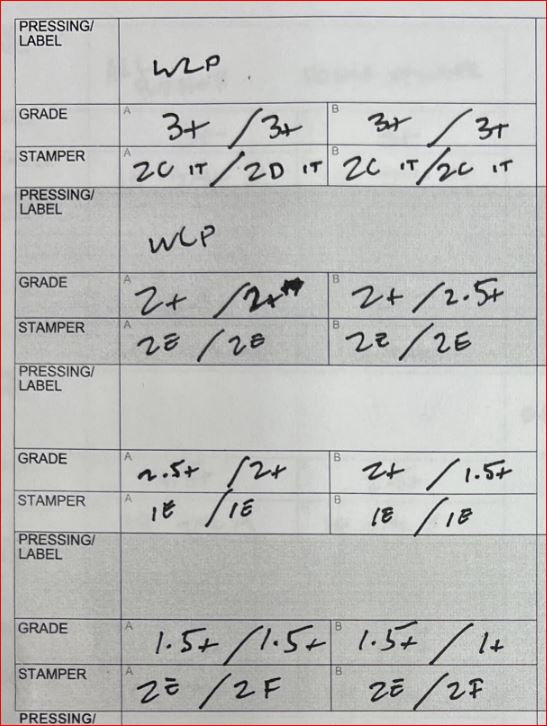
What interests me in these findings is that the stampers for a White Label Promo copy, the second one, the one with mostly Super Hot grades, are almost identical to the one that came in last in the shootout, with barely passable grades.

If an audiophile collector were to go to Discogs, find the WLP pressings, write down their stampers, and then check them against the copies he owned or might want to buy, he could either find himself with a top quality copy, or a not-nearly-as-good copy, depending on his luck. (And side four of the worst pressing earned a sub-Hot Stamper grade of 1+.)

Why one set of stampers sounds so much better than another set, or the same or similar set on a different pressing, is a mystery.

Does anyone have a practical way to get around the unfortunate reality that allows one set of stampers to sound great and the same or a similar set of stampers to sound not much better than decent?

Well, we can’t say there is a practical way, but we do know of an impractical one. We’ve been practicing and refining that one for more than twenty years.

(more…)

How Wide and Tall Is Your Copy of Little Queen? Compared to What?

Hot Stamper Pressings of the Music of Heart Available Now

Little Queen is yet another recording that only truly comes alive when you turn up your volume.

On the right system, this is a classic rock Demo Disc to beat practically anything you could ever throw at it.

Love Alive and Barracuda on this copy will deliver the full rock and roll power your system is capable of.

If you’ve got The Big Sound, this is the record that will show you just how big it is.

You get huge meaty guitars, big bass, a smooth top end, full-bodied vocals, powerful rock energy and dynamics, loads of richness and incredible transparency.

Wide and Tall

A key quality we look for in Hot Stamper copies of Little Queen is wide and tall presentation.

What exactly does that mean you ask? The best copies, the ones that really jump out of the speakers, tend to present some (usually high frequency) information higher and more forward than others. This is not hard to miss.

When you’re playing ten or fifteen copies of the same side of the same album and suddenly a cymbal crashes higher and more clearly than the others did in the part of the track you are testing, you can’t help but notice it. Wow! How did that get there?

Once you hear it you start to listen for it, and sure enough the next copy won’t do it, nor will the next. Maybe the one after that gets about halfway there: the cymbal crashes are higher than most, but not as high as the one that really showed you how high is up.

This is why we do shootouts, and why you must do them too, if owning the highest quality pressings is important to you.

Progress in Audio

And of course it all ties in with our revolutionary changes in audio commentary. If you’ve been making steady improvements to your system, or have better cleaning technologies, or better room treatments, or cleaner electricity, maybe ALL the Little Queen pressings do it now. They might ALL do something they never did before, and in fact they SHOULD be doing most things better now. 

Our last shootout was a while back. Since then many, many parts of the chain have undergone improvement. During this shootout we heard things in the recording we’d never heard before. This is the point of all this audio fooling around. It pays off, if you do it right. You have musical information waiting to be unlocked in your favorite recordings. It isn’t going to free itself. You have to do the work to set it free. Do it our way or do it some other way, but do it. You, more than anyone else, will be the one to get the benefit.

Problems Noted More Recently

(more…)

How Does the D1/D1 Jazz Giant Black Label Pressing Sound?

Hot Stamper Pressings of Contemporary Jazz Albums Available Now

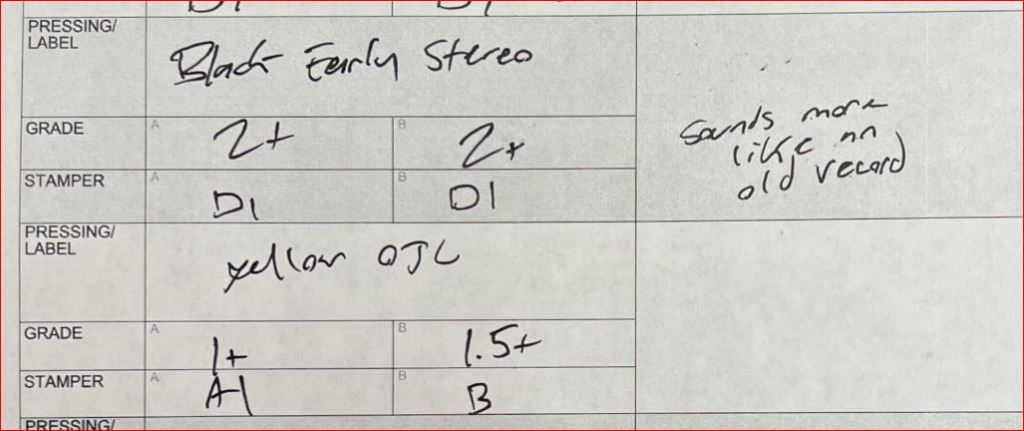
Even though the Black label original of Jazz Gianot we played in our shootout held its own well enough, it did suffer from a slight case of “old record” sound.

Head to head with the best vintage reissues, it was a bit crude, didn’t extend fully on the top end, and wasn’t as resolving in the midrange.

The fact that it earned a Super Hot (A++) sonic grade means that it could not have sounded too much like an old record. It was still doing most everything right.

It just had a few sonic shortcomings we recognized were holding it back.

The reissues that beat it in the shootout showed us just how good the album could sound, maybe not night and day better, but definitely better, a full grade better.

The Black Label original we played would still beat the pants off the godawful Analogue Productions Heavy Vinyl pressing that came out in the 90s, the one mastered by the formerly-brilliant Doug Sax.

For those who may not have been collecting back then, we describe in great detail the bad sound of the Heavy Vinyl pressing that AP produced for their version of Way Out West in 1992.

Mobile Fidelity got into the reissue act in 1994, making murky-sounding records on 200 gram vinyl and calling them Anadisqs.

Classic Records started producing their bright, screechy reissues of Living Stereo titles that year as well.

It seems a lot of bad sounding records were being made back then!

Is it any different now? (If it is, please contact me at tom@better-records.com and tell me what you think the differences are. I am at a loss after playing these six Heavy Vinyl titles in 2024 and finding that all of them fell well short of the mark. What mark is that, you ask? Why, the mark set by their vintage counterparts.)

(more…)

Lincoln Mayorga Volume 1 and Obvious Pressing Variations

Hot Stamper Pressings of Direct-to-Disc Recordings Available Now

After doing our first shootout many years ago for the record that single-handedly introduced the audiophile community to Direct to Disc recording, Lincoln Mayorga and Distinguished Colleagues, Volume One, I have to confess I was taken aback by the significant pressing variations we heard among the copies we played, 

These LPs are all over the map sonically.

Some Sheffield pressings are aggressive, many of them are dull and lack the spark of live music, some of them have wonky bass or are lacking in the lowest octave — they are prey to every fault that befalls other pressings, direct to disc and otherwise.

Which should not be too surprising. Records are records. Pressing variations exist for every album ever made. If you haven’t noticed that yet, start playing multiple copies of the same album while listening carefully and critically. If your stereo is any good at all, it should not take you long to notice how different one record sounds from another in practically every case.

Biggest problems on S9?

I would have to say smear is Number One.

When the brass loses its bite and the bells don’t have the percussive quality of metal being struck, this is not a good thing. The band also seems to lose energy when the pressing suffers from smear.

Number Two would be a lack of top end extension.

The harmonics of the sax and trumpet are muted on some copies, and the harpsichord really suffers when the top end isn’t all there. This lack of extension is most noticeable on all the lovely bells and percussion instruments that pepper the soundstage, but you can actually hear it on practically every instrument once you recognize the problem. It’s there on guitar harmonics, cymbals and snares, and on down the list.

Linked here are other records that are good for testing these same shortcomings:

(more…)

This Sibelius Violin Concerto Was Big and Lush but…

Hot Stamper Pressings Featuring the Violin Available Now
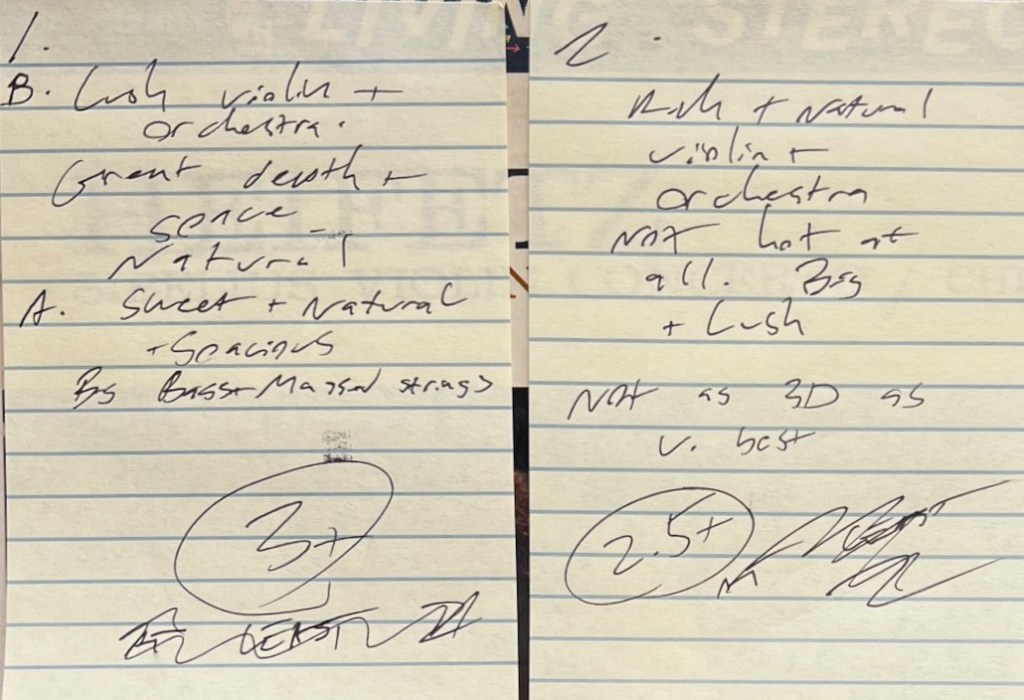
We love the way RCA recorded Heifetz back in the day, the day in this case being 1960. We usually have a good supply of vintage Heifetz titles on the site at all times. They often have our favorite performances, and the best copies, as the notes for the one below make clear, can have absolutely amazing sound.

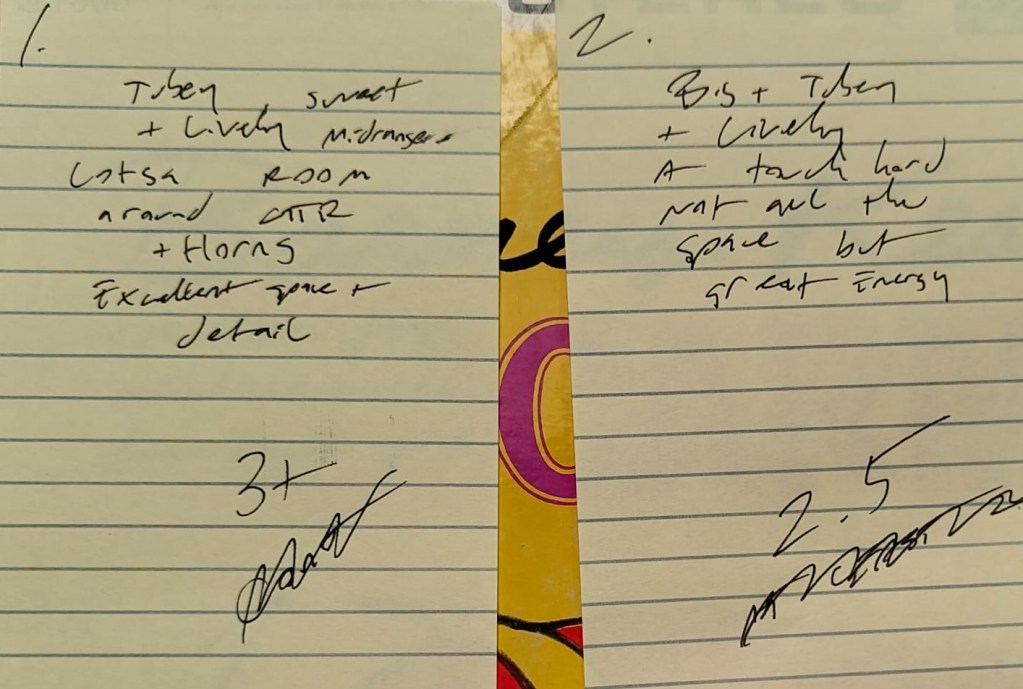
As you can see from the notes, side one of a recent shootout winning copy was doing everything right.

However, we had a side two that was slightly better than the side two you see here. When we played the two best copies back to back, this side one came out on top, earning a grade of 3+, but the side two of another copy showed us there was even more three-dimensionality to be discovered in the recording than we thought. Consequently this side two was dropped a half grade to 2.5+.

This is exactly why we do shootouts. If you really want to be able to recognize subtle (and not so subtle!) differences between pressings, you must learn to do them too.

(more…)

The Absolute Sound Was Half Right about Desperado

Hot Stamper Pressings of the Music of The Eagles Available Now

As we all know, the best sound on an Eagles record is found on the first album. For whatever reason, that record was left off the TAS Super Disc list, even though we feel that sonically it beats this one by a bit, and musically it beats it by a mile.

On the TAS Super Disc list, Harry Pearson recommends the British SYL pressings for this album. SYL pressings can sound very good; we’ve previously found one that rated a Double Plus on both sides.

But our champions for both sides were domestic, both this time and last time.

Does that mean the best domestics will always beat the best SYL pressings? Not at all. Only critical listening can separate the better pressings from the more typical ones. After playing more than a dozen copies of this album this week, we can definitively tell you that there are FAR more mediocre copies of this record — both domestic and import — than truly exceptional ones.

The typical pressing of this album, whether the domestic or SYL, falls far short of belonging on a Super Disc List.

There are killer domestic copies AND killer SYL imports out there, and the only way to know which ones sound good is to collect ’em, clean ’em, and play ’em.

Remember: TAS List doesn’t guarantee great sound, but Better Records does.

If you don’t think a record sounds as good as we’ve stated, we’ll always happily take that record back and refund your money. Good luck getting ol’ Harry to send you a check when the TAS-approved pressings you pick up don’t deliver.

Want to find your own killer copy?

(more…)

Silky Sound? Everybody Knows That’s Impossible

Hot Stamper Pressings of the Music of Neil Young Available Now

This early pressing of EKTIN IS an amazing find, the kind of record the thrillseekers who work here at Better Records live for.

As I was reading the notes, I saw a word there that I had never associated with the sound of the album: “silky.” Since when does Everybody Knows This Is Nowhere have silky vocals?

But there it was, describing the first track on side one (Cinnamon Girl) as well as both the third track on side two (Cowgirl in the Sand) and track one (Losing End (When You’re On)).

We don’t have a tag for silky sound. About the closest we could come would be “glossy sound,” the kind of sound you might find on a Toto album, or Gauch0, or Mirage, or Gorilla, or Abbey Road. Starting in the mid-70s, anything produced by Ted Templeman and engineered by Donn Landee would be sure to have glossy sound.

But this album is from 1969. Silky vocals are not easy to find on recordings from that year, Abbey Road being the obvious exception.

And they’re not easy to find on the vast majority of copies we have played over the years. I doubt that the other copies in the shootout have notes mentioning silky vocals.

But if your equipment is good enough, and you know how to clean your records right, and you dial in your setup to a T, with a big enough stack of copies you may be able to find an Everybody Knows… with silky vocals. Twenty years ago I wrote a commentary about diminishing returns in audio being a myth. Now, finding this amazing pressing of Everybody Knows, is just one more piece of evidence to support just how precient that idea was.

Hey, want to find your own top quality copy?

(more…)

Motown Still Had It in 1982

Hot Stamper Pressings of the Music of Marvin Gaye Available Now
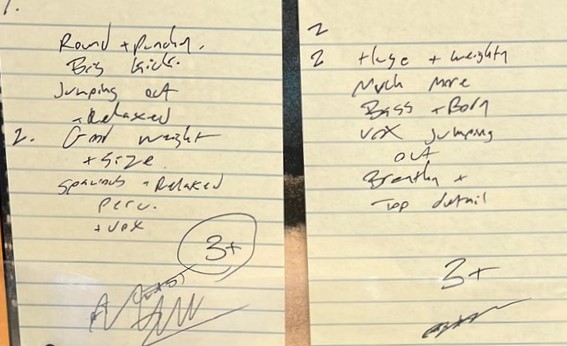
With two superb Shootout Winning Triple Plus (A+++) sides, this Midnight Love is certainly as good a copy as we have ever heard.

Here are just a few of the things we had to say about this amazing copy in our notes: “round and punchy”…”jumping out of the speakers”…”good size and weight”…”spacious and relaxed percussion and vox”…”top detail” (side two).

Our post-it notes tell the album’s story. (By the way, if you like reading our post-it notes, we’re putting more and more of them on the blog these days. We talk about the importance of taking notes as part of the shootout advice we share. This post will help you with the basics.)

Drop the needle on “Sexual Healing,” then sit back and relax as the rich, warm sound of analog sets the mood!

There’s good frequency extension up top and down low, with plenty of meaty bass and silky highs (check out those bells).

This copy has two qualities which are essential for this music to really work its soulful magic: silky vocals and a BIG meaty bottom end.

Check out all the texture to the synths on Turn On Some Music – this is a highly resolving pressing which takes Marvin Gaye’s music — the last he would make before his death — to another level.

Many copies of Midnight Love suffer from a phony hi-fi-ish quality, sacrificing much of the warmth that is the all-important hallmark of analog. Is that any way to listen to this great Soul Classic? (My sources say no.)

Hey, want to find your own top quality copy?

Consider taking our moderately helpful advice concerning the pressings that consistently win our Hot Stamper shootouts.

(more…)