*Thinking About Records

Have You Ever Noticed that Sometimes the Highs Come Back on Some Pressings?

More of the music of Sergei Rachmaninoff (1873-1943)

This side one is interesting., I would say that it starts out Super Hot (A++) and within a few minutes becomes White Hot (A+++). The piano is a bit veiled at the start, but within a relatively short period of time that subtle loss of transparency disappears and the piano is RIGHT THERE.

This is not unusual in our experience.

The first track on many records can sound dull, and by the second track the highs come back and the tonality is right from top to bottom. Who knows why?

We speculate that the vinyl did not have time to fully heat up the edge of the record, but that’s speculation, something that has almost no value in our (yours and mine) quest for better sounding records. 1A, 1B, first off the stamper, who gives a flying you-know-what. You have to play the record to know how it sounds.

The rest is BS, proffered mostly by those who are simply too lazy (or busy; some folks do have real jobs!) to do the work of cleaning and playing multiple copies of an album in order to have the evidence they need to support their opinions.

We much prefer real knowledge supported by real evidence, not the other kind.

(more…)

Are You a Soundphile? I Used to Be One

Hot Stamper Classical and Orchestral Pressings Available Now

UPDATE 2026

About 30 years ago I got hold of a Japanese pressing of Marriner conducting Haydn’s Toy Symphony and Mozart’s Eine Kleine Nachtmusik and was blown away by the absolutely phenomenal quality of the Haydn. Listing the record for sale, I raved:

DEMO QUALITY SOUND! This is the best sounding Toy Symphony you will ever hear!

…all the little toys that play along with the music just JUMP out of the speakers. The recording is so transparent and the toys are so well miked it’s like hearing the work for the first time, or live.

Now we know definitively that this is clearly not true, assuming yoy have one of our Hot Stamper pressings of the EMI original. They are better in every way than the Japanese pressing, which is the one purporting to have audiophile sound.

If this sounds familiar to you, I’m guessing this is not your first visit to the blog or our site. There is almost always a vintage pressing with superior sound when compared to the audiophile pressings made from the same recording.

The problem is: You just don’t know which vintage pressing will have superior sound. Maybe they all will. Maybe none of the copies you own will. There is one, but how do you find it?

In order to get that answer, you have to know how to do carefully controlled shootouts, and not just once, but more often than not a number of them over a period of years. Whatever answer you may come up will most likely be provisional, not definitve, because that’s the only way the process of discovery can work when applying scientific methodologies to the solution of a problem like “which pressings sound best on record X?”.

We did the shootout in 2022 and found out that the best of the original EMI pressings are quite a bit better, a classic case of live and learn, as well as one of the hundreds of breakthrough discoveries we’ve made over the years. That’s what happens when you are in the business of playing records and then selling the best of them to audiophiles looking for superior sound.

I believe I had at least one or two UK EMI pressings to play against the Japanese ones, but all the details of how I came to this conclusion — a proto-shootout, carried out long before I knew how to do a real one — are lost to the mists of time.

Keep in mind that my stereo was dramatically less revealing back then. Also I had not learned how to clean records properly. Those two facts, combined with the underdeveloped listening skills that go with them, helped me to arrive at the wrong conclusion.

No, the Japanese pressing, specifically targeted to audiophiles, or “soundphiles” if you like, is not superior to a properly mastered and pressed UK LP.

If you have more than a handful of Japanese pressings in your collection, you can be sure that there is still plenty of room for improvement in your audio system.

(more…)

Are Hot Stampers a Better Mousetrap? A Case of Added Value? A Scam?

Basic Concepts and Realities Explained

This hobby is supposed to be fun. If you’ve been in it for any length of time you know that sometimes it is and sometimes it isn’t.

But if you enjoy doing it at least some of the time, and you devote the proper resources to it — the three big ones are time, effort and money — you will no doubt derive much more pleasure from it than you ever dreamed would be possible.

Especially if you use our approach. It works for us and there’s no reason it can’t work for you.

Finding Hot Stampers is all about doing shootouts for as many different pressings of the same title as you can get your hands on.

There are four basic steps you must take, and you have to do right by each of the four if you are going to be successful at discovering and evaluating your own Hot Stampers. 

We discuss every one of them in scores of commentaries and listings on this blog. Although none of it will come as news to anyone who has spent much time reading our stuff, we cobbled together this commentary to help formalize the process and hopefully make it easier to understand and follow.

If you want to make judgments about recordings — not the pressing you have in your collection, but the actual recording it was made from — you have to do some work, and you have to do it much more thoroughly and carefully and above all scientifically than most audiophiles and record collectors apparently think is necessary.

Don’t be one of those guys. Do it right and get the results that are out of reach with any other approach.

(more…)

Is It All About the Music or Is It All About the Sound?

Top Quality Audio Is Key to Finding Good Records

UPDATE 2026

There is a word that better describes the trite phrase I discuss below than “truism” does. You can find it at the end of this commentary.


There is a truism  — a statement that is obviously true and says nothing new or interesting — that frequently pops up in the comments section on audiophile forums.

Working similarly to Godwin’s law, the longer an audiophile thread goes on, the more likely it is to be said. A quick recap of Godwin’s law:

“Godwin’s law, short for Godwin’s law (or rule) of Nazi analogies, is an Internet adage asserting: “As an online discussion grows longer, the probability of a comparison involving Nazis or Hitler approaches 1.”

The truism I’m talking about is commonly phrased, “It’s the music, stupid,” an echo of James Carville’s “It’s the economy, stupid,” from Bill Clinton’s presidential campaign of 1992. (I prefer not to use the word “stupid” when discussing my fellow audiophiles’ comments, but the play on words does not work without it, so there it is.)

Who would be foolish enough to take up the other side of such an argument, if we can call it that?

Allow me to have a go at it.

So, if I understand correctly, it’s all about the music, right? Not the sound?

What about other kinds of art? What is it about with respect to them?

Christopher Nolan shoots on IMAX film, which in its current iteration is either 65 or 70mm.

If his movies are about a story and its characters, why not shoot them on 35mm? Or 16mm. Or Super 8? Or, gasp, HD-digital?

Same story, same characters.  But would it be the same movie-going experience?

And nobody has trouble understanding that. Here’s Nolan on 70 mm.

(more…)

Finding Good Companies to Invest In Is a Lot Like Finding Good Sounding Records to Play

Important Lessons We Learned from Record Experiments

Which of the copies pictured below sound good and which ones don’t?

If you turn over enough of these “rocks,” you — and you alone — will know.

There are some amazing sounding winners in this pile. If you conduct your shootouts following the  tried and true methods we describe on the blog, you will be able to hear One Man Dog and every other album you love sound better than you ever dreamed possible.

Pictured below are just a small fraction of the rocks we’ve turned over in the 20 years since we began doing shootouts.

(more…)

Our Four Plus Shootout Winner for Dire Straits from 2011

Hot Stamper Pressings of the Music of Dire Straits Available Now

UPDATE 2026

This review for Dire Straits’ first album was written in 2011. We had just discovered that a pressing of the album was clearly superior to every other pressing we had ever played. We were pretty excited about it and wanted to share the news about our breakthrough.

A substantial amount of the time, breakthroughs come about due to the conventional wisdom being wrong — and us not knowing it until an experiment proved it wrong. The needle is the only thing that can give us an answer we can trust, certainly not the pundits or the self-described experts.

What makes them experts? We have no idea and they never say. They just seem to “know” things, but they never tell us how they know them.

We do. We can’t shut up about all the stuff we know!

No concept is more fundamental to collecting the best sounding pressings than to be able to test records to find out if the received wisdom you are using as a guide is right, wrong or somewhere in-between.

At the bottom of the listing for the album you can see a number of links to other records that share the same qualities as the first Dire Straits release does.

Note that it says “Reissue=Best.” This is because the killer copy we discovered in 2007 was indeed a reissue, and in 2011 we found an even better sounding copy, also a reissue, or perhaps we were somehow able to reproduce it better. Probably a bit of both.

The Hot Stamper pressings of this album we offer to the discerning audiophile are posted in the following categories. If you are looking for other records like the first Dire Straits album, click on any of the links below.


Our 2011 Review

(more…)

Can a Pile of Different Pressings All Sound the Same?

Skeptical Thinking Is Critical to Making Progress 

There are certain things we can stipulate as all but impossible. Nobody who says they can levitate should be taken seriously.

But are there aspects of audio reproduction that you’re not familiar with?

Are there stereos that reproduce music at a much higher level than any with which you are familiar?

Are there ways to make your stereo sound better than the ones you know of?

Are there record pressings that sound better than the ones you’ve heard?

The reason I ask is this: There is never been a case in which a person contacted me and told me that they had played a pile of copies of a particular album and that they all sounded the same.

(more…)

Dexter Gordon Knocked Us Out Back in 2007

Hot Stamper Pressings of Blue Note Albums Available Now

UPDATE 2026

In 2007 we had a low opinion of both the Blue Note label and the work of Rudy Van Gelder, but that changed over the decades as we auditioned more and more of his amazing recordings, many of them reissues of one kind or another.

(Some text has been altered, mostly the overuse of capitalization.) Our latest review for One Flight Up can be found here.


Our 2007 Commentary

This Blue Note LP is without a doubt one of the best sounding jazz records we’ve ever heard. We were auditioning a bunch of jazz records today (4/25/07), and when the needle hit the grooves on this one we were absolutely blown away.

I can’t think of one jazz record we’ve ever played here at Better Records with this kind of whomp. Everything here is so rich and full — nothing like a typical Blue Note album.

(more…)

With This UK Copy You’d Better Be Ready to Rock

Hot Stamper Pressings of the Music of Led Zeppelin Available Now

UPDATE 2026

The shootout for Zep IV discussed below was carried out in 2012.

It seems an early British PORKY/PECKO pressings did very well, winning side one and coming close to the best on side two.

For at least five years now we have been unable to find a British pressing that eaned grades better than 2+, or Super Hot. Since the British pressings tend to be very expensive and hard to find in good shape, we have simply stopped buying them as they do not seem to be capable of winning shootouts anymore.

Other comments may be problematic in this review as well, so best to consult our latest listing for what we think we currently know about the album. Here is a short test to get you started.


Our Review from 2012

We did a massive shootout in 2012 for Zep’s beloved fourth album and this British pressing earned a nearly perfect score with some of the BIGGEST, BOLDEST, HARDEST Rockin’ sound we have ever heard on the album. Without a doubt this is the best sounding IV side two we’ve ever played, with the biggest bottom of them all.

When the Levee Breaks, a problematical track on even the best copies, finally sounds the way you’ve always heard it in your head — relentless and so powerful it’s downright scary.

(more…)

Compromised Recordings – If It’s About the Music, the Choice Is Clear

Skeptical Thinking Is Key to Finding Better Sounding Records

UPDATE 2026

This commentary was written circa 2006. The Hot Stamper world was very different in those days. A few dozen had been done starting in 2004, and probably not nearly as well as they should have been, truth be told.

This was unexplored territory, a new world. At the time we had no way of knowing how much there was to learn and how much time and effort would go into learning it.

Thousands of shootouts later we have a pretty firm grip on how to go about finding the best sounding pressings of the greatest music ever pressed on vinyl. Those recordings, with sound that is dramatically superior to those that have come along since, are why this blog exists. (The blog also allows me to promote 100+ personal favorites that I think should be more popular with my fellow audiophiles.)


Our Story, Circa 2006

Years ago one of our good customers wrote to tell us how much he liked his Century Direct to Disc recording of the Glenn Miller big band, one of the few truly amazing sounding direct discs that offered music actually worth listening to. This was an actively touring big band, not a group of studio cats trying to make a record out of some charts somebody managed to cook up.

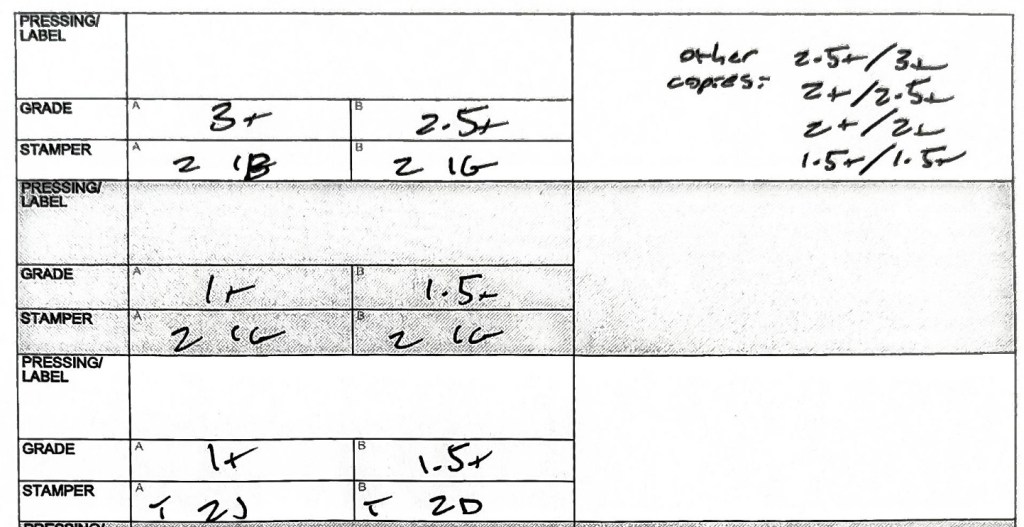
And you can read all about the killer copy we discovered a few years back here, complete with our shootout notes. (The notes can also be seen at the bottom of this post.)

Which brought me to the subject of Hot Stampers. (For those new to the idea, here are the short versions of what they are and how one goes about acquiring them.)

Hot Stamper pressings of jazz or popular music are almost always going to be multi-track, tape recordings with plenty of overdubbing and processing, about as far from purist live-in-the-studio performances recorded directly to disc as you can get.

They will invariably suffer a great many compromises, especially when compared to the approach of an audiophile label trying to eliminate all sources of distortion in the pursuit of higher fidelity. In the case of direct to disc recordings, this means the losses that result from the use of analog tape.

But when they do that, they almost always fail.

(more…)