*Mastering Issues

WW, LW, JW? Which Stampers Sound the Best?

Hot Stamper Pressings of Rock and Pop Albums Available Now

UPDATE 2026

In 2005 we acquired more than a dozen sealed copies of a popular Warner Bros. title, how I don’t remember. (For now we are keeping that title, and even the band that recorded it, a mystery. It might have been The Doobie Brothers, but then again, it might not.)


Our story goes like this:

Knowing that no two of these pressings would sound exactly the same, we decided to crack them open, clean them up and play them.

2005 was very early in the development of Hot Stamper Shootouts. By 2007 we were much better at them, and not coincidentally, that is also the year we decided that Heavy Vinyl pressings were just not good enough for us to bother selling.

All three of the major stamper prefixes for Warners were represented in the various matrix numbers: WW, JW and LW. Once we started to play them it quickly became clear that most copies of this record just do not sound very good.

The typical copy is hard, midrangy, opaque, dull and badly lacks Tubey Magic.

Only one of the prefixes — WW, JW, LW — actually has any hope of sounding good, and surprisingly it’s not the one I would have expected it to be. Live and learn, right?


We liked either JW or WW back in 2005, I don’t remember which, but the evidence we compiled over the ensuing twenty years contradicted that finding.

Live and learn is right, because since the dark days of 2005, we have done this shootout many times, at least five by my count, and it turns out that the stampers we tend to like are exactly the ones we tend to like in general for Warner Bros.

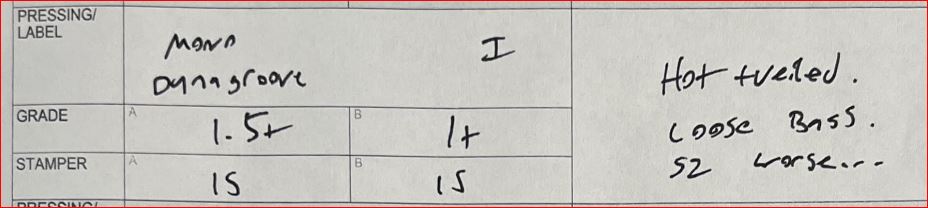
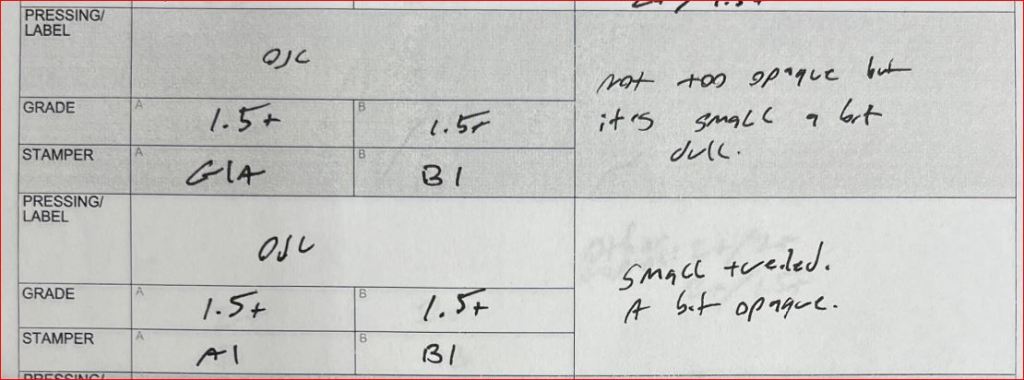
Here is the full stamper sheet from a shootout we did not long ago laying out the stampers we like for this mystery title: LW, with low numbers.

(more…)

Straight Up Trash from Ron Furmanek on 2 LPs

More of the Music of Badfinger

This British 2 LP reissue from 1993 was (badly) digitally remastered by a Mr. Ron Furmanek. May his name live in infamy.

It contains alternate mixes of 6 songs at 45 RPM on the second record, with sound every bit as bad as the sound of the first record.

The whole Apple series of remastered releases — at least the ones we played — was awful sounding and should be avoided completely. These records are nothing but audiophile bullshit.

If you are a record collector and must have those alternate mixes, just buy the CD. The vinyl is terrible, the CD probably sounds every bit as bad, but at least the CD is cheap and plays all the songs straight through.

If you own this record, my guess is it is pristine.

If you played it at all, you played it once and put it away on a shelf where it probably sits to this very day. Good records get played and bad records get shelved. If you have lots of pristine records filed away, ask yourself: Why aren’t you playing them?

(more…)

This Tony Hawkins-Mastered Pressing Sure Was a Letdown

Hot Stamper Pressings of Orchestral Spectaculars Available Now

This London original pressing with 1K/1K stampers (the work of Tony Hawkins) was so bright, dry, and shrill I could hardly stand it for more than the minute it took me to realize it was not going to get any better. The sound is bad enough to send it right into our hall of shame.

There are a number of other Deccas and Londons that we’ve played over the years that were disappointing, and they can be found here.

The copy we had back in 2010 was a very good sounding record, or so we thought.

Maybe we were wrong! It’s not as though we don’t admit to the possibility. You can read all about it below.

(more…)

Symphonie Fantastique – Three Mastering Options

Hot Stamper Pressings of the Music of Berlioz Available Now

UPDATE 2026

Years ago we played a reissue of the title you see pictured which prompted us to make some observations and ask some questions about the approach the mastering engineer might have taken.


And this one comes complete with the bonus 7″ entitled “Berlioz Takes a Trip,” in which Bernstein explores the work “with musical illustrations by the New York Philharmonic.”

Clocking in at around 45 minutes, Symphonie Fantastique is a difficult work to fit onto a single LP,  which means that the mastering engineer has three options when cutting the record:

  1. Compress the dynamics,
  2. Lower the level, or
  3. Filter the deep bass.

On this side two it seems that none of those approaches were taken by the engineer who cut this record in the early 80s — there’s plenty of bass, as well as powerful dynamics, and the levels seem fine.

How he do it? Who knows? Like so much in the world of records, it’s a mystery.

(more…)

Remastered, But Why on Earth Would They Bother?

New to the Blog? Start Here

Supersax Plays Bird is awful music with awful sound.

In 1980 this record single-handedly convinced me that MoFi would lower themselves to remastering records that have little in the way of actual musical value.


UPDATE 2022

I just looked up the mastering engineer credited with cutting the original pressings in 1973, Wally Traugott. Now what are the chances that Stan Ricker cut this record better than Wally Traugott? One in a million? That would be my guess.

Which simply means that the right domestic pressing on Capitol might just be a good sounding record.

But why should anyone care? The music is hopeless.

(more…)

Shootout Winning Stampers for La Boutique Fantasque Revealed

Hot Stamper Pressings of the Music of Rossini Available Now

UPDATE 2026

Our current favorite recording of La Boutique Fantasque is the one Solti recorded for Decca in 1957.

It belongs to that very special group of roughly 150 orchestral recordings which have the potential to offer the discriminating (and well-heeled) audiophile the best performances of major works with by far the highest quality sound.

It has been our experience that modern remastered pressings simply cannot compete with the best pressings of these landmark recordings.

The Fiedler (LSC 2084) is still a very good record, but we no longer see much reason to carry it when the Solti is better in almost every way (and quieter as a rule to boot).

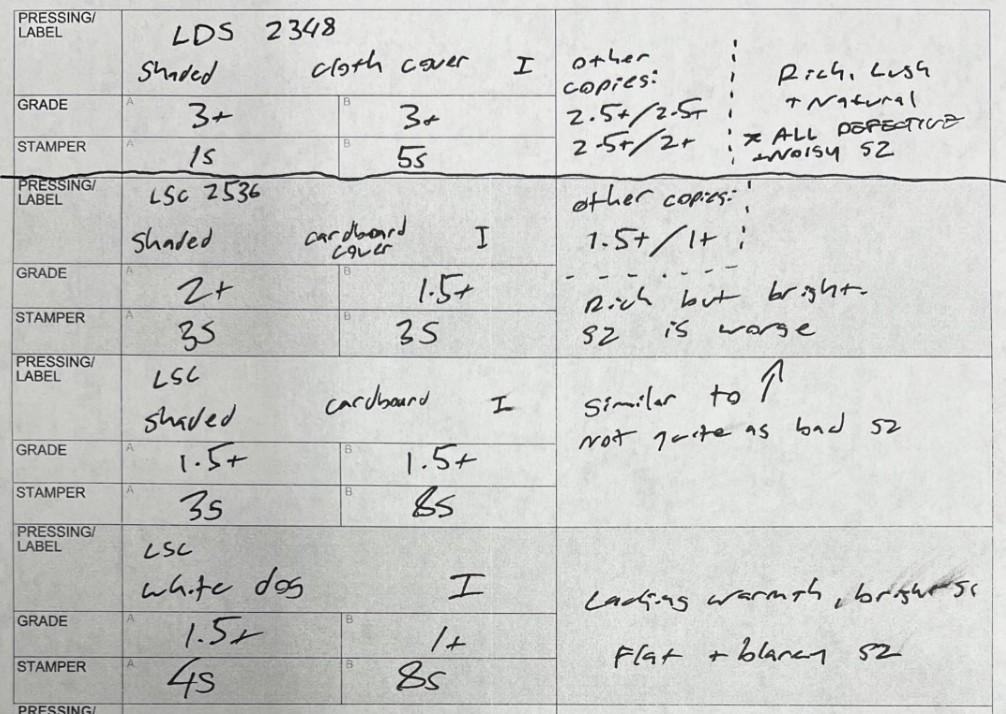
Below we have reproduced our full stamper sheet, including the Shootout Winning stampers, which happen to be 3S/4S for this album.

The early pressings for this album tend to be too bright in our experience as seen from one of the stampers sheets below.

(more…)

Do Pressings Remastered at 45 RPM Have Better Sound?

More Reviews and Commentaries for 45 RPM Pressings

No doubt some do, but based on our admittedly limited experience, we rather doubt any of the titles shown here, or from this series, are likely to be very good sounding.

I was going to write about the awful Holst The Planets with Previn from this series that I had played a few years back, but never got around to it.

Lots of punchy, powerful and deep bass — yes, 45 RPM mastering is known for that — but the dry, overly clean, clear, modern sound and the screechy strings made me take it off the turntable halfway through the first side. (We write more about EMI and Angel pressings here.)

If you want a good sounding pressing of The Planets, our favorite by far is Previn’s reading on EMI from 1974.

As usual, our advice is to accept no substitutes. There are a lot of bad sounding, poorly performed Planets out there.


(more…)

I Owe a Huge Debt of Gratitude to Mobile Fidelity

Hot Stamper Pressings of the Music of Supertramp Available Now

For me, Crime of the Century worked like a gateway drug to get me addicted to the amazing soundscapes found on so many 70s Prog Rock and Art Rock recordings, although I didn’t know what the term Art Rock meant or whether it even existed yet. I surely never heard anyone use the term.

I just knew I loved Supertramp’s music. Both Crime and Crisis? What Crisis? were in heavy rotation in the cheap apartment I rented three blocks from the beach in San Diego where I was living in the mid-70s.

(It shared no common walls with any other units, which was an absolute necessity for someone who liked to play his music good and loud and often late into the evening. The police came knocking on my door once at two in the morning after I got a bit too carried away with the “running around the airport” song on Dark Side of the Moon. Apparently the next door neighbors were not enjoying it as much as I was.)

MoFi Rocks

The first Supertramp album I bought on audiophile vinyl would have had to have been Crime of the Century released by Mobile Fidelity in 1978.

It was that label’s first rock release and it showed me the kind of Big Rock Sound I didn’t think was possible for two speakers to produce no matter how big they were, and mine were very big indeed.

In my mind it sounded to me like live music at a concert. I had simply never heard sound like that in my livingroom.

Partly that was because a few years earlier I had upgraded to some very big speakers and some awesomely expensive tube gear in 1976.

When I threw that super Hi-Fi Audiophile pressing on the turntable and turned the volume up good and loud, I thought there could be no question that finally, after all these years and after so many different stereo systems, I had reached the pinnacle of home audio. How could the sound possibly get any better? (Of course, although I didn’t know it at the time, I would devote the next 40-plus years to exploring that question.)

By 1978, Crisis? What Crisis and Even in the Quietest Moments had already come out, and though you couldn’t buy either of those albums on a super-duper disc from Mofi, there was a Half-Speed of Crisis which, I have to admit, sounded great to me at the time and well after it should have. (I don’t know what I thought of the Sweet Thunder pressing of EITQM, but I know what I think of it now: it sucks.)

I became an even bigger fan of Crisis than I had been of COTC, if you can believe such a thing. (None of my friends could.)

Since Crime… is one of those albums that I still listen to regularly, I can say with confidence that it is the better album by a small margin, and one that would come with me to my desert island even if I were limited to as few as ten titles — that’s how good it is.

And I owe a debt of gratitude to a label that comes in for a lot of criticism on this blog, the one that took Supertramp’s best album and made it a Demo Disc the likes of which I had never heard before, Mobile Fidelity.

(more…)

Cat Stevens on 2 Heavy Vinyl 45 RPM Discs, Part 1 – Is This the Truest Tillerman of Them All?

About ten years ago we auditioned and reviewed the 2011 edition of Tea for the Tillerman pressed by Analogue Productions, the one that came on a single Heavy Vinyl 33 RPM LP.

I wrote a very long commentary about the sound of that record, taking it to task for its manifold shortcomings, at the end of which I came to the conclusion that the proper sonic grade for such a record is F as in Fail. My exhaustive review asked the not-very-subtle question, this is your idea of analog?

Our intro gave this short overview:

Yes, we know, the folks over at Acoustic Sounds, in consultation with the late George Marino at Sterling Sound, supposedly with the real master tape in hand, and supposedly with access to the best mastering equipment money can buy, labored mightily, doing their level best to master and press the Definitive Audiophile Tea for the Tillerman of All Time.

It just didn’t come out very well, no matter what anybody tells you.

Recently I was able to borrow a copy of the new 45 cutting from a customer who had rather liked it. I would never have shelled out my own money to hear a record put out on the Analogue Productions label, a label that has an unmitigated string of failures to its name. But for free? Count me in!

The offer of the new 45 could not have been more fortuitous. I had just spent a number of weeks playing a White Hot Stamper Pink Label original UK pressing in an attempt to get our new Playback Studio sounding right.

We had a lot of problems. We needed to work on electrical issues. We needed to work on our room treatments. We needed to work on speaker placement.

We initially thought the room was doing everything right, because our Go To setup disc, Bob and Ray, sounded super spacious and clear, bigger and more lively than we’d ever heard it. That’s what a 12 foot high ceiling can do for a large group of musicians playing live in a huge studio, in 1959, on an All Tube Chain Living Stereo recording. The sound just soared.

But Cat Stevens wasn’t sounding right, and if Cat Stevens isn’t sounding right, we knew we had a Very Big Problem. Some stereos play some kinds of records well and others not so well. Our stereo has to play every kind of record well because we sell every kind of record there is. You name the kind of music, we probably sell it. And if we offer it for sale, we had to have played it and liked the sound, because no record makes it to our site without being auditioned and found to have excellent sound.

But I Might Die Tonight

The one song we played over and over again, easily a hundred times or more, was But I Might Die Tonight, the leadoff track for side two. It’s short, less than two minutes long, but a lot happens in those two minutes. More importantly, getting everything that happens in those two minutes to sound not just right, but as good as you have ever heard it, turned out to be a tall order indeed.

(more…)

What Exactly Does Van Gelder Stamped in the Deadwax Tell You?

Hot Stamper Pressings of CTI Titles Available Now

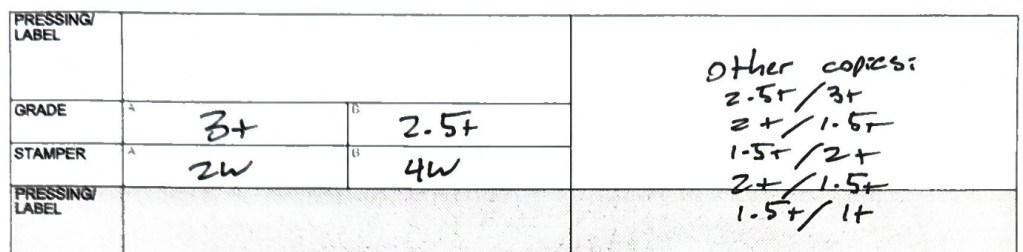
The section of the stamper sheet we wrote up after our most recent shootout belongs to George Benson’s White Rabbit album, the one released by CTI in 1972.

We think these stampers illustrate an important reality regarding the variability of record pressings, and it’s one that we run into on regularly during shootouts.

Keep in mind that the notes you see were made without the listener knowing what the stamper numbers were for the copy being evaluated.

Some relevant facts:

  • Rudy Van Gelder cut all the original domestic pressings for the album that we played in our shootout since those are the only ones we know of to have the potential for Hot Stamper sound. (Hint: forget the reissues, imports, etc.)

(more…)