Mobile Fidelity

Labels with shortcomings – Mobile Fidelity

Put Us to the Test! We Can Tell a Good Record from a Bad One, Digital or No Digital

Skeptical Thinking Is Key to Finding Better Sounding Records

And we don’t need to know anything about how it was made in order to judge it!

For those of you who did not follow this story from a few years back, you may want to catch up here.

Although it’s behind a paywall, you can get a free test drive easily enough.

Now that you are up to date on the overall contours of this mess, here is another one of the many thoughts I have had concerning the revelation that Mobile Fidelity has been secretly sourcing at least some of their masters digitally since 2015.

Back in August of 2022, I wrote what you see below to Geoff Edgers, the reporter who exposed this ridiculous mess. (I toned it down quite a bit. The original version was not suitable for publication.)

Earlier that same year he had visited me at my studio, where I played him the awful Dire Straits first album that MoFi remastered, one of the worst half speeds ever made (review coming, but you can get a good idea of my take on it here).

By August of 2022 he was starting to see just how crazy the world of audiophiles actually is, and the more he learned about some of these people, the crazier they seemed. And he was not wrong about that.

My letter (with a few additions):

Jim Davis (of MoFi) is not one to be trusted and would have loved to cover up this whole thing if he could have figured out how to do it. It got away from him, and as far as I’m concerned, good.

And you heard how shitty their Dire Straits record is. Who cares if it’s digital? The sound is bad. Why bother trying to figure out the reasons this crappy label doesn’t know how to make good records? It’s just a fact. Accept it.

Many of MoFi’s now-exposed records were on Fremer and Esposito’s own lists of the best sounding analog albums.

Of course they were. I defy you to find me two “audiophile experts” who are wrong more often than these guys!

From the article:

One of the reasons they want to excoriate MoFi is for lying,” says Howarth. “The other part that bothers them is that they’ve been listening to digital all along and they’re highly invested in believing that any digital step will destroy their experience. And they’re wrong.

These people who claim they have golden ears and can hear the difference between analog and digital, well, it turns out you couldn’t.

The best ears? Are you kidding me? In their dreams. These guys give every indication that they are virtually devoid of critical listening skills. The evidence supporting this reality has been laid out in this very blog in scores of commentaries over the course of more than twenty years.

(more…)

Back to the Stone Age with The Pines of Rome on Mobile Fidelity

Hot Stamper Pressings on Decca & London Available Now

An audiophile hall of shame pressing and another MoFi LP reviewed and found wanting.

MoFi’s version of this The Pines of Rome (#1-507) is one of the worst sounding classical records they ever produced, and that’s saying something, because practically all of their classical catalog is just awful — thin and bright, with sloppy bass and completely unnatural string tone.

As hard as it may be to believe, the MoFi of the Pines of Rome makes the typical Classic Records pressing sound good, shrill strings and all.

The UHQR is somewhat better, especially in the lower octaves, but it’s maybe a D+ or C-, not an audiophile record if we are using the term to mean what it no longer means —  a pressing with higher quality sound. (more…)

Traveling Back in Time with Cat Stevens on Mobile Fidelity

Hot Stamper Pressings of the Music of Cat Stevens Available Now

Our good customer Roger wrote us a letter years ago about his Tea for the Tillerman on Mobile Fidelity, in which he remarked, “Sometimes I wish I kept my old crappy stereo to see if I could now tell what it was that made these audiophile pressings so attractive then.”

It got me to thinking. Yes, that would be fun, and better yet, it could be done. There are actually plenty of those old school audio systems of the 60s and 70s still around. Just look at what many of the forum posters — god bless ’em — are running. They’ve got some awesome ’70s Japanese turntables, some Monster Cable and some vintage tube gear and speakers designed in the ’50s.

With this stuff you could virtually travel back in time, in effect erasing all the audio progress made possible by the new technologies adopted by some of us over the last 30 years or so.

Then you could hear your Mobile Fidelity Tea for the Tillerman sound the way it used to when you could actually stand to be in the same room with it.

My question to Roger was “What on earth were we hearing that made us want to play these awful half-speed mastered records? What was our stereo doing that made these awful records sound good to us at the time?”

In Search of a Bad Stereo

I know how you can find out. You go to someone’s house who has a large collection of audiophile pressings and have him play you some of them. Chances are that his stereo will do pretty much what your old stereo and my old stereo used to do — be so wrong that really wrong records actually start to sound right! It seems crazy but it just might be true.

(more…)

The Most Serious Fault of the Typical Half-Speed Mastered LP?

Hot Stamper Pressings of Revolver Available Now

UPDATE 2026

This commentary must be fairly old because we haven’t bothered to play anything put out by Sundazed in longer than I can remember.


The most serious fault of the typical Half-Speed mastered LP is not incorrect tonality or poor bass definition, although you will have a hard time finding one that doesn’t suffer from both.

It’s dead-as-a-doornail sound, plain and simple.

And most Heavy Vinyl pressings coming down the pike these days are as guilty of this sin as their audiophile forerunners from the 70s. The average Sundazed record I throw on my turntable sounds like it’s playing in another room. What audiophile in his right mind could possibly find that quality appealing? (Apparently the guy who wrote this absurd list of records you should buy It has a number of inexcusably at best mediocre and mostly awful sounding Sundazed records.)

But Sundazed and other companies just like them keep turning out this crap. Somebody must be buying it.

So how does the famous MoFi pressing of Revolver sound? In a word, clean. Also not as crude as the average British import, and far better than any Japanese or domestic pressing we heard.

But it’s dead, man. It’s just so dead.

(more…)

Breezin’ – “Hot Stamper” MoFi Reviewed

Hot Stamper Pressings of the Music of George Benson Available Now

UPDATE 2026

Having heard so many good sounding copies of this album, it is unlikely we would find much to like on the MoFi. But we can’t deny that we did, a long time ago, after cleaning and playing three MoFi copies, two of which were awful.


Sonic Grade: B-

Another MoFi reviewed, and surprisingly this one isn’t awful.

It has an excellent side two backed with a pretty good side one.

Side two has excellent bass — for a MoFi — and lots of energy — for a MoFi.

It’s slightly smooth, but overall it’s very musical. The best domestic copies are going to eat its lunch, but try to find one that sounds good. Most of them are awful. 

This MoFi copy, though lacking in many ways, is much better sounding than the other MoFi copies we played it against, which were muddy and compressed.

Side one of this copy has some of that sound. Side one lacks the transients we found on other copies and it’s a tad recessed and compressed. However, it does have relatively good bass definition and the strings are nicely textured.

(more…)

MoFi Proves Once Again It Has No Idea How to Make a Good Record

Hot Stamper Pressings of the Music of Women Who Rock Available Now

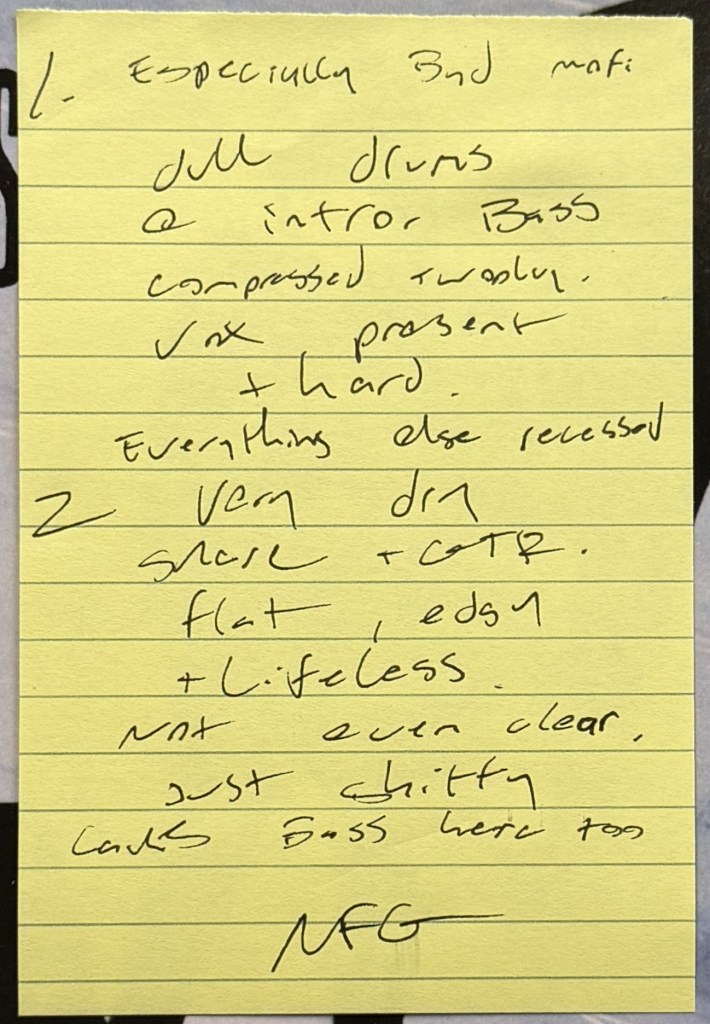
We recently auditioned the Mobile Fidelity pressing of Learning to Crawl and wrote down our impressions as the record was playing that you see below.

We try to be very specific about the strengths and weaknesses of the records we play, which is why we reproduce our notes — in this case for audiophile records — whenever possible. (There are plenty of shootout notes for vintage pressings on the blog as well.)

The title at the top of our post-it sets the stage for what you are about to read: the specific faults of an “especially bad MoFi.”

Do they make any other kind? Well, sometimes, to be sure, but the good ones are few and far between.

It must be hard to make a record sound this bad, but if anyone can do it, Mobile Fidelity has proven that they are the men and women for the job. Let’s get down to brass tacks.

Side One

Dull drums at intro.
Bass compressed and wooly.
Vocal present and hard.
Everything else recessed.

Side Two

Very dry snare and guitar.
Flat, edgy and lifeless.
Not even clear.
Just shitty.
Lacks bass here too.

Consensus

NFG.

This one definitely belongs in the Mobile Fidelity hall of shame (along with 66 of their other titles). My CD sounds better.

To aid you in understanding just how lost the buyers of these audiophile records are these days — and who am I to talk? — we reproduce the five most recent reviews from Discogs as of 5/2026 below.

(more…)

Double Vision – MoFi Reviewed

Hot Stamper Pressings of Classic Rock Albums Available Now

This title is yet another record that belongs in the audiophile hall of shame.

Like most Mobile Fidelity pressings, it’s better suited to the stone age stereos of decades past.

There is a Mobile Fidelity Half-Speed Mastered version of this album currently in print, and an older one from the days when their records were pressed in Japan (#052).

We haven’t played the latter in years; as I recall it was as lifeless and sucked-out in the midrange as many of the other famous MoFi’s of that period, notably The Doors (#051) and Trick of the Tail (#062), which is perhaps the most lifeless record this ridiculous label ever released.

Is there any doubt that the newer MoFi pressing of the album will be every bit as bad or worse? (more…)

Remastered, But Why on Earth Would They Bother?

New to the Blog? Start Here

Supersax Plays Bird is awful music with awful sound.

In 1980 this record single-handedly convinced me that MoFi would lower themselves to remastering records that have little in the way of actual musical value.


UPDATE 2022

I just looked up the mastering engineer credited with cutting the original pressings in 1973, Wally Traugott. Now what are the chances that Stan Ricker cut this record better than Wally Traugott? One in a million? That would be my guess.

Which simply means that the right domestic pressing on Capitol might just be a good sounding record.

But why should anyone care? The music is hopeless.

(more…)

I Owe a Huge Debt of Gratitude to Mobile Fidelity

Hot Stamper Pressings of the Music of Supertramp Available Now

For me, Crime of the Century worked like a gateway drug to get me addicted to the amazing soundscapes found on so many 70s Prog Rock and Art Rock recordings, although I didn’t know what the term Art Rock meant or whether it even existed yet. I surely never heard anyone use the term.

I just knew I loved Supertramp’s music. Both Crime and Crisis? What Crisis? were in heavy rotation in the cheap apartment I rented three blocks from the beach in San Diego where I was living in the mid-70s.

(It shared no common walls with any other units, which was an absolute necessity for someone who liked to play his music good and loud and often late into the evening. The police came knocking on my door once at two in the morning after I got a bit too carried away with the “running around the airport” song on Dark Side of the Moon. Apparently the next door neighbors were not enjoying it as much as I was.)

MoFi Rocks

The first Supertramp album I bought on audiophile vinyl would have had to have been Crime of the Century released by Mobile Fidelity in 1978.

It was that label’s first rock release and it showed me the kind of Big Rock Sound I didn’t think was possible for two speakers to produce no matter how big they were, and mine were very big indeed.

In my mind it sounded to me like live music at a concert. I had simply never heard sound like that in my livingroom.

Partly that was because a few years earlier I had upgraded to some very big speakers and some awesomely expensive tube gear in 1976.

When I threw that super Hi-Fi Audiophile pressing on the turntable and turned the volume up good and loud, I thought there could be no question that finally, after all these years and after so many different stereo systems, I had reached the pinnacle of home audio. How could the sound possibly get any better? (Of course, although I didn’t know it at the time, I would devote the next 40-plus years to exploring that question.)

(more…)

On this MoFi Anadisc, We Can Save You a Hundred Bucks, Maybe More!

Hot Stamper Pressings of the Music of The Moody Blues Available Now

UPDATE 2026

This awful sounding MoFi record from 1995 typically sells in used condition for about a hundred dollars.

A hundred bucks! For this piece of trash?

Yes, it’s true, record collectors are paying those prices for some of the murkiest, muddiest analog we have ever heard. A subset of these record collectors consider themselves audiophiles, but we cannot understand how any “lover of sound” could find this sound lovable. (We admit we gave up trying to understand it long ago.)

Take our word for it — you are getting nothing for your money, regardless of how little or how much you pay for it.

If you scroll to the bottom of this post you can find the Discogs stats for this pressing — how many have it, how many want it, what they pay for it on average –as of March, 2026.

We were shocked at the poor quality of MoFi’s Anadisq series right from the get-go. Our original review from the 90s follows:


Pure Anadisc murky mud, like all the Moody Blues records MoFi remastered and ruined in the 90s with their misbegotten foray back into the world of vinyl. By 1999 they were bankrupt and deservedly so.

Their records were completely worthless to those of us who play LPs and want to hear them sound good but, unsurprisingly, a quick search on ebay or Discogs indicates that they’re still worth money to those who collect the kind of audiophile trash this label has been putting out for decades. We don’t understand it.

(more…)