Audiophile Vinyl

Piano Works of Debussy & Ravel – This Is How to Make a Good Audiophile Record

Hot Stamper Pressings Engineered by Robert Ludwig Available Now

A lovely solo piano recording from Athena, which is certainly not a label we have ever associated with good sound. Just the opposite in fact.

But they did a great job on this album (or at least I thought so many years ago when I last played it. For purposes of this commentary, let’s assume the sound still holds up).

This is how to make a good audiophile record.

Yes, there is such a thing. They may be rare but they do exist. We have a few of them for sale as a matter of fact.

Take a good tape, hire someone who knows his way around a normal-speed cutting lathe (with 5800+ credits on Discogs, I would hope he knows what he’s doing) as well as classical music (he cut a huge number of records for Nonesuch back in the day), press it on good vinyl and let the audiophiles of the world enjoy it.

The Connoisseur Society original may in fact be better, but where are you going to find one?

Robert, Bernie and Doug – An Honest Comparison

In another listing for an audiophile record that Robert Ludwig cut, we noted:

I suspect that if Ludwig hadn’t stopped cutting records years ago, we would not be complaining nearly as much about the questionable sound of the modern Heavy Vinyl pressings currently inundating the market.

Bernie and Doug really started letting the record lovers of the world down, beginning as far back as the 90s. See here and here.

(more…)

Obscured By Cloudy Japanese Vinyl

Hot Stamper Pressings of the Music of Pink Floyd Available Now

When I was just getting up to speed in audio and exploring the world of music available on vinyl in the 70s, many of the stereo stores I frequented carried Japanese pressings. They were widely believed to have superior sound relative to their domestic counterparts — in this case, the mass-produced pressings I would see at the Tower Records right across from the Sports Arena in my hometown of San Diego. I went there at least once a week, probably more like two or three times.

Tower was far and away the best place to go record shopping in those days. The store was huge and they had dramatically more stock than Licorice Pizza or The Wherehouse.

They also had a separate section for Half-Speed mastered pressings from a number of labels, which of course was the first place in the store I would visit, digging through the bins to see what new remastered titles may have been produced for audiophiles searching for the ultimate in sound quality.

Of course, I identified as just such a person. In terms of sound quality, and with the extremely limited knowledge I had acquired at the time, I believed I set a high standard for the sound of the records I bought. I was willing — eager even, you could even say excited — to pay whatever premium price I had to for a record that was sure to deliver superior sound quality. To me, in the late 70s, that meant two things: direct to disc recordings, and Half-Speed mastered pressings.

(There was a another category of records that did not fall into the above two, best exemplified by American Grammaphone and the Fresh Aire series, but the less said about those schlocky releases the better, other than to point out that some of their titles are TAS list carryovers from HP’s time running the Super Disc list, specifically Fresh Aire 2 and 3, both best avoided.)

And, like any other open-minded individual, when it came to Japanese vinyl I was willing to give a few a spin.

However, the more of them I bought, the more clear it became to me that even the best of them sounded mediocre (veiled, smeary and dubby from second generation tapes) and more often than not they were just plain awful. (Second generation tape issues being the main problem, of course, with the additional insult of poor tonality, the result of being mastered using wacky equalization, typically with added brightness where none was needed.)

Pink Floyd

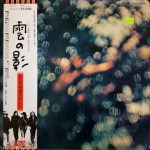
The notes for the Pink Floyd album you see below, Obscured by Clouds, were written sometime in March of 2025 as part of the shootout we conducted for the album.

If we assume it would be an audiophile who would be attracted to this pressing, perhaps for its quieter playing surfaces, perhaps operating under the assumption that the Japanese engineers mastering the record would be more likely to do a better job as well, then what we have here is a textbook case of an audiophile bullshit pressing.

One that sounds nothing like the album is supposed to, based on having played a number of exceptionally good sounding copies, all British and all on the Green Harvest label, mastered from good tapes, sometimes by the legendary Harry T. Moss. We feel we are more than qualified to make these judgments. If we can’t make them, nobody can.
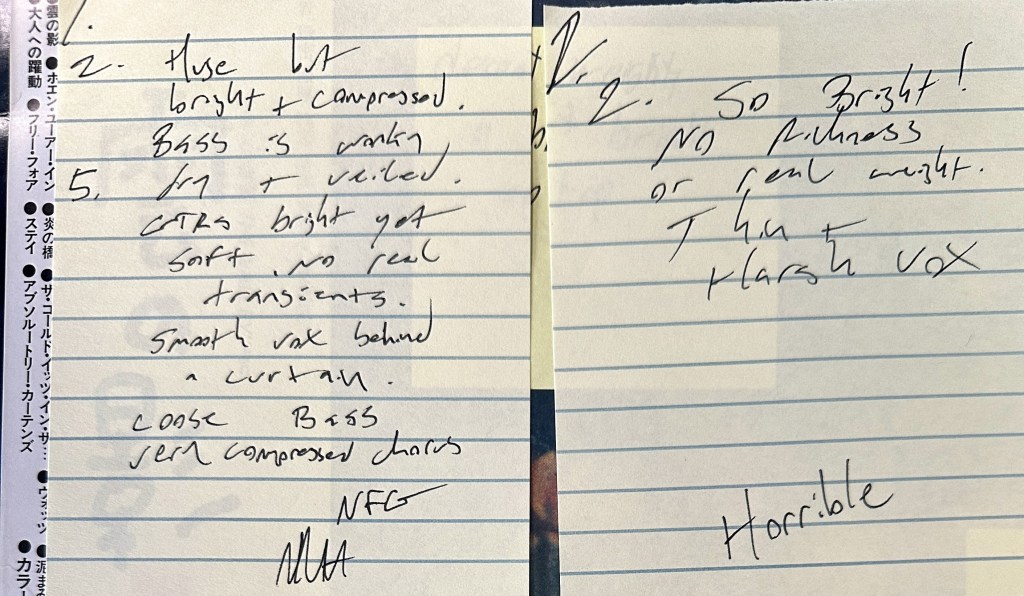
Discogs allows us to glean some information regarding the desirability of this Japanese reissue with the record buying public currently in the market for Pink Floyd vinyl who register on their site.

(more…)
Breakfast in America – An A&M Half-Speed Mastered Disaster

Hot Stamper Pressings of the Music of Supertramp Available Now

Sonic Grade: F

This title is yet another Half-Speed we think belongs in our audiophile hall of shame.

It’s better suited to the stone age stereos of decades past. I should know — my system in 1976 was one-tenth as revealing as the one we use now.

But this pressing is so awful even my old system could not be fooled by this kind of audiophile BS sound. The console you see pictured might be the ideal system to play it. Hard to say, I haven’t heard one of those since the 60s.

It is just ridiculous that someone would consider marketing this kind of sound to audiophiles.

So washed out, brittle, thin and lifeless, it practically defies understanding that anyone with two working ears ever considered calling this piece of crap an “audiophile” record.

But are today’s remastered records marketed to those looking for superior sound any better? Not the ones we’ve played recently. (If you know of any good ones, please drop us a line.)

Is this A&M pressing the worst version of the album ever made? It’s hard to imagine it would have much competition.

(more…)

An RCA Direct Disc with Bad Music & Bad Sound, Like Most Audiophile Albums from the ’70s

Hot Stamper Pressings of the Music of The Beatles Available Now

The records being marketed to audiophiles these days may have second- and third-rate sound, but at least they now have good music. That’s progress, right?

It is progress, because this RCA direct to disc recording is the kind of crap that used to qualify as an “audiophile record” when I was starting out in the mid-70s. These records were displayed on the walls of all the hi-fi stores I used to frequent back in the day.

They cost a lot more than regular records did too. Many were pressed in Japan, and I vaguely recall that the retail prices were in the range of $15 to $18. That’s $77 to $92 in today’s money. Can you imagine paying that for a record with such poor sound and music?

The Beatles Medley is particularly misguided. These guys have no idea what to do with the music of The Beatles.

A record such as this clearly belongs in our audiophile hall of shame, which is a general catchall section for the many bad sounding records that have been marketed to audiophiles over the last fifty years. We’ve played and reviewed more than 300 to date, which of course is but a mere fraction of the many thousands of questionable pressings that have been produced since the 70s. There has always been a mid-fi collector market, and no shortage of enterprising types to take advantage of it.

It turns out that many of the most shameful offenders for sound are more recent releases that have only come our way in the last few years. Here are some of their stories.

(more…)

Cat Stevens Part 2 – Is This the Truest Tillerman of Them All?

If you haven’t read Part 1 of this story, please click here.

Back to our real story. I listened to my good original pressing. I call it White Hot at least!

Then I put the new pressing on the table, set the SDS for 45 RPM, and got the volume just right. I proceeded to carefully adjust the VTA by ear, going up and down with the arm until the sound was right, which is simply standard operating procedure for every record we audition.

These are my actual notes for But I Might Die Tonight.

This is what I heard as the song worked its way through the various sections, in real time.  The first thing I heard at the start was Zero Tubey Magic for the first verse. One of the last things I heard at the end was No Real Space. Space is what you hear at the end for the big piano and drums finish.

Let’s take it line by line. First up:

Zero Tubey Magic

I didn’t hear much Tubey Magic on the new pressing. The best early pressings — domestic A&M Browns, Pink or Sunray UK Islands — often have simply phenomenal amounts of the stuff. It’s a hallmark of the recording.

If a new pressing comes along without it, that’s a problem. I guess that George Marino‘s cutting system at Sterling could probably do some things well, but it sure doesn’t seem to be able get the sound of tubes right. His 33 RPM cutting had no Tubey Magic, and this one has no Tubey Magic.

If I had hired him to cut a record for me and it came out sounding like this, I would find somebody else to cut records for me.

He’s dead now, rest in peace. I would doubt that anyone at Sterling has a better cutting system, and therefore no one should expect any records that have been mastered there to sound very good.

Vocal Is Clear, Clean and Dry

This is the sound you sometimes get with modern, super-clean transistor cutting equipment. It’s low distortion, like a CD is low distortion. We don’t think we should have to put up with dry vocals on records when the good pressings we have been playing all our lives have noticeably richer vocals.

Not rich like Dream With Dean, nothing is that rich, but rich and full-bodied the way the good pressings of this album always make them sound.

(more…)

Son of Schmilsson at 45 RPM – How Can It Possibly Sound This Bad?

Hot Stamper Pressings of the Music of Harry Nilsson Available Now
Alternately titled: Forty Five, Schmorty Five.

Recently someone loaned us a copy of the Mobile Fidelity pressing of this album, the one they put out in 2021 on two discs cut at 45 RPM, remastered by that notorious hack, Krieg Wunderlich.

Our last shootout took place all the way back in 2021. Although I listen to this title regularly,  unfortunately it does not sell all that well, so we haven’t been making the effort we should to find copies in order to offer the best of them to our customers.

Why the album is not more popular is a question we ask about a number of titles on our site. We love the music and we love the sound, as can be seen from what we (with the help of Allmusic) had to say about a very good sounding pressing back then:

  • This is one of Nilsson’s best albums, sonically and musically. (With Ken Scott at the board at Trident Studios the sound just has to be good, doesn’t it?)
  • Son of Schmilsson has more than half a dozen of the best songs Nilsson ever wrote, and should make it a Must Own for every right thinking audiophile with sophisticated tastes in popular music (we hope this means you)
  • 4 1/2 stars: “… this is all married to a fantastic set of songs that illustrate what a skilled, versatile songsmith Nilsson was. No, it may not be the easiest album to warm to — and it’s just about the weirdest record to reach number 12 and go gold — but if you appreciate Nilsson’s musicality and weirdo humor, he never got any better.”

So true!

The MoFi, however, is a joke next to a properly-mastered and properly-pressed RCA vintage release. Our notes for it read:

  • Big but flat
  • Voice is recessed and lacks richness
  • Rock songs, track one in particular work OK but
  • Ballads lose all the magic

(more…)

Dave Grusin – Discovered Again!

  • Grusin’s jazz Masterpiece from 1976 returns to the site for only the second time in sixteen months, here with INCREDIBLE Shootout Winning Triple Plus (A+++) grades or close to them throughout this original import copy – fairly quiet vinyl too
  • Here are just a few of things we had to say about this killer copy in our notes: “weighty, deep bass and kick”…”3D, rich, and silky”…”excellent detail and size”
  • After critically listening to this record good and loud, and hearing it sound the way this copy sounds, we have to call it One of the All Time Great Direct to Disc Recordings
  • The songs, the players, the arrangements, the sound – this is a record that will reward hundreds of plays for decades to come
  • Side one of this copy is out of polarity and not a copy you should buy if you can’t switch
  • “…makes for the kind of demo material audiophiles are so fond of using to impress friends and neighbors.”

We are on record as being big fans of this album. Unlike most Direct to Disc recordings, Discovered Again actually contains real music worth listening to. During our all-day shootout, the more we played the record, the more we appreciated it. These are top quality players totally in the groove on this material. When it’s played well, and the sound is as good as it is here, there’s nothing dated about this kind of jazz. Hey, what can we say — it works.

(more…)

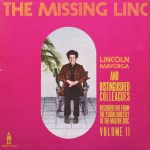
Lincoln and Doug Produced The Audiophile Sgt. Pepper of Its Day

Hot Stamper Pressings of the Music of Lincoln Mayorga Available Now

When I was selling audio equipment back in the 70s (Audio Research, Fulton speakers), The Missing Linc this was a favorite Demo Disc in our store.

With a big speaker like the Fulton J, the bass drum at the end of track two would shake the walls. At the time I had never heard a record with bass that went remotely that deep. (The album came out in 1972. I’m guessing I probably first heard a copy in ’75 or ’76 when I bought my Fultons, which would have been sometime in my early twenties.)

Every bit as amazing to me was the string quartet on side 2. You could actually hear the musicians breathing and turning the pages on their music stands, just as if you were actually in their “living presence.” No recording I had ever owned allowed me to hear that level of natural detail.

This is one of the albums that made me realize how good audio in the home could be.

(more…)

Good Digital Beats Bad Analog Any Day

Hot Stamper Pressings of the Music of Sonny Rollins Available Now

And this is some very bad analog indeed!

We here present our 2010 review of the Sonny Rollins Plus 4 album, the one remastered on two slabs of 45 RPM Analogue Productions Heavy Vinyl.

It has everything going for it, right?

Steve Hoffman, Kevin Gray, 45 RPMs, Heavy Virgin Vinyl, fancy packaging — clearly no expense was spared!

The ingredients may have been there, but the cake they baked was not only not delicious, it was positively unlistenable — I mean, inedible.

I cannot recall hearing a more ridiculously thick, opaque and unnatural sounding “audiophile” pressing than this Rollins record, and believe me, I’ve heard plenty. (And it seems the bad news will never stop.)

As I noted in another commentary “Today’s audiophile seems to be making the same mistakes I was making as a budding enthusiast more than thirty forty years ago. Heavy Vinyl, the 45 RPM 2 LP pressing, the Half-Speed limited edition — aren’t these all just the latest audiophile fads, each with a track record more dismal than the last one?”

It reminds me of the turgid muck that Doug Sax was cutting for Analogue Productions back in the 90s. The CD has to sound better than this. There’s no way could it sound worse.


CD Update:

I managed to track down a copy of the CD and it DOES sound better than this awful record, and by a long shot. It’s not a great sounding CD, but it sure isn’t the disaster this record is.

Buy the CD, and whatever you do, don’t waste money on this kind of crap vinyl.


This is a very bad sounding record, so bad that one minute’s play will have you up and out of your chair trying to figure out what the hell is wrong with your system. But don’t bother. It’s not your stereo, it’s this record.

It has the power to make your perfectly enjoyable speakers sound like someone wrapped them in four inches of cotton bunting while you weren’t looking.

(more…)

Universal Japan and the Economics of Buying a Pig in a Poke

Skeptical Thinking Is Critical to Finding Better Records

One of my good customers sent me this email shortly after this series came out, circa 2000:

I noticed that Universal Japan has come out with several new titles, stuff I’m interested in, like Stevie Wonder / Innervisions… Stan Getz, James Brown… and many others — that are on acousticsounds.com.

Generally, for these somewhat expensive heavy vinyl releases (relative to used prices), I’m trying to stick with stuff where your site has favorable comments regarding the sound quality, but you don’t seem to carry these new items.

Do you think they are bad, or you just have not had a chance to check them out yet?”

I replied as follows:

We have a longstanding antipathy toward records pressed in Japan that were not recorded in Japan. (Here is one of the exceptions because the mastering was done by the real mastering engineer, using the real tape, here in America. There are also some excellent direct to disc albums that were recorded here in the states and subsequently pressed in Japan.)

Japanese pressings almost NEVER sound good to these ears. The only report I’ve heard concerned Aja, which was that it was awful, bright as bright can be.

A Japanese pressing that’s too bright? Shocking. Say it isn’t so.

We are going to be carrying almost no new releases of Heavy Vinyl pressings from now on.

They just don’t sound good to us and we don’t want to waste our time playing bad records when there are so many good ones sitting around that need a loving home.

If you pay $30 for Heavy Vinyl reissues and only one out of five sounds good — an optimistic estimate if you ask me — you’re really paying $150 for the one good one, right?

This makes no sense to me. And since the real odds are one out of ten, it’s really $300 for the good one.

(more…)