250-500

The Ideal Turntable Setup Disc

More Hot Stamper Pressings Featuring the Violin

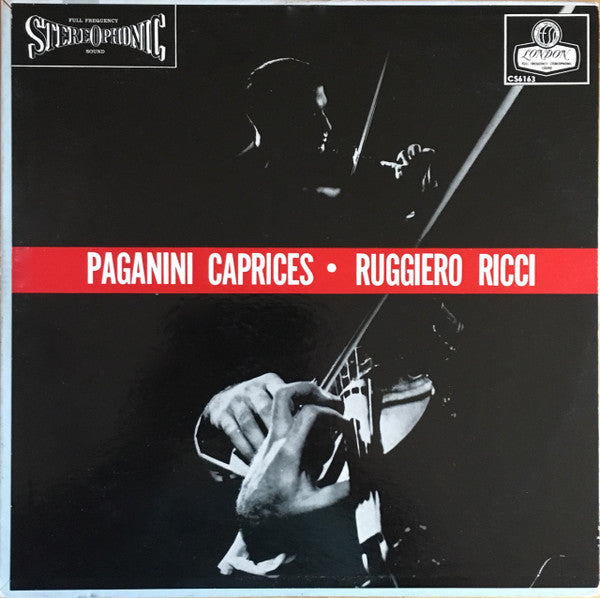
We’ve wanted to have Hot Stamper pressings of this album of Paganini’s Caprices (CS-6163) to offer our customers for years, not for the music per se, but to use as a handy test disc for those who are interested in setting up and dialing in their front ends better.

After all, these are only practice pieces. If you want real music written for the violin, we have plenty of albums to choose from that would be much more enjoyable.

If you like the sound of solo violin — and who doesn’t? — you will have a hard time finding a better sounding recording of it than this. That’s assuming you can set your Vertical Tracking Angle (VTA) correctly, not something every audiophile can manage. If you can, look out — you are in for a sonic treat.

Solo violins in live performance are clear, clean and present. You have no trouble at all “seeing” them clearly.

Our vintage Hot Stamper pressings will always have that kind of clear and present sound for the violin. If they didn’t, they would not qualify as Hot Stamper pressings.

Setup Advice

This is truly the perfect turntable setup disc; when your VTA, azimuth, tracking weight and anti-skate are correct, this is the record that will make it clear to you that all your efforts have paid off.

What to listen for you ask?

(more…)

Breakfast in America – An A&M Half-Speed Mastered Disaster

Hot Stamper Pressings of the Music of Supertramp Available Now

Sonic Grade: F

This title is yet another Half-Speed we think belongs in our audiophile hall of shame.

It’s better suited to the stone age stereos of decades past. I should know — my system in 1976 was one-tenth as revealing as the one we use now.

But this pressing is so awful even my old system could not be fooled by this kind of audiophile BS sound. The console you see pictured might be the ideal system to play it. Hard to say, I haven’t heard one of those since the 60s.

It is just ridiculous that someone would consider marketing this kind of sound to audiophiles.

So washed out, brittle, thin and lifeless, it practically defies understanding that anyone with two working ears ever considered calling this piece of crap an “audiophile” record.

But are today’s remastered records marketed to those looking for superior sound any better? Not the ones we’ve played recently. (If you know of any good ones, please drop us a line.)

Is this A&M pressing the worst version of the album ever made? It’s hard to imagine it would have much competition.

(more…)

Listening in Depth to The Royal Scam

Hot Stamper Pressings of the Music of Steely Dan Available Now

We really went overboard with the track commentary for this one many years ago. This should make it easy for you to compare what we say about the sound of these songs with what they sound like to you on your system, using the copy you own or, better yet, one of our Hot Stampers. 

If you end up with one of our pressings, listen carefully for the effects we describe below. This is a very tough record to reproduce — everything has to be working in tip-top form to even begin to get this complicated music sounding the way it should — but if you’ve done your homework and gotten your system really cooking, you are in for the time of your Steely Dan life.

Side One

Kid Charlemagne

By far the most sonically aggressive track on this album, Kid Charlemagne is a quick indicator of what you can expect from the rest of the side. The typical copy is an overly-compressed sonic assault on the ears. The glaring upper midrange and tizzy grit that passes for highs will have you jumping out of your easy chair to turn down the volume. Even my younger employees who grew up playing in loud punky rock bands were cringing at the sound.

However, the good copies take this aggressive energy and turn it into pure excitement. The boys are ready to rock, and they’ve got the pulsing bass, hammering drums, and screaming guitars to do it.

Without the grit and tizz and radio EQ — which could have been added during mastering or caused by the sound of some bad ABC vinyl, who can say which — the sound is actually quite good on the best copies.

It’s one of the toughest tests for side one. Sad to say, most copies earn a failing grade right out of the gate.

The Caves of Altamira

This is the best test for side one.

There are sweet cymbals at the beginning, and Fagen’s double tracked voice should be silky and smooth, but on the really hot copies it’s also big and alive.

When I was first doing these shootouts, I noted that the hi-hat is front and center in the mix of this song, and when that hi-hat sounds grainy or aggressive, it’s positively unlistenable.

That hi-hat needs to sound silky and sweet or this song is going to give you a headache, at least at the volume I play it at: GOOD and LOUD.

(more…)

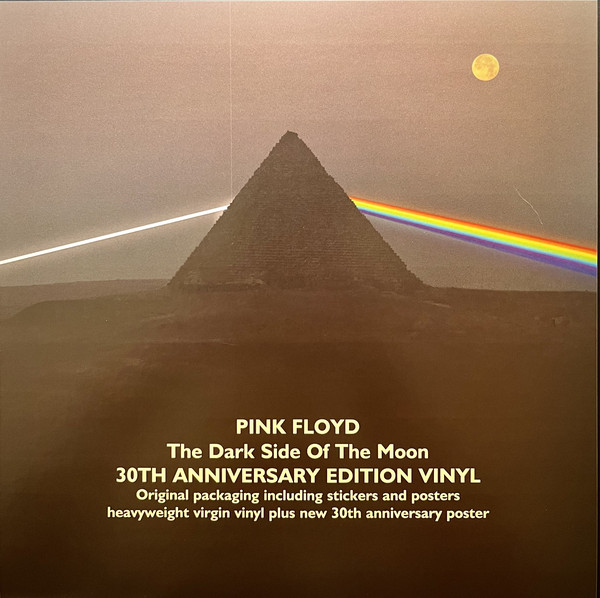
The Dark Side of the Moon – 2003 Heavy Vinyl Reviewed

Pink Floyd Hot Stamper Pressings Available Now

An audiophile hall of shame pressing and a Heavy Vinyl disaster if there ever was one (and oh yes, there are plenty).

The 30th Anniversary Heavy Vinyl pressing is too bright. There is a boost in the top end, probably in the 12K region, that appears to be a poor mastering choice the late Doug Sax made, one that is surely not doing this recording any favors.

In fact, in the case of this new pressing, it’s positively ruinous, assuming you have set your VTA correctly and have the properly functioning tweeters to show you how bright this record is. If you like the phony detail a boosted top end provides, this record should be right up your alley. However, you would do well to recognize that this is a blind alley, and the best way forward is to turn around and start heading in the opposite direction.  

Some audiophiles revere a record like this (last time I checked, the average selling price on Discogs was $149.50) because they need it to wake up their sleepy stereos. My stereo hasn’t been sleepy enough to play this 2003 recut for a very long time, and I hope you can say the same.

As a service to the audiophile community, please click on the link below to find other records that your system should be able to make clear are too damn bright.

(more…)

Roxy Music, Rhett Davies, Yanick Etienne and the Making of Avalon

Hot Stamper Pressings of Roxy Music’s Albums Available Now

I consider Roxy Music to be one of the greatest Art Rock bands in the history of music.

The general public and most audiophiles would no doubt cast their vote for Avalon as the band’s masterpiece, but I much prefer their eponymous first album, along with Stranded, Country Life and Siren to the more “accessible” music found on Avalon.

To be fair, that’s splitting hairs, because any of those five titles are absolute Must Own albums that belong in any serious popular music collection.  

Roxy Music’s “Avalon”

By Rick Clark

When asked in 1982 about the concept of Avalon, Ferry responded, “I’ve often thought I should do an album where the songs are all bound together in the style of West Side Story, but it’s always seemed like too much bother to work that way. So instead, I have these 10 poems, or short stories, that could, with a bit more work, be fashioned into a novel.

“Avalon is part of the King Arthur legend and is a very romantic thing,” Ferry added. “When King Arthur dies, the Queens ferry him off to Avalon, which is sort of an enchanted island. It’s the ultimate romantic fantasy place.”

Regardless, the entire album sustains a cohesive mood that isn’t just a product of Ferry’s lyrical thematic vision. It was a product of the process that Davies and the band employed in laying down grooves and having players interact with them, and then shaping those performances in a way that would ultimately inspire Ferry to articulate his melodies and words.

“We were creating tracks back then,” Davies says. “We didn’t have the songs. The songs were virtually the last things to go on there. We were very much creating a musical atmosphere that we wanted the musicians to respond to.

“In those days, Bryan and Roxy would have a musician in for a day or two and they would want that musician to play on all the songs and see what came out of that,” Davies continues. “I would have to be able to throw the tracks up pretty quickly and they had to sound the same every time. Rather than spending half-an-hour putting the track up and then another half-an-hour getting the bass sound, we wanted to work fast. In the initial stage of throwing a track at somebody, it was always that first response that you got when someone was fresh that was very important. Then we would spend days and weeks agonizing over it and fiddling around with it,” he adds with a laugh. “But the initial process we wanted to keep fast.” (more…)