Audiophile Vinyl

Universal Japan and the Economics of Buying a Pig in a Poke

Skeptical Thinking Is Critical to Finding Better Records

One of my good customers sent me this email shortly after this series came out, circa 2000:

I noticed that Universal Japan has come out with several new titles, stuff I’m interested in, like Stevie Wonder / Innervisions… Stan Getz, James Brown… and many others — that are on acousticsounds.com.

Generally, for these somewhat expensive heavy vinyl releases (relative to used prices), I’m trying to stick with stuff where your site has favorable comments regarding the sound quality, but you don’t seem to carry these new items.

Do you think they are bad, or you just have not had a chance to check them out yet?”

I replied as follows:

We have a longstanding antipathy toward records pressed in Japan that were not recorded in Japan. (Here is one of the exceptions because the mastering was done by the real mastering engineer, using the real tape, here in America. There are also some excellent direct to disc albums that were recorded here in the states and subsequently pressed in Japan.)

Japanese pressings almost NEVER sound good to these ears. The only report I’ve heard concerned Aja, which was that it was awful, bright as bright can be.

A Japanese pressing that’s too bright? Shocking. Say it isn’t so.

We are going to be carrying almost no new releases of Heavy Vinyl pressings from now on.

They just don’t sound good to us and we don’t want to waste our time playing bad records when there are so many good ones sitting around that need a loving home.

If you pay $30 for Heavy Vinyl reissues and only one out of five sounds good — an optimistic estimate if you ask me — you’re really paying $150 for the one good one, right?

This makes no sense to me. And since the real odds are one out of ten, it’s really $300 for the good one.

(more…)

Laurindo Almeida – Virtuoso Guitar

More of the Music of Laurindo Almeida

  • A killer copy of this 45 RPM direct to disc recording featuring Shootout Winning Triple Plus (A+++) sound or close to it on both sides – fairly quiet vinyl too
  • Some of the tubiest, warmest acoustic guitar sound you could ask for from a “modern” record – this is the sound of analog done right
  • It has the kind of sound we prefer, with none of the razor sharpness that you get on some direct to disc recordings
  • One of the best Almeida albums we know of and probably the best Crystal Clear title (which we know isn’t saying much)

Volume Is Key

This recording has very little processing or EQ boost, and the studio is somewhat dead sounding (all too common in the late 70s). That combination can mean only one thing: If you don’t play this record loud enough, it will not sound right.

The famous Sheffield S9 is exactly the same way. It sounds dead and dull until you turn it up. When you do, lookout — it really comes alive.

The best pressings can sound shockingly like live music, something one just does not hear all that often, even when one plays records all day long as we do.

(more…)

Led Zeppelin on Prestigious Japanese Limited Edition Vinyl

Hot Stamper Pressings of the Music of Led Zeppelin Available Now

A classic case of live and learn. In 2006 I finally woke up to how ridiculously bad these Japanese pressings I was selling back in the 90s actually were.

It’s what real progress in audio is all about, in this case about ten years’ worth. Those are ten years that really shook my world, and by 2007 we had discovered much better cleaning technologies and given up on Heavy Vinyl and audiophile bullshit pressings such as these, whew!

Our story from 2006:

I used to sell the German Import reissues of the Zep catalog in the 90s. At the time I thought they we’re pretty good, but then the Japanese AMJY Series came out and I thought they were clearly better.

I couldn’t have been more wrong. I now realize those Japanese pressings are bright as bright can be. Now, not-too-surprisingly, the German pressings sound more or less right (on some of their titles).

They tend to be tonally correct, which is more than you can say for most Zep pressings, especially some of the Classics [linked here], which have the same brightness issue (as well as many other problems).


UPDATE 2024

Only one of the German-pressed Zeppelin records is good enough to win shootouts, the only title of theirs on German vinyl that we buy these days. Of course we tried them all, at no small expense I might add, because there were a great many pressings cut by many different engineers over the course of decades that were pressed in Germany, and the only way we could judge them was to buy them and have them shipped over. In the end only one had the big, bold, dynamic sound we were after.

(more…)

The Fox Touch Is Not As Good As We Thought, Sorry!

Hot Stamper Pressings of the Music of J.S. Bach Available Now

The review reproduced below was written in 2010. More recently (2015 or so) I have played copies of these Crystal Clear organ recordings and been much less impressed.

The ambience is a fraction of what it should be, and the reason I know that is that the vintage organ recordings we play these days have dramatically more size and space than these audiophile pressings do. (We wrote about it here.)

A classic case of live and learn.

As we like to say, all these audiophile records sound great sitting on the shelf. When you finally pull one out to play it, you may find that it doesn’t sound the nearly as good as you remember, and that’s a good thing.

It’s a sign you are making progress in this hobby.

Ten years from now, if during that time you’ve worked hard on your stereo system, room, electricity and all the rest, your Heavy Vinyl pressings will also have plenty of flaws you never knew were there.

Our customers know what I am talking about. Some have even written us letters about it.

Linked here are some other records that are good for testing orchestral depth, size and space.


Our old review — way off the mark it seems!

White Hot on both sides, a DEMO DISC quality organ Direct to Disc recording.

Full, rich, spacious, big and transparent, with no smear.

The size and power of a huge church organ captured in glorious direct to disc analog.

We’ve never been fans of Crystal Clear, but even we must admit this recording is Hard To Fault.

Are we changing our tune about Audiophile records? Not in the least; we love the ones that sound right.

The fact that so few of them do is not our fault. 

The methods used to make a given record are of no interest whatsoever to us. We clean and play the pressings that we have on hand and judge the sound and music according to a single standard that we set for all such recordings. Organ records, in this case, get judged against other organ records. If you’ve been an audiophile for forty years as I have, you’ve heard plenty of organ records.

Practically every audiophile label on the planet produced at least one, and most made more than one. Some of the major labels made them by the dozen in the ’50s and ’60s, and many of those can sound quite wonderful.

Who made this one, how they made it or why they made it the way they did is none of our concern, nor in our mind should it be of any concern to you. The music, the sound and the surfaces are what are important in a record, nothing else.

Richter was making recordings of this caliber for London in the ’50s. Clearly the direct to disc process is not revelatory when it comes to organ records (or any other records for that matter), but finding vintage Londons with quiet vinyl that sound as good as this disc does is neither easy nor cheap these days, so we are happy to offer our Bach loving customers a chance to hear these classic works sounding as good as they can outside of a church or concert hall.

(more…)

Virtuoso Guitar Is Potentially an Awesome Direct to Disc Record

Hot Stamper Pressings of Direct-to-Disc Recordings Available Now
This recording has very little processing or EQ boost, and the studio is somewhat dead sounding (all too common in the late-70s). That combination can mean only one thing: If you don’t play this record loud, it will not sound right. 

The famous Sheffield S9 is exactly the same way. It sounds dead and dull until you turn it up good and loud. When you do, lookout — it really comes alive. The best pressings can sound shockingly like live music, something one just does not hear all that often, even when one plays records all day long as we do.

The snare drum on this copy represents one of the most realistic and dynamic sounding snares I have ever heard. Talk about jumping out of the speakers! If you have plenty of large, fast, powerful dynamic drivers like we do, you are in for a real treat. Track one, side one — lookout!

Our Shootout Winner from Years Ago

As usual, the shootout allowed us to hear what was lacking on side two.

Side One

A+++ As Good As It Gets sound from top to bottom. No copy was as transparent, lively or high-rez. No copy actually did ANYTHING better, which is unusual. The distortion level is close to zero on this one. The louder you play it the better it sounds.

Side Two

With a grade of A Double Plus this copy was close to the best, falling a bit short in the area of upper midrange presence and top end. Still, there’s lots of space, the cello sounds full and rich, as does the guitar, and none of the plucked instruments suffer from smear at all.

A great side, just a bit dark compared to the very best.

(more…)

Jack Sheldon / Unreleased UHQR Test Pressing

More Hot Stamper Pressings of Digital Recordings with Audiophile Quality Sound

UPDATE

We reviewed this album in 2007, which was a long time ago, so please take that into consideration when reading this review.


This is a practically brand new UHQR JVC test record.

I’m SHOCKED at how good this record sounds.  It has AMAZING live-in-the-studio jazz sound.

(more…)

Our Shootout Winner Had Sound that Was Really Jumping Out of the Speakers

Hot Stamper Pressings of Direct-to-Disc Recordings Available Now

Recently we put up a copy of this wonderful direct to disc recording with this description:

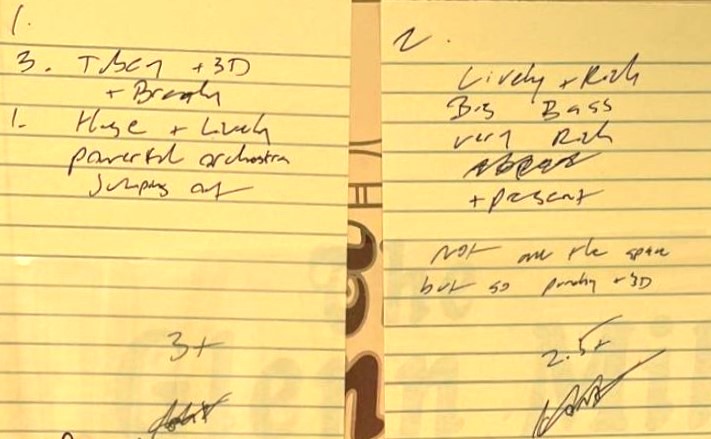
Here are just a few of the things we had to say about this incredible copy in our notes: “tubey and 3D and breathy”…”huge and lively”…”powerful orchestra”…”jumping out of the speakers”…”very rich and present.”

Great energy, but the sound is relaxed and Tubey sweet at the same time, never squawky, with plenty of extension on both ends – that’s analog for ya!

This is no sleepy over-the-hill Sheffield Direct-to-Disc (referring to the later Harry James titles, not the excellent first one) – these guys are the real deal and they play their hearts out on this album, recorded in a church with exemplary acoustics.

Note that side two did not have all the space, but was so punchy and 3-D that it was easy to award it a Nearly White Hot Stamper grade of 2.5+. The copy that beat it had all the same qualities and more space, sounding more like side one of this very pressing.

And here are the actual notes for the Shootout Winning copy we found.

We have no trouble hearing when a record is doing everything right, and when a record has one side that is a bit lacking, it’s the shootout that shows us in what area it is lacking.

In this case, our notes read:

  • Not all the space but so punchy and 3-D

Track one had sound that “jumped out of the speakers,” and if — like us — that’s the kind of sound you are looking for, our Hot Stamper pressings are where you can find it.

If you would like to test the pressings you own, here are a few that might make good tests for that quality. Also, many of our customers have commented about that quality in the Hot Stamper pressings we sent them, and you can read their letters here.

(more…)

The Three – Liner Notes and a Rave Review

Hot Stamper Pressings of The Three Available Now

Excerpts from the Liner Notes

On a windy and unusually cold night in Los Angeles, each of the three musicians arrived before the session start time of 10 PM on November 28, 1975. At exactly 10 PM, The Doobie Brothers session that was going on since morning ended. Two assistants immediately started setting up for the session. The Steinway concert grand piano, delivered the previous day, was wheeled in to the center of the room and got tuned. Shelly Manne’s drum kit was assembled in a makeshift “booth.” Microphones were set up, checked and positions adjusted.

Initially, Telefunken microphones were positioned on the piano, but later were replaced by two Neumann U87s. The piano lid was opened to the concert position and microphones were centered relative to the keys and placed a foot (30 centimeters) inward from the hammer and a foot (30 centimeters) away from the strings. One mic was pointed toward the bottom notes and the other pointed toward the top.

To record Ray Brown’s bass, a Shure SM56 and a Sony 38A were pointed at the bridge of the bass, two inches above it. The Shure was used to capture the attack and the Sony mic was used to capture the rich low tones.

Seven microphones were used to capture the sounds of the drum set. Two U87’s were placed overhead, roughly 16-inches above the cymbals facing down. The bottom quarter of the kick drum was dampened with a blanket on the outside and was mic’ed with a Shure SM56. SM56’s were also used for toms and bass toms. Sony 38A was used on the snare and Sennheiser’s Syncrhon on the high-hat.

Each mic was placed 2 inches away from the instruments in a close mic set up. Mr. Itoh got involved with fine tuning mic positioning for tone, stereo placement and balance. Meanwhile, final adjustments were being made on the cutting machine set up.

Within the hour, the set up was done and all preparations were completed. The musicians finished warming up and were ready for Take One. The usual banter subsided and everyone put on their “game face.” Even Ray Brown, who usually cracked jokes in a loud voice, looked serious as he turned his attention to Mr. Itoh, waiting for his cue. As soon as he was notified through the intercom that the cutting needle was put down, Mr. Itoh gave the signal with his hand, and the recording started. In 16 minutes, three tracks were recorded in rapid succession.

Relieved that the initial take was over, the musicians joined the producer and engineer in the control room to listen back from the 2-track tape that was used as back up. With the initial tension gone, all three excitedly made comments and evaluated their own performance and the sounds they got. The thumbs-up was given by the cutting engineer for take one and the musicians went back to the live room for the next take. This process was repeated until 4 AM the following morning, resulting in a total of three takes per track.

(more…)

Grossman & Renbourn Direct to Disc – Updated

Hot Stamper Pressings of Direct-to-Disc Recordings Available Now

Many years ago we described the East World Direct-To-Disc Japanese import LP you see pictured this way:

Lovely acoustic music; the best cuts are the first two tracks on side two. They sound like a classic Vanguard recording from the 60s. One of the best East World titles.


UPDATE 2025

In preparation for a possible shootout, we got another copy of the record in and were much less impressed in 2025 than we were in 2010, which was probably the last time we had played the record.

It was somewhat veiled and dry. The sound wasn’t bad, it was actually fairly good, but that’s a long way from amazing. If we’re going to offer you an acoustic guitar recording, it’s going to have to be amazing sounding because there are a lot of amazing sounding vintage acoustic guitar albums from the 50s to the 70s to compete with.

And to compare it to a classic Vanguard recording is just ridiculous.

Vanguard produced some the most natural recordings in the history of the recorded music. East World produced some decent, modern and somewhat artificial-sounding recordings of mostly forgettable music in the 70s. We had no business comparing the two of them.

We obviously had a long way to go in audio before we got straightened out on that point. We’re always banging on about making audio progress so that you can recognize and collect better sounding records, and this East World pressing is the perfect example of us taking our own advice.

Our stereo had improved so much over that span of fifteen years that it was now obvious to us how second-rate this Japanese Direct-to-Disc actually was.

If you have any Direct-to-Disc recordings still sitting on your record shelf, pull some of them down and see how well the sound — and the music — hold up. Chances are good that a number of them might soon be finding a new home in the trade-in pile, in order to clear more space for better records.

(more…)

Find the Dubs = Less Records = Progress!

Robert Brook runs a blog called The Broken Record, explaining that the aim of his blog is to serve as:

A GUIDE FOR THE DEDICATED ANALOG AUDIOPHILE

Here is Robert’s posting from 8/26/2025 containing a great deal of good advice for record collectors and audiophiles of all ages, especially us old ones.

He admits to being wrong about the sound of a record he wrote about on his blog. When have you ever seen an audiophile admit to being wrong about a record? The very idea!

Why was he wrong? Because his stereo got dramatically better, so much better that he could see how mistaken he was about a Japanese pressing he thought for sure was made from the master tape. Now it sounds dubby. It was always dubby; he just hadn’t gotten his system, room, electricity, setup and who knows what else to the point where the true nature of that copy could be revealed.

Robert revisited a record he was sure he knew well, well enough to rave about on his blog, and found out things had changed — apparently quite a lot! — while he wasn’t looking.

A great deal of audio progress had been made, and that audio progress is what allowed Robert to also make some progress on the record collecting front, a win-win if every there was one. Congratulations are in order.

We here at Better Records live with this reality every day. Our mea culpas are occassioned by the shootouts we do for the same records over and over again, which is what allows us to discover even better pressings of albums than the ones we thought were the best. It’s surely the most rewarding part of the job.

FIND the DUBS = LESS RECORDS = PROGRESS!

Please to enjoy the lessons Robert learned.

I wrote about a similar experience I had myself back in the early-2000s.

If presently you are the happy owner of many Japanese pressings, perhaps now would be a good time to pull them out and play them. Very few master tapes went to Japan, and, as a result, most Japanese pressings in our experience sound like they are made from copy tapes, which of course they are.

Some of them have the potential for top quality sound, but most do not.

If your stereo is not revealing enough to show you their shortcomings, the way Robert’s was not revealing enough just five years ago, please take his advice and make the kinds of changes he has made.

The steps you take next will be the most satisfactory of all. Now you can clear the shelves of all your second- and third-tier records, which, of course, will not be limited to Japanese pressings, but should in fact include most of your Heavy Vinyl LPs, if not all of them. Let the culling begin!

(more…)