Record Mysteries

Perhaps you can explain these record mysteries. We sure can’t.

When All the Stampers Are the Same, What’s a Mother to Do?

Hot Stamper Pressings of Blue Note Albums Available Now

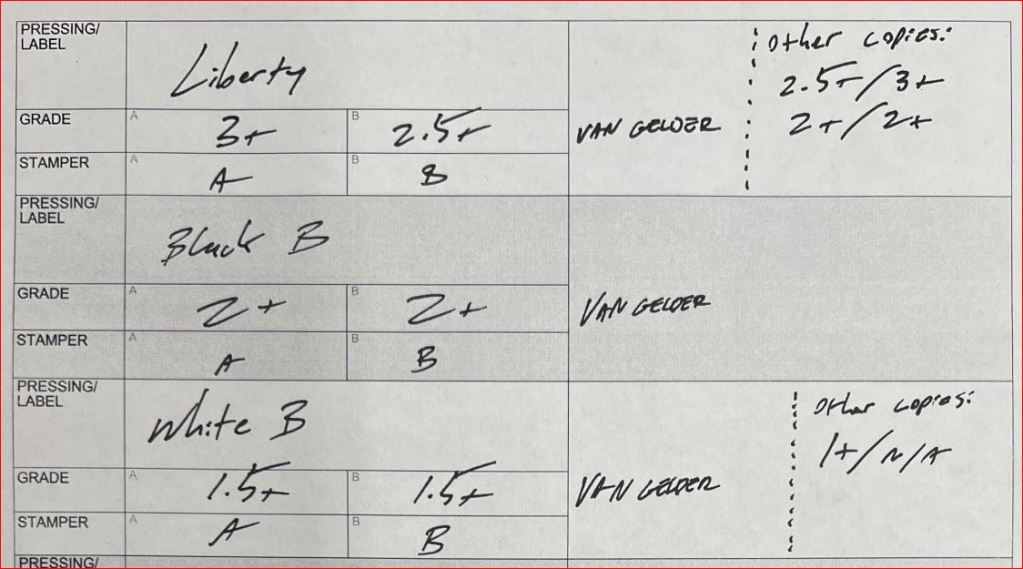
What happens when all the stampers are A and B and every one of them is cut by Rudy Van Gelder?

This is precisely the problem we were faced with on the mystery Blue Note album whose stampers can be seen below.

It’s not Cornbread — those are really hard to find! We did a shootout last year and hope to have another one coming before long, but most of what we buy ends up going back to the seller for noise issues, so it may be a while before we can get it going.

In the meantime, whatever you do, don’t waste your money on the Tone Poets reissue — it’s ridiculously bad.

What information can you rely on when trying to find the best sounding pressings?

The stamper numbers are no help.

And you can’t look for the VAN GELDER stamp in the deadwax since they all have it.

Of course, now that we’ve done the shootout, we know to buy the Liberty label pressings, but that could hardly have been predicted beforehand. Plenty of later labels beat the early label pressings on Blue Note’s albums.
But readers of this blog surely know that we are being facetious when we say we faced a lack of stamper information with the title above.

We have no way of knowing what the label is for any copy that is playing on our turntable, so how could the stamper information possibly matter, ever, under any circumstances?

We judge records by their sound quality, then grade them on that single metric, ignoring all others.

Only later do we learn which labels and stamper numbers correspond with which sonic grades, assuming they actually correspond at all. (Some don’t.)

If you are buying certain pressings because they have earlier labels, rather than pressings with later labels, predicated on the theory that the earlier labels should have better sound, this blog will be a godsend — because it will prove to you that the approach you are taking is not a particularly good one.

You are only fooling yourself if you think it is. It might work more often than not, but do you really want to be wrong about four records out of ten? Forty out of a hundred. Four hundred out of a thousand? With no way of knowing which group — good or bad — any given title happens to fall into?

A record collection of a thousand records is a decent sized collection. But with four hundred titles having second-rate or worse sound? Nobody wants that.

Buying originals is just not a good way to insure your collection will have top quality sound. Fortunately we know of a way that does.

(more…)

The Originals Can Be Very Good, But the Right Reissues Never Fail to Beat Them

Hot Stamper Pressings of Blue Note Recordings Available Now

Warning: the record you see pictured is not the record we are discussing in this commentary.

For this mystery title our recent shootout involved two early New York Blue Note pressings.

We don’t need to tell you that those are the ones that take us years to find, and cost us a pretty penny (in audiophile playing condition) when we do find them.

One of them we’ve had on the shelf for years to use as a reference pressing. We knew it could be beaten, that it would never be able to win a shootout, but we also knew it had a lot of the qualities we were looking for on the album.

It sounds right, the way the best Blue Notes from this era usually do, regardless of what you may have read elsewhere.


Our Hot Stamper pressings are guaranteed to soundly beat (ahem) whichever versions of the album have been recommended by any of the self-described audiophile “experts” or your money back.

When those who produce Blue Note reissues and those who review them tell you Rudy did not know how to cut a record that sounds right on good equipment, you can easily prove to yourself how hard of hearing these people must be by simply buying one of our Hot Stamper pressings.

You can send it back — that’s up to you — but at least you will know how full of it these audiophile reviewers must be to write such nonsense. We love Rudy and make no bones about it.

Our notes for both early pressings are shown below.

Top copy:

This New York label pressing is very sweet and open. It lacks some warmth and depth in the midrange.

Lower copy:

This one is very tubey, big and bold, but it gets hot on the horns and needs space.

(more…)

Sure, 1s Wins, But Why Does 2s Do So Much Worse?

Hot Stamper Living Stereo Classical and Orchestral Titles Available Now

Below you will see a section of the stamper sheet for a shootout we did recently.

Keep in mind that, as usual, the album you see pictured is not the record we did the shootout for.

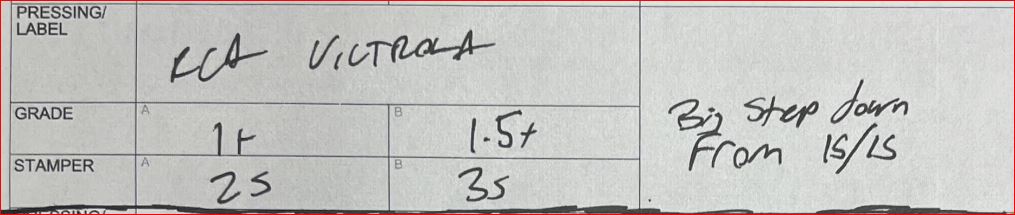
In the case of this mystery record, the 1s stamper was by far the best, with the Plum Label copies having later stampers (2s) earning a sub-Hot Stamper grade on side one.

The 1+ grade found on this side one means it’s simply not very good, the kind of sound we consider to be no better than passable, We do offer records with 1+ grades as Hot Stamper pressings.

What would be the point? You can find them on your own. The world is full of mediocre records. They sit in the bins of every record store you walk into and make up the bulk of record collections of both audiophiles and music lovers alike.

How Come?

Since, as we discovered recently, 1s wins, and wins handily, why does 2s/3s do so much worse?

I could guess, but that would violate our policy against pretending to know what cannot be known.

Something in the range of five to ten per cent of the major label Golden Age recordings we play will eventually make it to the site. The vast majority just don’t sound all that good to us. (Many have second- and third-rate performances and those get tossed without ever making it to a shootout.)

(more…)

Now That You Know the D2 Stampers Have the Best Sound, What’s Your Next Move?

Hot Stamper Pressings of Contemporary Jazz Albums Available Now
Recently we conducted a shootout for yet another superb Contemporary recording, one that we had auditioned a couple of times before, and one for which we had a good understanding of both the music and the quality of the sound. We’ve played vintage Contemporary pressings by the hundreds at this point. Rarely are we surprised by how good the right stampers and labels can sound.

It’s not the record you see pictured, however. For now, the title of this album will have to remain a mystery, along with a great many others we’ve been discussing on the blog recently.

The cost of discovering the right stampers for famous and often expensive records is often high, can take decades, and is fundamentally at the heart of how we make our money. We are in the business of finding potentially amazing sounding pressings. Often they have stampers we know to be good, and sometimes they have stampers we discover are even better.

We clean them up, play them, and offer to our customers those that, for whatever reasons no one has yet figured out — including us — are far better sounding than any others.

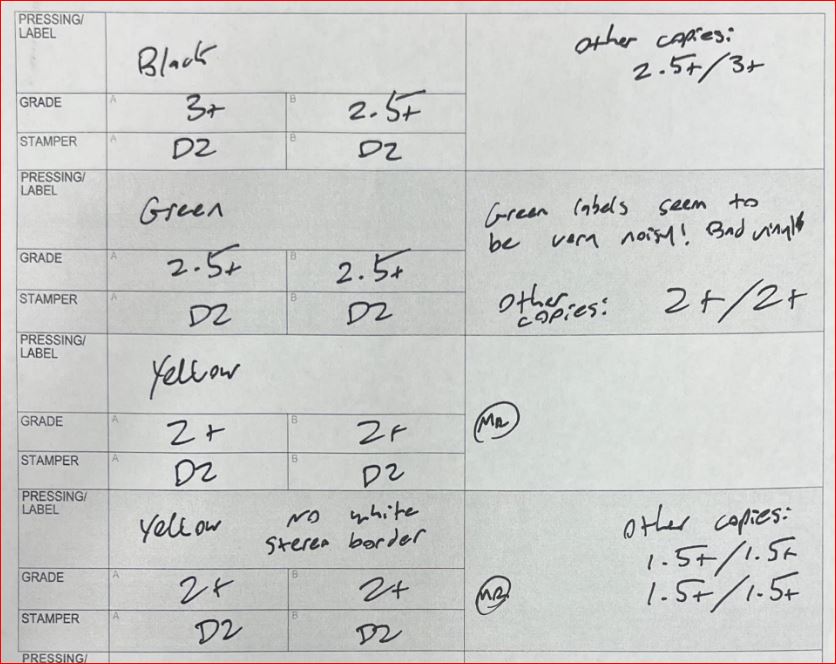
You’ll notice that the early Black Label pressings did the best in our shootout, followed by the later Green Label pressings, followed by the Yellow Label pressings with the earlier cover at 2+, which are in turn followed by the Yellow Label pressings in the later cover.

Depending on which D2 you’re playing, the sound could be absolutely amazing, or perhaps excellent, or, as in the case of the 1.5+ copies, merely good, not great.

Lessons Learned

Knowing the right stampers are D2 for this title does not allow us to predict which pressings will win a shootout. We actually have to sit down and play all the copies to come up with the hierarchy we laid out above.

However, knowing that the Black Label originals with D2 stampers are the copies most likely to win shootouts is very helpful information.

(more…)

Bernie Finds the Right Sound for The Genius After Hours

charlgeniusHot Stamper Pressings of Titles that Sound Better in Mono Available Now

This commentary from ten years ago has been updated with the latest information from the shootout we did in 2025.


Proof positive that there is nothing wrong with remastering vintage recordings if you know what you’re doing. These sessions from 1956 (left off of an album that Allmusic liked a whole lot less than this one) were remastered in 1985 and the sound — on the better copies mind you — is correct from top to bottom.

The highest compliment I can pay a pressing such as this is that it doesn’t sound like a modern remastered record.

It sounds like a very high quality mono jazz record from the 50s or 60s.

Unlike modern recuts, it doesn’t sound EQ’d in any way.

It doesn’t lack ambience the way modern records do.

It sounds musical and natural the way modern records rarely do.

If not for the fairly quiet vinyl, you would never know it’s not a vintage record. The only originals we had to play against it were too noisy and worn to evaluate critically. They sounded full, but dark and dull and somewhat opaque.


UPDATE 2025

The originals on the Atlantic Plum and Red Label are not the way to go on this album. Our shootout notes below make that clear. Take our friendly and helpful advice and avoid them.

(more…)

Today’s Rock Record Mystery – How Can Stampers 3, 4 & 6 Beat 1 & 2?

Hot Stamper Pressings of the Music of Tom Petty Available Now

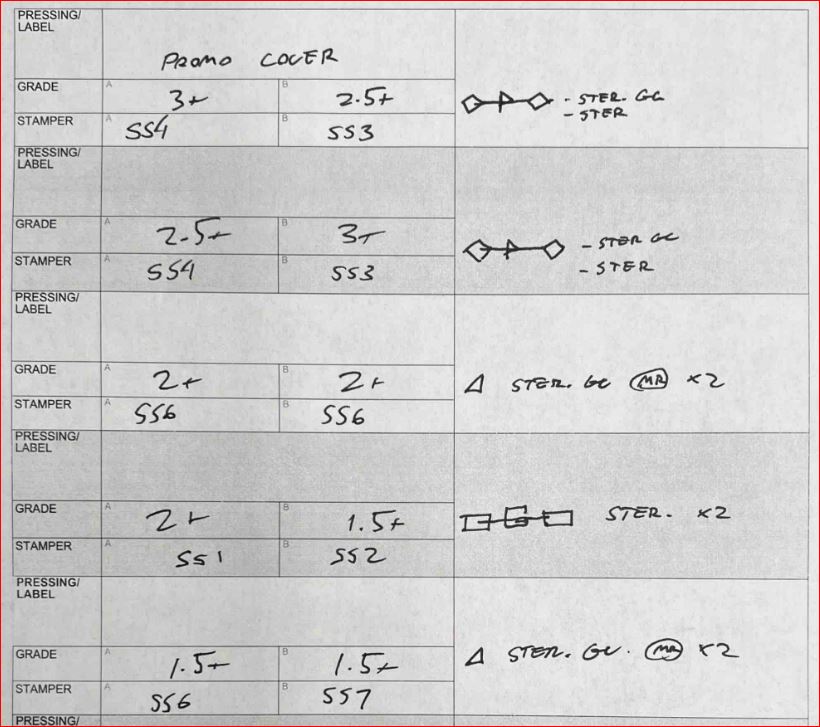
The earliest stampers for this mysterious Tom Petty album — not the one you see pictured — were some of the worst sounding in our shootout.

Most audiophiles, when given a choice between earlier stampers and later stampers, all other things being equal, would take the early ones, right?

As a matter of fact, so would we. Most of the stamper sheets we put up on this blog show the early numbers beating the later numbers.

As a rule of thumb it’s not a bad one, but unless you actually do a shootout, how would you know that your SS1/SS2 copy isn’t the best?

How could you possibly know that the SS4/SS3 murdered it?

The promo cover might be helpful, but lots of promo pressings don’t win shootouts, or even do all that well in them.

Like so many realities of the world of records, these are all mysteries, ones that are very unlikely to be solved.

The winners of the next shootout could have the exact same stampers as the record that did the worst in this one. It happens!

One of the best reasons mysteries such as this have little chance of being solved is that no one with any real expertise, using methodologies that are reliable and reproducible in any serious way, is taking on this kind of work — other than us.

We actually like testing records, and over the many years we have been in business we’ve refined* a method for doing it that is as reliable and reproducible as any method can be in the world of audio: the record shootout.


*As far as I know, my friend Robert Pincus was the one who invented the record shootout. He would evaluate each side of a record independently against other copies of the same album, taking notes that described the strengths and weaknesses he heard on each copy he played.

He assumed nothing, and neither do we. Our rigorous controls, blinded experiments and use of the scientific method to arrive at reproducible results are simply advances on his original approach.

(One of the most important differences between his shootouts and ours is that we have someone whose only job is to play the records, and another person to do the listening and take the notes. When the listener has no idea what pressing is being played, there is little chance of the kinds of psychological biases that are the scourge of the record shootout.)

(more…)

Is This Really Robert Ludwig’s Doing? I Thought He Was One of the Good Guys

Hot Stamper Pressings of Rock and Pop Albums Available Now

Below is the complete shootout stamper sheet for a rock record whose name we do not plan to reveal at this time.

We could reveal it, since knowing the “right” stamper numbers appears to be of no help at all — the best stampers and the worst stampers are exactly  the same stampers! (Nothing new there.)

RL stands for Robert Ludwig and MD stands for Masterdisk.  As you can see, Robert Ludwig cut all seven of the pressings that made it to the shootout.

One of them actually won. “Robert Ludwig’s stuff cannot be beat!” might be the post on whatever audiophile forum you frequent. (If it’s Hoffman’s forum, it would more likely read “Robert Ludwig’s stuff cannot be beat except by Steve Hoffman!”)

Another pressings with those same markings came in next to last, with such mediocre-at-best sound that it would not qualify as a Hot Stamper at all. (1.5+ on both sides or better is the minimum grade for any record we sell.)

Robert Ludwig really screwed up the mastering of this title, another forum member might post.

Can they both be wrong? Of course they can. When has any information posted on a forum been reliable or free from error?

If you were to tell me you have the Robert Ludwig-mastered original pressing for this record and it sounds amazing, I would be inclined to agree with you that that is very possible. If, on the other hand, you were to tell me you have the Robert Ludwig-mastered original pressing for this record and it sounds terrible, I would say I happen to know firsthand that that’s possible too.

The most likely sound for any copy you might have is “good, not great,” because only two copies earned grades of 2+ or better on both sides. Two out of seven. (Which is disappointing because it hurts our bottom line when so few copies in a shootout will end up selling for much more than we invested in them in money and labor.)

(more…)

Why are the First Pressings of this Title the Worst Sounding?

Hot Stamper Pressings of Recordings by Decca Available Now
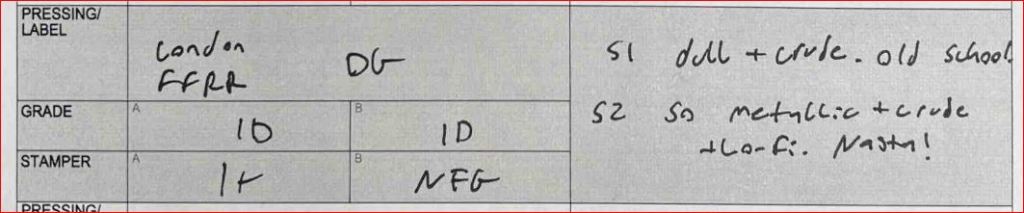
The record you see pictured is not the record we are discussing in this posting. The stamper numbers you see below belong to a different album.

We’ve lately been giving out much more stamper information than we used to, but for now we are keeping this title close to the vest.

We happen to know the best stampers for this album, but somehow a copy with the “bad” stampers ended up in our shootout. It did about as badly as they usually do.

Of course, the person sitting in the listening chair had no idea that a copy with the worst stampers was playing. The jackets and labels of this pressing are identical to the copies with the good stampers.

He simply heard what the recording actually sounds like when it’s mastered badly and registered his complaints.

Side One

  • Dull and crude. Old school.
  • 1+

Side Two

  • So metallic and crude and lo-fi. Nasty!
  • NFG

Apparently Mr. D, real name: Jack Law, did a piss-poor job mastering this album. Another engineer would come along sooner or later and master the record right, so right that it became one of our favorite Demo Discs for sound and performance.

How did this pig’s ear eventually manage to become a silk purse?

Simple. It was always a great recording, it just needed to be mastered right, and whoever got the job to remaster it knocked it out of the park the first time through.

(more…)

Is CTFR-1 Dark and Congested, or Flat and Bright?

Hot Stamper Pressings of Mercury Classical Records Available Now

For Mercury classical and orchestral recordings, the original RFR-1 pressings on the plum label are the way to go, right? 

In some cases, yes. The first pressings of Mercury albums often win our shootouts.

And for both sides of a copy to win a shootout, like our gold promo seen in the stamper sheet below, everything about the pressing must be right. We call records that win their shootout, earning 3+ grades on both sides, Top Shelf pressings. They are rare and special enough to have a section of their own on the site (which, as of this writing, has all of 19 records in it.)

What we find to be interesting about this specific shootout, however, is that we had two later pressings, both with the same stampers, and they sounded markedly different from each other. (Note that the stamper numbers you see below belong to a different album than the one shown above.)

If a collector were to tell you that that the CTFR pressings tend to be dark and congested, and you owned one with the exact same stampers, CTFR-1, you might be inclined to agree with this person.

But if you were the owner of the copy we played that was flat and bright, again, with CTFR-1 in the dead wax of both sides, you would think this person was 1.) Out of his mind, or, 2.) Deaf as a post, or, 3.) The owner of some very inaccurate playback equipment.

He could be all three, but in this case, an unusual one to be sure, his copy of the album doesn’t tell you anything about the sound of your copy of the album. They could match, or they could be completely different. Some records are like that. Not all that many, but definitely some.

Sample Sizes and One Man Bands

Those of us who play a variety of pressings of the same album know how easy it is to draw mistaken conclusions about records. CTFR-1 on this title is the perfect example of a record whose stampers don’t tell you much about its sound. (Even RFR-1 on side one of one copy was no better than “good,” quite a long ways from the best.)

(more…)

How Is It that the Earliest Pressings from the Tube Era Often Lack the Sound of Tubes?

Hot Stamper Pressings of Music on Island Records Available Now
Please note that the album you see pictured on the left is not the one we are discussing here.

It has been our experience going back many years that the earliest pressings for many records on the Island label are not very good.

To be fair, this one — again, not Mr. Fantasy — is not a bad sounding pressing.

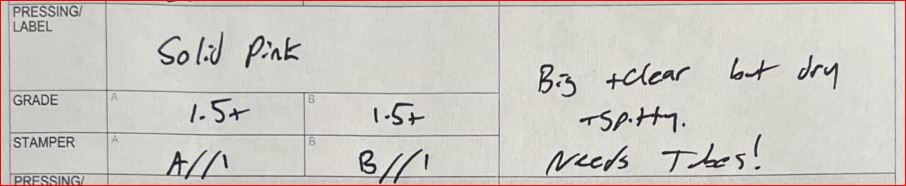
With grades of 1.5+ on both sides, it fits comfortably in our section for good, not great sounding LPs. But the right reissues are a big step up in class sonically. They’re the ones that win shootouts, not these Pink Label LPs.

It’s big and clear but dry and spitty and badly needs tubes — or the sound of tubes — in the cutting chain.

That’s not supposed to happen, the early pressings are supposed to be the most Tubey Magical ones, with the reissues being less Tubey Magical — but in the world of records, when has that rule of thumb ever counted for anything?

Been There, Done That

We’ve run into so many sonically-flawed Pink Label Islands by now that hearing one sound lackluster if not actually awful doesn’t phase us in the least. Some of the other Pink Labels that never win shootouts can be found here.

(more…)