con-wis-fail

Many audiophiles are inclined to believe the conventional wisdom they receive from like-minded enthusiasts.

Some of it is right, some of it is wrong, but if you don’t know how to critically listen to records for yourself, you will never be able to tell which is which.

You’ll be stuck with the approaches most audiophiles use — guessing and assuming. Neither are a reliable method for getting to the truth.

Letter of the Week – “I dropped the needle on side one and started singing by the end of the first verse.”

Hot Stamper Pressings of the Music of Neil Young Available Now

One of our good customers had this to say about some Hot Stampers he purchased recently (emphasis added):

Hey Tom,  

Two fantastic finds; well done once again. The After the Gold Rush you sent is incredibly revealing. The pressing removed the veil. This LP typically sounds dull and I don’t mean the songs.

I dropped the needle on side one and started singing by the end of the first verse. I had planned to have a critical listen first as I always do, so I have a reference in which to make comparisons. If an album is great I start to sing the second time thru. That should tell you what I think of this pressing.

When I played my copy it lasted one verse and one chorus before it was removed from the platter. Exceptional pressing!!! 

Re: Rubber Soul. I have 3 copies of this LP, all Parlophone and all earlier pressings than the one I purchased from you. One doesn’t really count because it is from the very first pressings that had problems.

However, the other 2 are very good pressings. One is very transparent but extremely bass shy. The other is very much the opposite. It has lots of whomp but is grainy.

The pressing from Better Records is beautifully transparent, especially in the voice, and is nowhere near as bass shy.

I believe that being closest to the source usually reveals more accuracy.

That goes for most every discipline of study. This pressing, though not being the actual closest, was the winner. Go figure!

(more…)

We Learned a Valuable Lesson About Goats Head Soup in 2016

More of the Music of The Rolling Stones

Presenting a classic case of live and learn.

We would agree with very little of what we had to say about Goat’s Head Soup as a recording when we wrote about it back in 2011 — and for the previous 35+ years since I had first played a domestic original. (Turns out the imports are no good either.)

Having done a big shootout for the album in 2016, we now know that there most certainly are great sounding pressings to be found, because we found some. We broke through.

The data are in, and now we know just how wrong we were.

In our defense, let me just ask one question: Did anybody else know this record was well recorded? I can find no evidence to support anyone having ever taken such a contrarian position.

But we’re taking that position now.

All it takes is one great sounding copy to show you the error of your ways, and we had more than one.

Here’s what we had to say back in 2011. After having played dozens of copies and never hearing the record sound more than passable, can you blame us?

(more…)

Exile on Main Street – A Good Test for Grit and Grain

More reviews and commentaries for the music of The Rolling Stones

The best copies will tend to have the qualities we discuss below, and the more abundant these qualities are on any given pressing, the higher its grade will be.

Yes, it is a science, an empirical one, which can only be carried out by the use of strict protocols and controls, but it sure ain’t rocket science.

All you need is the system, the room, the records, the time and the will to do the painstaking critical listening required to carry out the task.

It can be done, but you could spend a lifetime meeting audiophiles of the vinyl persuasion and never run into a single one who has made the effort more than a handful of times.

To be honest, shootouts are a bitch. If you aren’t getting paid to do them the way we are, finding the motivation to devote the time and energy required to do them right — not to mention the piles of copies of each record you will need — is daunting to say the least.

So, back to the question: what to listen for? (more…)

The Reissues Consistently Beat the Originals on this Mercury

Hot Stamper Pressings of Mercury Classical Records Available Now

For Mercury classical and orchestral recordings, the original FR pressings on the plum label are the way to go, right? 

In some cases, yes. We talk about how much better the FR pressings for The Firebird are compared to the much more common, and still quite good, M2 reissue pressings here.

The stamper numbers you see below belong to a different album.

The notes for the FR original pressings we played read:

  • Less spacious, more bright and flat.

They’re not bad sounding, they’re just not as good sounding as the RFR reissues, which, incidentally, won the shootout.

We’ve lately been giving out much more stamper information than we used to, but we make it a point to never give out the stamper information for our shootout winners, as finding those very special pressings has been the work of a lifetime and is certainly not something that should be given away for free.

Rules of Thumb

It’s just another one of a number of rules of thumb collectors use (“A method or procedure derived entirely from practice or experience, without any basis in scientific knowledge; a roughly practical method”), one that will sometimes lead you astray if what you are trying to find are not just good sounding pressings of albums, but the best sounding pressings of albums.

Same with reissue versus original. Nice rule of thumb, but it only works, to the extent that it works at all, if you have enough copies of the title to know that you’re not just assuming the original is better. You actually have the data — gathered from the other LPs you have played — to back it up.

Who Knew?

Who knew the recording would sound so much better on the right reissue pressings?

Certainly not us, not until we had done the shootout.

The difference between the way we do things and the way others do them boils down to this: We assumed that the original could be the best, and then we tested that assumption and found out we were wrong.

But the right reissues of this Mercury — again not the ones you see pictured — is indeed an exceptionally good sounding record.

This is why we do shootouts, and why you must do them too, assuming that owning the highest quality pressings is important to you.

(more…)

Letter of the Week – “Smokes the best of my three UK 1st press red apple covers I have collected.”

Hot Stamper Pressings of Let It Be Available Now

Our customer Michael S. wrote to tell us how much he likes his Hot Stamper pressing of Let It Be.

Hi guys,

The Let It Be 3+/3+ I bought from you few weeks ago is an absolute stunner that smokes the best of my three UK 1st press red apple covers I have collected over the last few years. Thanks again and keep’em coming!

All the best,

Michael S.

Michael,

Thanks for writing. That’s great to hear.

You could buy fifty of those original pressings and the White Hot Stamper pressing we sent you would smoke every last one of them.

We don’t bother with them because we know which pressings can beat them, so why waste the money for the so-called “original” when the reissue is — as you now know — superior sounding?

The conventional wisdom that the original is the way to go with most Beatles records is something we learned was mistaken more than 30 years ago and nothing has changed our minds about it since then, and that’s after having played literally hundreds and hundreds of Beatles records in the ensuing years.

(more…)

The Drums and Cymbals Are Key to the Best Pressings of Presence

Hot Stamper Pressings of Led Zeppelin’s Albums Available Now

The drum sound on the best copies is punchy and huge, with prodigious amounts of studio space swirling around Bonham’s kit.

There’s real resonance to the toms, not the standard overdamped sound of a studio kit, which gives them a lively, realistic, natural quality that you rarely hear outside of Zep records.

And the cymbals crash and splash just like real cymbals do, which is yet another sound you rarely hear outside of the best Zep pressings. (The best copies of Zep IV have crashing cymbals on Black Dog and Rock and Roll like few records in the history of rock.)

We just finished a massive shootout for this album and were reminded just how hard this album rocks. Achilles Last Stand, For Your Life and Nobody’s Fault But Mine are all KILLER on a Hot Stamper pressing like this one. After cleaning and playing a pile of copies we are pleased to report that the best of them are full of The Real Zep Magic. The average LP may not be much of a thrill but our Hot Stampers sure are, with all the energy, dynamics, whomp, and presence (pun only slightly intended) you could hope for.

That is EXACTLY the kind of sound we love here at Better Records.

Hey Man, Turn It Up!

We’re hoping this copy ends up in the hands of someone who will play it good and loud because that’s the way it was meant to be heard. It’s the only way the mix works, which is a sure sign that that is clearly how the artists intended their records to be played.

Turn up the volume and play the midsection of For Your Life on side one or the entire Nobody’s Fault But Mine on side two to hear Zep rockin’ out in their prime.

Nobody did it better than these four guys. If you have Hot Stampers of their albums, you have some of the best sounding rock and roll records ever made, records that sound the way Zep wanted you to hear them as long as you play them at good loud levels.

(more…)

Domestic Pressings of Clear Spot? Forget ‘Em!

Hot Stamper Pressings of the Music of Captain Beefheart Available Now

We did this shootout many years ago, so many years ago that I cannot find a record of it.

I remember we thought the German pressings were perhaps a bit boosted on both ends and not as natural sounding as the domestic pressings.

After a multitude of improvements in our cleaning and playback, we would agree with our previous understanding that the German pressings are often wrong, but now we also know how right the right ones can be.

It turns out tha some German pressings are not particularly good, another piece of the puzzle that fell into place during our most recent shootout, as painful as that turned out to be considering the money wasted on them.

Did we have the bad German stamper pressings last time around? Who knows?

The producer, Ted Templeman, (Doobie Brothers, James Taylor) brought his mainstream talents to bear on this music, and when the Captain’s free-form tendencies smashed into Templeman’s conservatism, the result was this musical supernova — out there, but not too far out there.

(Play Trout Mask Replica sometime if you miss that feeling from your old hippie days of being on acid. With that music, drugs are entirely superfluous.)

I don’t know how many audiophiles like Captain Beefheart, probably not too many, but if you’re ever going to try one of his albums, this is the place to start: his masterpiece.

(more…)

The Original Mercury Pressings Don’t Sound Good on this Title, But Why?

Hot Stamper Pressings of Mercury Classical Recordings Available Now

For Mercury classical and orchestral recordings, the original FR pressings (when there are such pressings) on the plum label are the way to go, right? 

In some cases, yes. We talk about how much better the FR pressings for The Firebird are compared to the much more common, and still quite good, M2 reissue pressings here.

And the FR pressing of the Rachmaninoff record you see pictured above may indeed have the best sound.
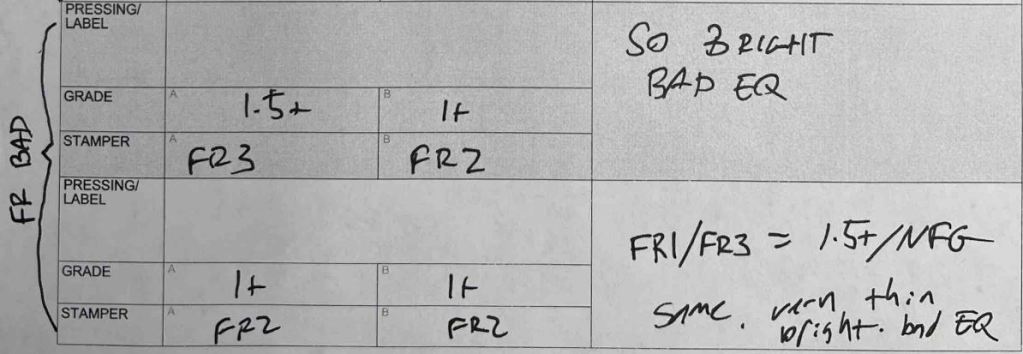

The stamper numbers you see below belong to a different album.

(We’ve lately been giving out much more stamper information than we used to, but for now we are keeping this title closer to the vest.)

Note that we had FR1, FR2 and FR3, all originals, yet none of them could be considered good enough to offer our customers.

It’s just another one of a number of rules of thumb collectors use (“A method or procedure derived entirely from practice or experience, without any basis in scientific knowledge; a roughly practical method.”), one that will sometimes lead you astray if what you are trying to find are not just good sounding pressings of albums, but the best sounding pressings of albums.

Same with reissue versus original. Nice rule of thumb, but it only works, to the extent that it works at all, if you have enough copies of the title to know that you’re not just assuming the original is better. You actually have the data — gathered from the other LPs you have played — to back it up.

Who knew the recording would sound so much better on the right reissue pressings?

(more…)

If You’re Looking for the Best Sound on Standard Coltrane, Look No Further

Hot Stamper Pressings of the Music of John Coltrane Available Now

As you may have guessed by now, remastered is a bit of a dirty word around these parts.

Most remastered records we play, from The Beatles to John Coltrane to ZZ Top, sound to us like pale imitations of the real thing, whether the real thing is an original or a vintage reissue from back in the day.

But only a fool could fail to appreciate how correct and lively the best copies of this remastered record sound, and we’re no fools here at Better Records. We judge records by one and only one criterion: the quality of their sound.

We pay no mind to labels, record thicknesses, playback speeds, mastering speeds or anything else you can read about on audiophile websites.

We’re looking for the best sound. We don’t care where it comes from.

On that basis we’re awarding side two of this recent shootout winning copy the award for the best sound on Standard Coltrane.

No other pressing of the album could do what this side two was doing. And the good news is that side one was nearly as good, making this the best copy to ever hit the site.

Side One

So dynamic, present and lively, with a rich sax and clear, solid piano. Great energy.

Side Two

Even better, with tighter, bigger bass.

Let’s give RVG a hand, the tonality on this side is HTF: Hard To Fault.

Only a small percentage of the many remastered records we’ve played over the years can make that claim in our experience.

(more…)

Revisiting the Analog Vs. Digital Debate with Donald Fagen

Hot Stamper Pressings of the Music of Steely Dan Available Now

Many years ago we did a big shootout for this album. Afterwards we asked this question:

Do all the pressings of The Nightfly sound like CDs?

The average copy of this digitally recorded, mixed and mastered LP sounds just the way you would expect it to: like a CD.

It’s anemic, two-dimensional, opaque, thin, bright, harsh, with little extreme top and the kind of bass that’s all “note” with no real weight, solidity or harmonic structure. Sounds like a CD, right? (That’s the way many of my CDs sound, which is why I rarely listen to them these days.)

But what if I told you that the best copies of The Nightfly can actually sound like a real honest-to-goodness ANALOG recording, with practically none of the nasty shortcomings listed above? You may not believe it, but it’s true.

How do I know it’s true?

The same way I came to learn practically everything I believe about the sound of equipment and records. I heard it for myself. (Keeping in mind that I am sure to be wrong about some things. Not to worry. When I find out which things those are, I will post them in this section of the blog where they can join the other 175+ entries.)

I heard a copy sound so natural and correct that I would never have guessed it was digital. On my honor, that’s the truth. The best copies of The Nightfly can actually be shockingly analog.

Simply put, the question before the house is: Can this record sound analog? We’ll be taking the affirmative.

The problem with the typical copy of this record is gritty, grainy, grungy sound — not the kind that’s on the master tape, the kind that’s added during the mastering and pressing of the record. When that crap goes away, as it so clearly does on a copy we played recently, it lets you see just how good sounding this record can be. And that means really good sounding.

On most copies, the CD-like opacity and grunge would naturally be attributed to the digital recording process. That’s the conventional wisdom, so those with a small data sample (in most cases the size of that sample will be one) could be forgiven for reaching such a conclusion. Based on our findings it turns out to be false.

The bad pressings do indeed sound more like CDs. The best pressings do not.

If you like having your biases confirmed, then by all means, keep your digital-sounding copy and pretend you know why The Nightfly sounds bad on vinyl.

(more…)