Speaker Advice

Do Reviewers Have What It Takes to Play an Album Like This?

More Albums that Come Alive When You Turn Up Your Volume

Big speakers and expensive equipment might seem like the ticket, but they are not enough.

If you want to hear some smokin’ Peter Frampton power chords from the days when he was with the band, this album captures that sound better than any of their studio releases, and far better than Frampton Comes Alive on even the hottest Hot Stampers.

Grungy guitars that jump out of the speakers, prodigious amounts of punchy deep bass, dynamic vocals and drum work — the best pressings of Rockin’ The Fillmore have more firepower than any live recording we’ve ever heard.

We know quite a few records that rock this hard. We seek them out, and we know how to play them.

Who knew?  We didn’t, of course, until not that many years ago (2014 maybe?). But we are in the business of finding these things out. We get paid by our customers to find them the best sounding pressings in the world. It’s our job and we take it very seriously.

Did any audiophile reviewers ever play the album and report on its amazing sound?

Not that I know of.

Do they have the kind of playback systems — the big rooms, the big speakers, the speed, the energy, the power — that are required to get the most from a recording such as this?

Doubtful. Unlikely in the extreme even.

They don’t know how good a record like this can sound because they aren’t able to play it the way it needs to be played.

(more…)

Revolutionary Changes in Audio – What Works for Us Can Work for You

Basic Audio Advice — These Are the Fundamentals of Good Sound

This listing, like the stereo itself (mine and yours), is a work in progress. It used to be on our website. Now it resides here on the blog.

When I first got started in audio in the early- to mid-70s, the following important elements of the modern stereo system did not exist:

  • Stand-alone phono stages.
  • Modern cabling and power cords.
  • Vibration controlling platforms for turntables and equipment.
  • Synchronous Drive Systems for turntable motors.
  • Carbon fiber mats for turntable platters.
  • Highly adjustable tonearms (for VTA, etc.) with extremely delicate adjustments and precision bearings.
  • Modern record cleaning machines and fluids.
  • And there wasn’t much in the way of innovative room treatments like the Hallographs we use.

Our reason for having this kind of commentary on a site ostensibly devoted to the selling of records is simple: the better your stereo sounds, the better our records sound, and, more importantly, the bigger the difference between our records and the copies you already own. That includes LPs recommended by “audiophile” record dealers, which tend to be on Heavy Vinyl, at 45 RPM, Half-Speed mastered or pressed in Japan.

We have no interest in any of them. Why?

On our system they rarely sound better than second-rate.

(more…)

My Stereo from the 70s and the Audio Cult I Was In

Basic Audio Advice – These Are the Fundamentals of Good Sound

A somewhat strange coincidence occurred not long ago. I found an old commentary describing the speakers I used to own, part of a discussion explaining why I have never wanted to settle for small speakers.

At the same time, I saw that a fellow on Audiogon was selling the electrostatic tweeter array for the very same speaker I owned, the RTR 280DR.

Let me tell you, it really took me back; I haven’t seen a pair in over twenty years. The RTR 280DR you see pictured below plays full range, but there is an optional electrostatic tweeter array that is designed to sit on top of it, which provides a radical improvement in the mids and highs. 

The sound of the 280DR with the electrostatic array was dramatically better than any speaker I had ever heard up to that time.

Here is the story from the old listing talking about the RTRs, sparked by a discussion of Demo Discs.

Fooled Again

I was duped into buying my first real audiophile speaker, Infinity Monitors, when the clever salesman played Sheffield’s S9 through them. I desperately wanted sound that incredibly real in my playback system, and so I agreed to buy them then and there.

It was only later when I got home with them that none of my other records sounded as good, or even good for that matter. That was my first exposure to a Direct to Disc recording. To this day I can still picture the room the Infinity’s were playing in; it really was a watershed moment in my audiophile life.

And of course I couldn’t wait to get rid of them once I’d heard them in my own system with my own records. I quickly traded them in for a pair of RTR 280DR’s. Now that was a great speaker! A 15 panel RTR Electrostatic array for the highs; lots of woofers and mids and even a piezo tweeter for the rest. More than 5 feet tall and well over 100 pounds each, that speaker ROCKED.

(more…)

Big Speakers, Loud Levels and Plenty of Bass Work Their Magic on Stand Up

Hot Stamper Pressings of the Music of Jethro Tull Available Now

It’s common for pressings of Stand Up to lack bass or highs, and more often than not the copies that we play in our shootouts — shootouts which are strictly limited to import pressings on Island or Chrysalis — lack both.

The bass-shy ones tend to be more transparent and open sounding — of course, that’s the sound you get when you take out the bass.

90-plus percent of all the audiophile stereos I’ve ever heard were bass shy, no doubt for precisely that very reason: less bass equals more detail, more openness and more transparency. Go to any stereo store or audiophile show and notice how bright the sound is. (Yet another good reason not to go to those shows. We stopped decades ago.)

Just what good is a British Classic Rock Record that lacks bass?

It won’t rock, and if it don’t rock, who needs it? You might as well be playing the CD. (The average CD of Stand Up — I have a couple of them — is terrible, but the MoFi Gold CD is superb in all respects.)

The copies that lack extreme highs are often dull and thick, and usually have a smeary, blurry quality to their sound. When you can’t hear into the music, the music itself quickly becomes boring. Most Island pressings suffer from these shortcomings.

If I had to choose, I would take a copy that’s a little dull on top as long as it had a meaty, powerful, full-bodied sound over something that’s thinner and more leaned out. There are many audiophiles who can put up with that sound — I might go so far as to say the vast majority can — but I am not one of them.

(more…)

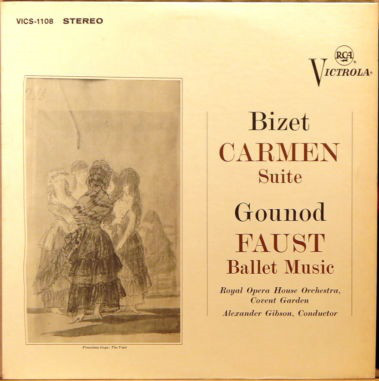
Gounod / Faust – Does Your Copy Have Clipped Bass?

This RCA Plum Label Victrola LP, the budget reissue of the incredibly rare LSC 2449, has some of the best and worst Golden Age sound I’ve ever heard. It has most of the magic of the better VICS copy I rave about.

When a cutting amplifier runs out of juice, the bass simply “clips.” The beginning of the bass note is heard, and then it just stops.

A fair number of RCA Shaded Dog originals have this problem. The cutting amplifiers of the day were often not up to the job. They ran out of power.

It’s amazing to me that so few collectors of these records even know what I’m talking about when I mention this shortcoming. They just assume it’s something in the recording perhaps. But it’s not. Oftentimes it is simply stamper variations that separate the clipped records from the unclipped records.

The more compression that is used, the less likely it is that the amplifiers will clip at all. But that’s obviously not the solution. And of course if you play records like this back on say, Quads, a notoriously compressed and bass-shy speaker to begin with, you’ll never notice any of this.

You also won’t hear it on this system.

Ah, but here is a wonderful recording that, on the better pressings at least, has deep, powerful, unclipped bass that can rattle the walls and sound like your flooring is in danger of being warped. But you need big woofers to get that effect, and lots of them.

But side two actually sounds quite good. Not as good as the best Shaded Dog copies possibly, but since those are $1000 and up, this has to be considered a good alternative at a fair price.

Lots of Living Stereo magic and a wonderful performance by Gibson make this record easy to recommend.

Robert Brook Gets Mugged by an Audio Reality

A fellow audiophile, who also happens to be a friend and good customer, has a blog which he calls

A GUIDE FOR THE DEDICATED ANALOG AUDIOPHILE

He recently made an attempt to hear for himself a speaker that others had spoken of highly. He was able to take part in two demos at the homes and offices of “passionate” audiophiles selling the speaker in question — stereo showrooms being a thing of the past — as well as lots of other high-end equipment.

Let’s just say that all did not go as well as Robert had hoped.

On the bright side, he now has a newfound appreciation for the listening skills, or lack thereof, of some of the folks in our hobby.

Spatial Audio Lab M3 Sapphires: NOT a Review!

This youtube demonstration of the speakers is worth watching, or at least skimming through, which is about all I could manage. I’ve added some of my own comments at the end of Robert’s review which you may find interesting.

One quick note: the monstrous Legacy Whisper speaker system I used to own had a similar design, with four 15″ woofers per side in an open baffle array. It did some things I have never heard any other speaker do, and the free-air design no doubt was a big part of its remarkable ability to move air with great speed and authority above a hundred cycles or thereabouts.

Below that, not so much, which turns out to be a problem that is very difficult to solve.

It was fun while it lasted, but it had too many shortcomings, shortcomings its little brother, the Legacy Focus, I discovered to my endless joy, did not have. The Focus sounds right to us in every way, which is why it is our reference speaker and will likely remain so far into the future.

I freely admit that there are surely better speakers in the world. I just have not heard them.


(more…)

My Favorite Speaker, Badly Set Up

More Speaker Advice

Here is a picture of someone else’s old Focus speakers, likely very much like our own, but of course we have stands that angle the speakers (an angle that took me months to get dialed in right), and he has his speakers sitting directly on the floor with no spikes underneath them at all, which is a very bad idea!

The speakers are way too close to the back wall and somewhat too close to the side walls too.

Lots of other issues but, hey, not my stereo so what difference to me does it make? He clearly has a lot to learn about audio.

Which simply means he has lots of work to do, but if you’ve been in this game as long as I have, we both know he will probably never do it. His system as it is stands is probably musical and enjoyable, and for most folks that is enough.

Robert Brook has been experimenting with different aspects of audio lately. His Broken Record blog has lots to say about these issues. I agree with much of what he has written. The Analog Set Up section on his blog is probably a good place to start to see what he has learned by ignoring conventional wisdom and testing every aspect of audio with an open mind. (more…)

The Last Record Album – A Great Test for Smaller Speakers and Screens

More Speaker Advice

The piano on track three of side two, Somebody’s Leavin’, should sound rich and full and solid, yet percussive.

Rarely does it sound right, which is what makes it a good test for side two.

Most copies of this album are ridiculously dull and compressed. The band itself sounds bored, as if they don’t believe in their own songs. But it’s not their fault. Whose fault it is is never easy to fathom; bad mastering, bad tapes, bad vinyl, bad something else — whatever it is, that thick, lifeless sound turns this powerfully emotional music into a major snooze-fest. 

The best copies have the kind of transparency that allows you to hear the space around all the instruments. Most copies have a bad case of “cardboard drums;” even the best copies have a bit of that sound. But when you have one of the high-rez copies spinning, the sound of the drums doesn’t call attention to itself. It may not be the BEST drum sound you ever heard, but it’s a GOOD drum sound, and in a lot of ways you could argue that it’s the RIGHT drum sound. It’s rich and fat, a perfect match for the sound of the album as a whole.


The KEF speakers you see pictured retail for $8,999.

Yes, you read that right.

Roughly 2% of my record collection might play just fine on them. Perhaps less than 2%. Either way, I don’t want to find out.

A True Test

Now if you have mini-monitors or screens, some of that sound won’t come through nearly as well as it might with another speaker, a big dynamic one for example. To our way of thinking, this is the kind of record that one should bring to one’s favorite stereo store to judge their equipment. They can play some of the songs on Famous Blue Raincoat; they do it all day long.

But can they play The Last Record Album and have it sound musical and involving?

This is a much tougher test, one that most systems struggle to pass. Leaner and cleaner — the kind of audiophile sound I hear everywhere I go — is simply not going to work on this album, or Zuma, or Bad Company, or the hundreds of other classic rock albums we put up on the site every year. There has to be meat on those bones. To switch metaphors in the middle of a stream, this album is about the cake, not the frosting.

You should keep that in mind when they tell you at your local audio salon that the record you brought with you is at fault, not their expensive and therefore “correct” equipment.

I’ve been in enough of these places to know better. To mangle another old saying, if you know your records, their excuses should fall on deaf ears.

Loud Levels and Big Woofers Will Rock Your World on Crime of the Century

Hot Stamper Pressings of the Music of Supertramp Available Now

Yet another in the long list of recordings that really comes alive when you turn up your volume.

The bass on the best copies is AWESOME. Playing a Hot Stamper copy at loud levels with big woofers will have your house quaking. Add to that the kind of ENERGY that the better pressings have in their grooves and the result is an album guaranteed to bring most audiophile systems to their knees, begging for mercy. 

This is The Audio Challenge that awaits you. If you don’t have a system designed to play records with this kind of SONIC POWER, don’t expect to hear Crime of the Century the way the brilliant engineer Ken Scott and the boys in the band wanted you to. The album wants to rock your world, and that’s exactly what our Hot Stamper pressings are capable of doing.

With sound that stretches from wall to wall and floor to ceiling, this is a Big Speaker Rock Demo Disc with very few rivals in my experience, offering the dedicated audiophile the kind of sound I have been lusting after since I first got heavily into audio in the early- to mid-’70s.

The Mobile Fidelity Pressing Used to Be Impressive

The typical Brit copy is dull, and that quality just takes all the magic out of the recording.

The three dimensional space and clarity of the recording rely heavily on the quality of the top end.

The MoFi, on the best copies, shows you what is missing from the typical Brit, domestic or other import LP. This is what impressed me back in the ’70s when I bought my MoFi. It was only years later that I realized what was missing and what was wrong.

(more…)

Sometimes the Most Fundamental Questions in Audio Are Simply Overlooked

Hot Stamper Pressings that Sound Their Best on Big Speakers at Loud Levels

UPDATE 2026

This post was written circa 2005.


This commentary is about two things — knowing the kind of music you like, and getting the kind of sound you want.

If you believe what you read on the various sites where audiophiles freely dispense advice about everything under the sun regarding music, recordings and equipment, you are asking for trouble and you are surely going to get it.

You will encounter an endless supply of half-truths, untruths and just plain nonsense, more often than not defended tooth and nail by those with impressive typing skills but not much enthusiasm for the tedium of tweaking and critical listening

big_speakersWhat kind of equipment are these people using?

How deep is their experience in audio?

Truth be told, I was pretty misguided myself during the first ten (or twenty, gulp) years I spent in audio, reading the magazines, (I still have my Stereophiles and Absolute Sounds from the 70s in boxes in the garage), traipsing from stereo store to stereo store, trying to figure out what constituted Good Sound so that I could manage to get my own equipment to produce something closer to the best of what I was hearing.

Questions

I sympathize with those who have trouble making sense of this hobby. It can be very confusing, especially to the neophyte. It takes a long time (with plenty of effort and money expended along the way) to be able to answer some of the most fundamental (and most often overlooked) questions in audio:

1.) What kind of music do you like?

2.) What aspects of sound quality are the most important to you?

Armed with answers to the above two, the next question to be asked is:

3.) What equipment will best be able to give you the sound you want on the music you like, within the limits of your budget, room, WFA (Wife Acceptance Factor), etc.

If you haven’t been doing this audio stuff for at least ten years, you probably don’t know the answers to those last two questions. In other words, you still have a lot to learn.

I may not have all the answers, but after being in audio for more than thirty years [now close to 50], about half of that full-time (full-time being sixty to seventy-plus hours a week), I can say without embarrassment that I have some of them.

And for the most part I got them the old-fashioned way: I earned them.

Do You Like Rock Music?

Then make sure you buy speakers that can play rock music.

Don’t buy screens, panels or little boxes. With subs or without, don’t buy them.

(more…)