Unsolicited Audio Advice

Mostly unsolicited.

Letter of the Week – “Why don’t you talk about other cartridges on your blog?”

More Letters from Customers and Critics Alike

Hi Tom:

With my 17dx out of commission, [a friend] loaned me his [redacted], a cartridge that retails for a little more than the Dynavector. It only served to show me how truly special the 17dx is. The [redacted] is giving me some very nice sound, but there’s a sense of exaggerated detail, a lack of bass drive, a flatter soundfield, and for whatever reason, overall the music is simply less engaging. This mimics [my friend’s] experience with the [redacted] vs Dynavector comparison. He’d use different words, but we both agree that the Dyna is the considerably more satisfying cartridge.

Why is this? Why’s it so hard to make a great-sounding cartridge? And, how does price not serve as a reliable guide to sound performance? I’ve now had a chance to hear several high-priced and well-regarded cartridges: Clearaudio, Sound-Smith, Ortofon, etc. Since I’ve made further improvements to my system since I had any of those other cartridges installed, it was easy for me to believe that I had gotten things to where the cartridge would be less important in the overall sound I was getting. Instead, I think all I’ve done is to create a system that lets me hear very directly what the cartridge is saying.

My question for you is this: Why don’t you talk about other cartridges more often on your blog? Yes, you talk about the 17dx a lot, but I see only a passing mention to other carts. Over the years, what other cartridges have you tried? What impressions did you have of them? I mean, if you want to keep readers on the straight and narrow, then warning them against certain popular cartridges seems like it’d be an even more valuable service than warning them away from bad heavy vinyl pressings. Without the right cart, other changes to your system, and other choices of records to play, almost don’t matter. I guess there’s two ways to put this message to your readers: DO buy a 17dx. (You’ve said that plenty of times.) But also: DON’T bother with those other cartridges. (I think you should say that too!)

ab_ba

ab_ba,

The simplest answer to these questions is that I have very little experience with other cartridges.

Until maybe twenty years ago, I was not in a position to borrow expensive carts and try them out. I had a more forgiving Dynavector, then went to the 17d3 and that was that. It had the sound I was looking for.

Most equipment of any kind is nothing special. It’s mediocre by definition, since it is most likely average. Why would it not be average? Because the owners of said equipment spent so many years trying to find the best? As far as I know, that never happens.

As you say, money buys very little in audio, with the exception of big speakers, but then big speakers are mostly not very good because they often require lots of power, and high power amps never sound good to me.

If you want good sound, you will have to do a lot of work and spend a lot of money to find it.

Or you can buy what I own and save yourself all that time and trouble! As long as you are willing to live with some compromises, it’s hard to imagine you could find something better unless you devoted a huge amount of time and money to the search, and had the listening skills to choose wisely.

These are skills that audiophiles rarely have. They are much harder to come by than good equipment. I talk at length about how wrong I was about so many things for so long during my formative years for the simple reason that recognizing errors is how you learn to make fewer of them.

Who can say they know what they are talking about in audio and get anyone to believe them?

It is a hard road and few want to travel it.

Best, TP

Tom, this got me thinking.

I think of a mountain range. From one peak, you see others, and wonder, “gee maybe the view is even more magnificent from that peak!” But, for most of the peaks, it’s about the same, certainly no better, and could be a lot worse. Maybe just behind that other hill that looks so enticing from here there’s a parking lot! And also, climbing each peak takes time and energy, and for most of the journey between the peaks, you are down in a valley. And, is the view really actually better over there? Just because it is higher, doesn’t mean it will be more rewarding. Just because it is dazzling at first, maybe you grow sick of it after a while.

You have created a system that sounds demonstrably fantastic. And, it is a system that is not too finicky – other people can copy it and get amazing sound, even without any tweaking and fine-tuning. Are there other great-sounding systems? For sure. But, who, or what, on earth could be my guide to finding those other peaks? Certainly not the magazines. Certainly not other audiophiles. Certainly not the guys at my local hi-fi store. Certainly not the price tag.

As I’ve spent more time with the [cartridge] my friend loaned me, its sonic character is becoming more evident. It is quite lovely on jazz. I threw on a $5 copy of Art Pepper’s Straight Life (Galaxy label, fwiw) and it sounded just fantastic. Sparkly highs, and the lack of bass that cartridge has was not noticably absent. I wondered, “has it settled in a little? Are my ears getting used to it?” I put on a few different records and said, “nope. It’s just got a sound signature that’s favorable to Art Pepper.” So there’s a perfect example of a mountain peak I would not want to build my house on. Does the Dyna have no character? Probably not, but different records sound different, and different genres all reproduce well on it, and no part of the spectrum calls attention to itself. If there is a signature to it, it’s one I can live with.

Last question – why is it that audiophiles are so uncomfortable with the idea that they might be wrong? I mean, you can’t improve if you think you are already right. I think most of them are loners with disposable income, and most people who make some money in life get it by being supremely confident, perhaps overconfident. You look at guys like [redacted] and me, scientists where humility and knowledge of our own ignorance is in the very fiber of practicing our professions well, and even if we don’t have the disposable income of some audiophiles and some of your customers, we value quality, we value expertise, and we are happy to spend our available funds on things of enduring value.

Ab_ba

Ab_ba,

I was no different back when I started. For about my first ten years in high-end audio, roughly 1975-85, I bought the most expensive equipment that I could afford, as long as it was well-liked by those whose ears I trusted and sounded good to me.

Is the audiophile of today doing something different?

(more…)

Bose Salutes the Sound Of Mercury Records (and Some Audio Lessons Learned Long Ago)

Hot Stamper Pressings of Mercury Recordings Available Now

This Bose / Mercury Demonstration LP is autographed by none other than Amar G. Bose. The autograph reads “To EMI, with regards and best wishes, Amar G. Bose.”

Bose may not have ever made very good speakers, but they sure knew good recordings when they heard them. This LP has excerpts from some of the top Mercury titles, including music by Copland (El Salon Mexico), Kodaly (Hary Janos Suite), Mussorgsky/ Ravel (Pictures At An Exhibition), and Rimsky-Korsakov (Russian Easter Overture).

I played one of these Bose records years ago and was surprised at how good it sounded. The transfers of the Mercury tapes were excellent. I guess that makes sense — if you want to show off your speakers you had better use a well-mastered record for the demonstration.

I was duped into buying my first real audiophile speaker, Infinity Monitors, when the clever salesman played Sheffield’s S9 through them. I bought them on the spot. It was only later when I got home that none of my other records sounded as good, or even good for that matter. That was my first exposure to a Direct to Disc recording.

To this day I can still picture the room the Infinity’s were playing in. It was a watershed moment in my audiophile life.

And of course I couldn’t wait to get rid of them once I’d heard them in my own system with my own records. I quickly traded them in for a pair of RTR 280-DRs. Now that was a great speaker! A 15 panel RTR Electrostatic unit for the highs; lots of woofers and mids and even a piezo tweeter for the rest. More than 5 feet tall and well over 100 pounds each, that speaker ROCKED.

(more…)

Even Shootouts Won’t Teach You What You Can Learn from Variations in Your Table Setup

Hot Stamper Pressing of the Music of Joni Mitchell Available Now

As anyone familiar with album knows, Court and Spark has loud vocal choruses on a number of tracks. More often than not, during the loudest sections they sound like they are either breaking up or threatening to. This quality of “almost breaking up” is most easily heard on Down to You.

I always assumed it was compressor or board overload. But on the best of the best copies there doesn’t seem to be any breakup — the voices get loud and stay clean throughout.

Which means that instead of being on the master tape, it might be compressor distortion that is occurring during the mastering.

Regardless of the source of the distortion, or lack thereof, the loudest choruses are a tough test for any system.

Setup Advice

If you have one of our hottest Hot Stampers, try adjusting your setup — VTA, Tracking Weight, Azimuth, Anti-Skate — Especially! Audiophiles often overlook this one, at their peril — and note how cleanly the loudest passages play using various combinations of settings.

Keep a yellow pad handy and write everything down step by step as you make your changes, along with what differences you hear in the sound.

You will learn more about sound from this exercise than you can from practically any other. Even shootouts won’t teach you what you can learn from variations in your table setup.

And once you have your setup dialed in better, you will find that your shootouts go a lot smoother than they used to.

(more…)

The Million Dollar Stereo (Updated)

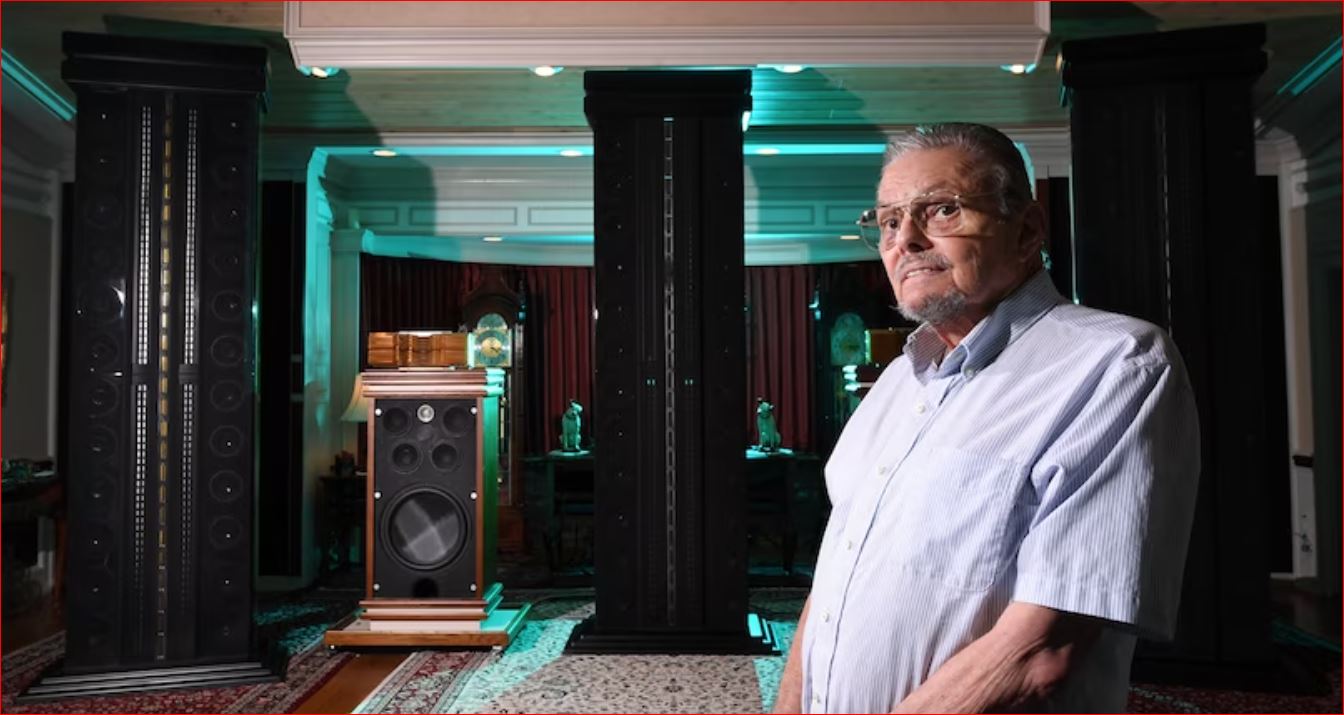
Ken Fritz turned his home into an audiophile’s dream — “the world’s greatest hi-fi”.

What would it mean in the end?

Geoff Edgers has written a highly entertaining story about an extremely misguided audiophile who went “searching for perfect sound” in ways that practically guaranteed he would never find it.

There are a number of lessons to be learned from this fellow’s mistakes.

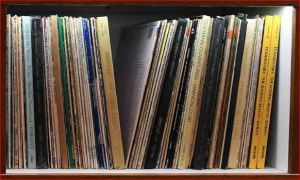
Just to take one obvious example, this picture of some of the records in his collection speaks volumes, at least it does to me.

He built a million dollar stereo to play records like these?

No amount of money spent on equipment can make most of these titles sound good, and failure to appreciate that fact is just one of the many fatal errors the late Mr. Fritz made in his approach to both records and audio.

He mistakenly thought he was at the “I know everything” stage, but that is just the prelude to the stages of knowledge where real understanding and progress begin, not end.

My own stereo history may be of some value in helping to shed light on these issues. Like everyone else, I started at the bottom. Thank god I didn’t have a million dollars to waste back then because I clearly didn’t understand audio any better than the late Mr. Fritz did.

Like him and practically every audiophile I’ve ever come in contact with, I sure thought I did. Having suffered myself from a serious case of pretentious-knowledge syndrome, it’s easy for me to spot the signs in others. (My understanding is that you can’t sign up on the Hoffman Forum without first proving your know-it-all bona fides.)

Why So Uncomfortable?

In a recent letter I received about the Dynavector 17dx cartridge we use, this question was posed:

Why is it that audiophiles are so uncomfortable with the idea that they might be wrong? I mean, you can’t improve if you think you are already right.

I answered as follows:

I was no different back when I started. For about my first ten years in high-end audio, roughly 1975-85, I bought the most expensive equipment that I could afford, as long as it sounded good to me and was well-liked by those whose ears I trusted.

Is the audiophile of today doing anything different?

What would you be doing if you hadn’t stumbled on a guy with some credibility — he sold you some records that sounded amazing, so he must know something — who turned you on to some audio stuff that sounds great and, better yet, didn’t cost that much?

And how did this guy — me — come to find out about all this stuff in the first place? Well, I’ll tell you.

He had a good audio friend who turned him on to Dynavector cartridges twenty years ago (but oddly enough not the really good one they sell. I had to make that leap for myself).

And this audio friend had learned through extensive trial and error that there were certain receivers one could pick up for cheap at thrift stores that offered excellent, audiophile-quality sound. (Trial and error were his forte. This is the same guy that clued me into the concept of Hot Stampers, a life-changing concept if ever there was one.)

As it turned out, even my friend did not know how good the sound of the receiver he sold me could be when fed by a top quality outboard phono stage, something he did not have access to. (The receiver’s phono stage is decent but hopelessly outclassed by the EAR 324p we use.)

I ended up buying four or five different models with mediocre-at-best sound before I realized the one I owned must be a fluke. Then I bought three more of the model I liked and they all sounded different too, although they ranged in sound at most from excellent to crazy good. So I put the best sounding one in my system and kept the other three for backup. Like I said, they were cheap.

When I met my friend George Louis in San Diego back in the 80s, he had a much better system than I did. He was using non-audiophile-approved equipment that drove custom speakers. He showed me that my audiophile electronics and my Fulton so-called state-of-the-art speakers were not nearly as good as I thought they were. What did I know back then? Not as much as I thought I did, that’s for damn sure.

When I moved to Los Angeles in 1987, I met a fellow audiophile named Robert Pincus and we quickly became friends. I was selling vintage classical records to audiophiles (along with lots of other records) and he was supplying me with whatever Shaded Dogs, Mercs, Londons, EMIs and such that he could dig up with top quality sound and surfaces.

He showed me that no two records sound the same, and even that often two sides of the same record don’t sound the same. Once I had a chance to listen to some of the “Hot Stamper” pressings he brought me, I was sold.

(more…)

In the Market for New Speakers? See How Well They Handle the Fat Snare on Dreams

Hot Stamper Pressings of the Music of Fleetwood Mac Available Now

Rumours is a record that is good for testing your speakers’ lower midrange and mid-bass reproduction.

What do the best copies of Rumours have that the also-rans don’t?

Lots and lots of qualities, far too many to mention here, but there is one you should pay special attention to: the sound of the snare.

When the snare is fat and solid and present, with a good “slap” to its sound, you have a copy with weight, presence, transparency, energy — all the analog stuff we adore about the sound of the best copies.

Now if your speaker is not capable of getting the snare to sound that way, perhaps because you have screen speakers or a small boxed design, or a lousy copy of the album (anything without KP in the deadwax), this is still a handy test. Next time you are on the hunt to buy new speakers, see which ones can really rock the snare.

That’s probably going to be the speaker that can do justice to Rumours, and The Beatles, and Zuma, and lots of other favorite records of ours, and we hope favorites of yours too.

The speaker you see to the left is probably not the right kind of speaker for a record such as Rumours. Three 6.5 inch woofers are just not going to be enough to get that snare to sound big and fat.

Here are some other records that are good for testing the sound of the snare drum.

(more…)

Cartridge Break-In and Setting Azimuth

Robert Brook runs a blog called The Broken Record, with a subtitle explaining that the aim of his blog is to serve as:
A GUIDE FOR THE DEDICATED ANALOG AUDIOPHILE

We know of none better, outside of our own humble attempt to enlighten that portion of the audiophile community who love records and are looking to understand them better.

Here is one of Robert’s most recent postings.

Cartridge BREAK-IN and Setting AZIMUTH

More of Robert’s advice on equipment and setup:

(more…)

Others May Help, But Most of the Time We Make Our Own Mischief

Robert Brook runs a blog called The Broken Record, with a subtitle explaining that the aim of his blog is to serve as:

A GUIDE FOR THE DEDICATED ANALOG AUDIOPHILE

We know of none better, outside of our own humble attempt to enlighten that portion of the audiophile community who love records and are looking to understand them and reproduce them better.

Here is Robert’s latest posting. I changed the title a bit from his, since the dictionary definition of the term mischief-making implies “deliberately creating trouble for other people,” and it is not quite right that the purveyors of these products are in any way purposely going about screwing up the sound of perfectly good stereos.

The way I see it, these products are designed to do something positive for some stereos under some conditions when playing some recordings for audiophiles who prize some qualities more than others.

Knowing what these kinds of things are doing, on what kinds of stereos, under what operating conditions, when playing what specific recordings, for what sound qualities a particular audiophile might be listening for, is more than the work of a lifetime. It is, in fact, impossible.

ISOACOUSTICS and the Un-MAKING of Audio MISCHIEF

After reading Robert’s story, I was inspired to write a long piece detailing my own lessons learned as I first embraced, then rejected, one tweak or piece of gear after another, starting in 1975 or thereabouts. (Many such stories are chronicled here. The picture of me you see was taken in the late-70s. I was in an audio cult at the time, but, of course, like today’s similarly-situated audiophiles, I had no way of knowing it.)

I am still working on the commentary mentioned above, but I expect it should be ready before long. The short version goes like this:

Dramatic limitations and massive amounts of colorations are endemic to home audio systems.

The only way to get rid of them is by doing the unimaginably difficult work it takes to learn how to identify them and then figure out ways to root them out.

This, in my experience, is a process that will rarely be accomplished, even by the truly dedicated. It unfolds slowly, over the course of decades, and only for a very small percentage of audiophiles. Most will simply give up at some point and choose to enjoy whatever sound quality they have managed to achieve up to that time. To attempt to go further feels like banging your head against a wall.

To push on in this devilishly difficult hobby we have chosen for ourselves is for the few, not the many.

(It helped that we got paid to do it. An undiagnosed but all-too-real obsessive personality disorder also played a part, as did certain records that I fell in love with a long time ago.)

The completed post can be found here.

(more…)

Can Every Audiophile System Do Its Job Well?

More on the Subject of Speaker Advice

That depends on exactly what job you think you’re giving it to do.

If its job is to allow you to enjoy music in the comfort of your home, then the little box speakers you see pictured to the left can do that job just fine, with the caveat that you must be able to enjoy the kind of sound that comes out of little boxes.

If the job you give your stereo to do is to reproduce the full range of music with high fidelity, then the little boxes you see pictured are going to fail miserably. Until the laws of physics are repealed, however that might happen, they will never be able to reproduce music in a lifelike way.

I like big dynamic speakers because they do a better job of reproducing music in a lifelike way compared to every other speaker I have ever heard, horns included, which can be very lifelike indeed, but have other shortcomings that I cannot abide.

This is not just another post bashing small speakers. I say these things to introduce the comment sent to me that you see below.

I received this anonymous letter recently in reply to a commentary I had written entitled Tone Poets and one-legged Tarzans.

Another poster defended rl1856’s claims for the abilities of his system to judge different pressings, noting that his criticisms of these remastered records — both on Tone Poets and Classic Records — generally align with mine.

I find this ending hilarious: “Never Played One – To be clear, we have never played a Tone Poets record. We’ve played many titles mastered by Kevin Gray, and we know that he is credited with mastering some records for the label. Without exception we find that his remastered records leave a lot to be desired. You can find many of them in our Hall of Shame. Anyone defending his work to me has some heavy lifting to do.”

You condemn rl1856 for expressing an opinion regarding something YOU ADMIT YOU NEVER HEARD because you believe his equipment is not resolving enough ? The irony is that his opinion largely mirrors yours regarding the sonic virtues of original RVG recordings ! How is it that he, listening through his “inferior” system can hear the virtues you ascribe to RVG pressings, and also hear when those virtues are not present?

My reply, after a week of thinking about the points this gentleman makes, can be seen below.

Hi,
Thanks for writing.

Little box speakers do produce sound of some quality. It would be foolish for me to say that one can’t actually hear something through them. The question is how much?

I believe the answer is not much, and that nobody reviewing records, or comparing one pressing to another, should be fooling himself into thinking he can do either one with a speaker of such little fidelity to the sound of live music.

Good stereos playing good records can sound like live music. With the volume up high and a shootout winning pressing on the table, in our studio the best of RVG’s recordings sound very much like live music

Does anyone think that, brought into this gentleman’s listening room wearing a blindfold and seated in the listening chair, he could be fooled into thinking he was hearing live music instead something coming out of some boxes?

Nothing I’ve played that Kevin Gray mastered, when played on the system we use — the one we developed specifically to evaluate the sound quality of records — was ever noticeably better than mediocre.

We’ve played his records by the score. They all suffer from the same suite of shortcomings to one degree or another, the specifics of which we have described in detail in post after post throughout this blog. (Here is a good example of some of his recent work.)

(more…)

This Is Not a Cheap Hobby If You Want to Get Very Far

Hot Stamper Pressings of the Music of Paul McCartney Available Now

Some records are consistently too noisy to keep in stock no matter how good they sound. McCartney’s first album is one of them.

(We have a section for records that tend to be noisy, and it can be found here.)

Rick sent us a letter recently after having played his first Hot Stamper, the first record he ever bought from us. At $300 it wasn’t exactly cheap, but the best things in life never are, and certainly there is little in the world of audio that’s cheap and of much value.

This is not a cheap hobby if you want to do it right, and even tons of money doesn’t guarantee you will get good sound. It’s far more complicated than that. To quote Winston Churchill, you must be prepared to offer your  “blood, toil, tears and sweat.”

Churchill went on to say “You ask, what is our aim? I can answer in one word: Victory. Victory at all costs… Victory, however long and hard the road may be…”

Now, he wasn’t talking about audio, but he could have been, and I certainly am. It takes the serious commitment of resources — money and labor — to get the sound you want. That is the victory I am talking about.

On our Hot Stamper McCartney album, Rick no doubt heard the sound he was looking for — and then some — judging by his letter.

Hi Tom,

Well, I knew you guys were serious upon receiving the LP in 4 layers of wrapping and padding but when I put the disc on I was pretty stunned. Virtually everything was popping and so musical and rich sounding. Nothing like the 3 other pressings I’ve had of this recording in the past, the last of which I actually sailed out the window after 2 minutes of playing.

Every Night just sounds incredible, especially when he drops the bass an octave. And Maybe I’m Amazed gave me goosebumps for the first time since I bought it the week it came out. Also heard something on that track I never did (or could hear) before. During the guitar solo there’s a single high pitched vocal kind of buried in the background. Almost sounds like a mistake, making me think it could be Linda and Paul did what he could. Pretty wild.

My only very slight criticism is there is some surface noise but this is very overshadowed by all the positives. Overall it is superb. Can I give you guys a short list of LPs I’m looking for?

Thanks so much!

Best
Rick M.

Rick, we are so happy to hear you loved that record as much as we did. We have been touting McCartney’s first solo album for more than a decade. Ever read a word about it in an audiophile context elsewhere? Of course you haven’t! The audiophile world doesn’t know and doesn’t care about great albums like this one, but we at Better Records LIVE for  sound and music of this caliber.

It’s a permanent resident of our rock and pop Top 100 list for a reason: no other solo album by a Beatle can touch it.

As for surface issues, we wish we could find quietpressings of the album, but that is simply not an option, especially considering how dynamic the recording is. Mint Minus to Mint Minus Minus is roughly what yours was graded and that is certainly not dead quiet by any stretch. As we said:

(more…)

How We Test Equipment Like the Townshend Seismic Platform

Basic Audio Advice — These Are the Fundamentals of Good Sound

A few years back I discovered something wonderful about the Seismic Sink I was using under my turntable to control vibration.

In our experience, vibration control is one of the most important revolutionary advancements in audio of the last twenty years or so.

We sell the Seismic Sink and this is what I wrote to a customer who recently bought one:

Play your most complex test discs, the ones that are the hardest to get to sound right. Classical is the toughest test if you have some, but Pet Sounds is tough too. [I knew he was a fan and had a good copy of the album.]

Listen to one or two for a good while, at least 20-30 minutes, to know exactly what you are hearing on the tracks you know are the most difficult to get to sound right, the ones with the most problems.

Put the sink under the table. (You can also put it under your receiver, that works great too.)

Then play those tracks again.

Go back and forth a few times.

It should be pretty obvious what is going on.

Then read Robert Brook’s post.

Here is a very special tip.

The sound changes depending on how the seismic sink is “loaded.”

This means two things:

Where the weights are sitting on the sink.

    • For my integrated amp I have it all the way to the front of the sink. Sounds clearly better that way.
    • For the turntable, I have it weighted down with thin but heavy steel plates, about one quarter inch thick, about 4 inches by 8 inches. You can get them at Home Depot and similar places.

(more…)