
Hot Stamper Pressings of the Music of Holst Available Now
You may have noticed that on the few occasions when we actually do give out the stampers for the top copies of an album, we are loathe to identify the title of the record that has those Shootout Winning stampers.
As you can imagine, our huge investments in research and development make up a substantial share of the costs we bear, costs that sometimes accrue over the course of many years, decades even. Eventually these costs are passed on to our customers, accounting for some of the admittedly high prices you see on our site.
But this title is going to be an exception, with many more to follow. We are officially giving out stamper information for this London, information that took us more than a decade to acquire. Maybe even two decades.
The right 2W/4W pressings of CS 6734, the Decca recording of Holst’s The Planets conducted by Zubin Mehta, are the best we have ever played. Based on our experience over the years, these are the only stampers that have any chance of winning a shootout.
Below you will find the grades for all the top copies from our most recent efforts, as well as the also-rans with those same stampers that we played.
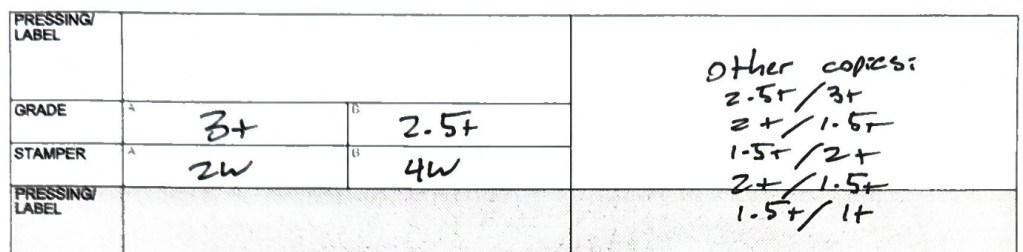
Only two pressings earned a top grade, and each of them managed to do so on only one side. This is by far the most common result of a shootout. 3+/3+ copies are the exception, not the rule.
Whatever caused the amazing sides of the best pressings to come out differently from the not-nearly-as-good sides of the other pressings must have happened in the plating and pressing stages of manufacturing, an area that was of course not under the control of the mastering engineer who cut the record in the UK for Decca, Harry Fisher.
I suppose we can say that the later stampers that Mr. Fisher cut are not his best work. As you can see from an earlier shootout seen below, 3W/4W and 6W/7W were so far off the mark that we have since given up on them altogether.
We have a long history with this recording. We’ve been playing pressings of it since we first read the rave reviews printed in The Absolute Sound back in the 80s.
It never sounded very good to me back then, so for decades I wondered what everyone was on about. Only later would I learn that I probably had copies with the wrong stampers as there are plenty of those about, or copies with the right stampers that didn’t sound good (again, plenty to choose from), or copies that needed a proper cleaning (something we only learned how to do in 2007).
In other words, there are lots of reasons a particular copy of a record won’t do what it might have the potential to do. This undeniable variability is foundational to the concept of Hot Stampers. The stamper numbers are not the whole story, and we tried to make that clear to everyone, especially our customers, right from the start.
| n/a | Holst | The Planets (Mehta) | London CS6734 | 3 | 3 | 2W | 4W |
other copies: 2.5/2.5, 2/2.5, 2/2
|
||
| n/a | Holst | The Planets (Mehta) | London CS6734 | 1.5 | 2 | 3W | 4W | |||
| n/a | Holst | The Planets (Mehta) | London CS6734 | 1 | NFG | 6W | 7W |
The Unanswerable Question
Now imagine you are a record collector of the audiophile persuasion. (Notice we rarely use the term “audiophile record collector” if we can avoid it — it leaves a bad taste in our mouths and has since 1987 when we started our little record business.) Any of the copies you see graded above could have been the one you might have bought in order to “test” the record for sound, music, vinyl quality, etc.
Keep in mind that without a proper cleaning — something few record collectors know how to do — the sonic grades would drop between one half plus and one full plus.
Consideer all the other copies, the ones with grades below 3+. They comprise four of the six we played, and we avoided the stampers we knew to be worse, something that the average collector would not be able to do until he had done at least a couple of shootouts, which we know from years of experience is way too many shootouts for any single person to do properly. (In other words, not like this.)
The sound of those four is decent, with maybe one pretty good side and one passable side, but no better than that, and much of the time worse. (The copy with a 1+ side two wouldn’t make the cut as a Hot Stamper pressing at all.)
And you’re going to tell me the vintage pressings of this recording are the better way to go based on this kind of decent-at-best sound quality?
No wonder people think we are full of it. They play third-rate pressings and think that that must be what we sell. They make judgments about our records without ever having played one. Welcome to the world of audio.
Knowing How Little You Know
Obviously, knowing the “right” stamper information in this case basically gets you nowhere. That’s why we don’t mind telling you what the best stampers are. The best stampers are only part of the solution, even for the audiophiles that are willing to go the distance finding, cleaning and playing a good-sized pile of pressings, something that not even one percent of the audiophiles in the world will ever be motivated to do.
Hot Stamper shootouts may be expensive, they may be a lot of work, but our experience tells us there is simply no other way to find top quality pressings, the ones that earn the 3+ grades, not all those other grades.
Further Reading
- More of our reviews for records with amazingly good sound
- Perhaps you can explain these record mysteries – we sure can’t
- First get good sound – then you can recognize and collect good records
P.S.
Thoughts on the London with Mehta versus our favorite, the Previn on EMI.

Other orchestral recordings with powerful drums can be found here
I found this page. I cannot make heads or tails of it as it has no context
I recommend you read this then:
https://ontherecord.co/the-basics/